Showing posts with label Peer review. Show all posts

Monday, May 18, 2009

Peer review by accountants

The hillarious Pharma Giles is fortunately alive and well and in communication with the great Pharmagossip. This relating of the nature of peer review was so important as to merit repeating in full. Listen up Journal of Bone and Mineral Research.

Pharma Giles writes......


A furore has erupted following The Scientist magazine’s revelations that Phoni Pharmaceuticals paid an undisclosed sum to scientific vanity publisher Elsleazier to produce several volumes of a publication that had the look of a peer-reviewed medical journal but which contained only reprinted or summarized articles, most of which presented data favourable to Phoni products. The journal appeared to act solely as a marketing tool with no disclosure of company sponsorship.

The Australian Journal of Boneheads and Joint Medicine, which was published by Extracta Moneya, a division of Dutch scientific publishing juggernaut Greed-Elsleazier, also contained little in the way of advertisements apart from ads for Formonimax, a Phoni drug for osteoporosis, and Viletoxx, Phoni’s controversial pain-killer.

In a statement provided last week to The Scientist, an eminent Australian physician and long-time member of the World Association of Medical Editors reviewed four issues of the journal that were published from 2003-2004.

“An average reader, such as a doctor, could easily mistake the publication for a genuine peer reviewed medical journal”, he said. "Only close inspection of the journals, along with knowledge of medical journals and publishing conventions, enabled me to determine that the Journal was not, in fact, a peer reviewed medical journal, but instead a marketing publication for Phoni."

“They’ve done a heck of good job, and it was only when I noticed that some of the names of the so-called “honorary editorial board” appeared to be made up that I became suspicious,” the reviewer admitted.

“Professor Phil. I. Daftwhoofing appears to be an anagram of “Ripping Off Fools Who Read This,” for example. Similarly, Dr. Leon Theophuleet is an anagram of “Pulled The Other One”. And “Gill Ripcheap” seems to be an anagram of Rich Pillager, who I believe is Phoni’s Head of Global Marketing…”

A spokesperson for Elsleazier, however, told The Scientist, "All of our journals are thoroughly peer-reviewed prior to publication, by our accountants. Our company would never publish a journal unless it was guaranteed to make us lots of money. After all, our publications are well-known for the standards they deliver – standards of living for our publishing executives, that is…"

Disclosure of Phoni's funding of the journal was not mentioned anywhere in the copies of issues obtained by The Scientist. Elsleazier acknowledged that Phoni had sponsored the publication, but did not disclose the amount the drug company paid.

The spokesperson added that Elsleazier had no plans to look further into the matter. “The high prices of subscriptions to our journals are a guarantee of their quality,” he said. “After all, everyone recognises the quality of Australian scientific publications, in the same way that American diplomacy journals or Nigerian accountancy and banking magazines are regarded…”

One of the genuine members of the Australian Journal of Boneheads and Joint Medicine's "Honorary Editorial Board," Dr. Táké Bakhandar, a rheumatologist in Australia, said he was delighted to serve on the board, however. Dr. Bakhandar has been on Phoni's Asian Pacific and international advisory boards since the mid 1990s, as well as the advisory boards of other pharmaceutical companies, including Pfizer and Amgen.

"You get involved in a whole bunch of things at this level," he said, adding that he had put his name on "quite a few advertorials" for pharmaceutical companies in the past 10 years. “I’m delighted to be able to promote the life-enhancing products of the pharmaceutical industry,” Dr. Bakhandar said.

His colleague and fellow member of the Australian Journal of Boneheads and Joint Medicine's Honorary Editorial Board, Dr. Pádme Baksheesh, agreed. “My own observations conclusively show that there is a direct relationship between the number of products I plug for pharmaceutical companies, and the degree to which my life is enhanced,” he said.

Rich Pillager, Head of Global Marketing for Phoni Pharm. Inc. was also unrepentant.

“The Australian Journal of Boneheads and Joint Medicine” is an important tool in Phoni’s CME (Continuing Medical Education) programme,” he said.

“After all, we’ve been putting out advertorials for years. Everyone remembers our series of children’s books that were designed to promote the use of Phoni’s SSRI Saloadatat in children, for example,” Pillager notes, referring to the controversial “Mr. Bipolar” book based on the UK “Mr. Men” franchise.

Our competitors have been doing exactly the same thing, only we’re aiming our latest fairy tales at the adult market. I can’t see what the problem is,” he frothed rabidly.

A related tale from the real world is recounted here. And it would also seem that a so-called scientific publisher in the parallel universe of reality has some “previous” when it comes to controversy...

Earlier|Later|Main Page

Thursday, April 30, 2009

The fake editorial board of Merck's fake bone journal

My previous post was about a fake scientific bone journal produced by Elsevier and paid for by Merck.

I thought it interesting to look at the editorial board - and at the names of my previous esteemed academic colleagues within the bone field who would lend their names to such fakery. The fake editorial board (see here) of this fake journal includes some well known luminaries (Reid, Seeman, Ebeling).

As an aside, Professor Peter Brooks was Executive Dean of Health Sciences at the University of Queensland at the time the University came down hard on Dr Andrew Gunn for asking scientific questions in public about a Merck drug which earns the University a mint (Brooks was not one of the bullies).

Also of interest is the regular appearance of clinicians who held postdoctoral positions at the Mayo Clinic (Rochester, Minnesota) from 1975 to 1985 in the list of clinicians involved in dubious practices in the field of osteoporosis. In this instance, even though this is an Australasian list, there are two such appearances (Peter Ebeling and Ego Seeman both trained at the Mayo under Professor Larry Riggs).

Editorial board of "The Australasian Journal of Bone and Joint Medicine"

Dr Jim Bertouch
Consultant Rheumatologist, NSW

Professor Peter Brooks
Executive Dean (Health Sciences)
University of Queensland

Professor Richard Day
St Vincent's Hospital, NSW

Professor Peter Ebeling
Royal Melbourne Hospital

Professor John Hart
Monash University

Professor Michael Hooper
Concord Repatriation General Hospital
Sydney

Dr Julien de Jager

Professor Geoff Littlejohn
Monash Medical Centre

Dr Peter Nash

Professor Nicholas Pocock
St Vincent's Hospital, NSW

Professor Ian Reid
University of Auckland
New Zealand

Professor Philip Sambrook
Sydney University

Professor I Ego Seeman
Austin and Repatriation Medical Centre

Professor David Sonnabend
Royal North Shore Hospital

Earlier|Later|Main Page

Friday, February 08, 2008

Micro Statistics Tutorial 04: Power - Can Schering Plough count?

As discussed earlier, there have been concerns raised about the possibility of "functional unblinding" in the ENHANCE trial of the drug Vytorin (ezetimibe/simvastatin-combination).

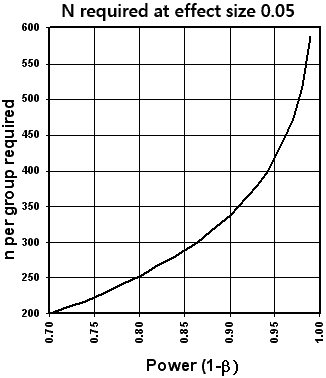
As the first part of this exercise, let us take a look at the POWER of the ENHANCE trial. There is something slightly odd here (I think). The question is: Can Schering-Plough count?

Power, for neophytes out there, is the probability of rejecting a false statistical null hypothesis. The goal is to allow you to decide (in advance of an experiment)
  • How many people (or things) you need to study to answer your question
  • How likely it is that your statistical test will be able to detect an effect of a given size
Good experiments must ensure that power is high enough to answer the question. To calculate power we need to know:
  • The precise question
  • The kind of statistical test that will be used
  • The size of the sample (bigger = more power)
  • The size of the experimental effects you want to detect (bigger effects need a smaller sample)
  • The amount of noise in the measurements (measurement error or biological variability)
Power calculations for the ENHANCE trial were published with the study protocol [Ref 1]. It states:
[Power statement]

Although it is possible to perform power calculations taking account of covariates or confounders (such as baseline IMT, center and so on) this is difficult, and no estimated covariate parameters are provided. One therefore has to assume that the power calculations were carried out using conventional methods (a t-test). In the end Schering Plough recruited slightly more patients than their prior power calculation suggested they should recruit as a minimum. However this is not the issue here. They could also claim that this is just a bit of rounding error (see further discussion in comments). This is again irrelevant - the fact remains that it is not possible to add two and two from the numbers they give, or to resuscitate their rather simple calculations. This bypassed the entire system of safeguards that is supposed to check these little details.

So on to the power. Well, as far as my humble brain can establish, Power for N=650 is in fact 88.9%, not 90%.
The required N for 90% Power, 2-tailed alpha 0.05, between group difference of 0.05mm and SD=0.20mm is not N=650.
It is N=674.

A small difference perhaps, but it does tell us something interesting about the process:
  1. Perhaps I can't count
  2. Perhaps Schering-Plough or Merck can't count
  3. Perhaps the authors of the protocol paper didn't read their paper
  4. Perhaps peer reviewers didn't back-check anything
  5. Perhaps there is something Merck or Schering-Plough aren't telling
  6. Perhaps Carrie Smith Cox can only count in units of $28 million


Reference
J. Kastelein, P. Sager, E. de Groot, E. Veltri (2005). Comparison of ezetimibe plus simvastatin versus simvastatin monotherapy on atherosclerosis progression in familial hypercholesterolemia. Design and rationale of the Ezetimibe and Simvastatin in Hypercholesterolemia Enhances Atherosclerosis Regression (ENHANCE) trial. Am Heart J. 2005 Feb;149(2):234-9.

See here for Collated Micro-Statistics Tutorials

Earlier|Later|Main Page