Showing posts with label Word of the Week. Show all posts

Monday, November 05, 2007

Psychopaths

DSM4 psychopathI have been flying around the past few days, and attended (amongst other things) an excellent meeting on academic integrity. It will take a few days to catch up here. My flight today, I sat next to a man who insisted on sending a million text messages during takeoff despite repeated requests by airline staff not to do so. I have no idea whether this causes real risk to other passengers, but it made me wonder what sort of person would recklessly place his fellow travellers at increased risk of any amount. The same sort of person or company who might find it easy to behave like this or like this or like this or this and still sleep well and play with their kids I suppose.

"...the most devastating features of psychopathy are a callous disregard for the rights of others and a propensity for predatory and violent behaviors. Without remorse, psychopaths charm and exploit others for their own gain. They lack empathy and a sense of responsibility, and they manipulate, lie and con others with no regard for anyone's feelings."
Read on: here and here.

See also DSM IV criteria for psychopathy.

Earlier|Later|Main Page

Wednesday, October 17, 2007

Memory Hole (17 October): The Panjandrum

Scientific Misconduct Blog Memory Hole: Events of October the 17th

A superiorvator

Words of the day: Panjandrum and the superiorvator

October 17th was a lazy uneventful day in the history of important people in science and medicine. I'll restrict myself to the word of the day, and a brief roundup of salient events.

The word of the day is: Panjandrum

panjandrum \pan-JAN-druhm\, noun: An important personage or pretentious official (like Lester Crawford). The rules that apply to a panjandrum are generally different from those that apply to anyone else.

The word used in a sentence:

"And so I have appointed myself the chairman, High Panjandrum, Grand Inquisitor, and sole member of a grievance committee of my own making."
-- Alan K. Simpson, Right in the Old Gazoo

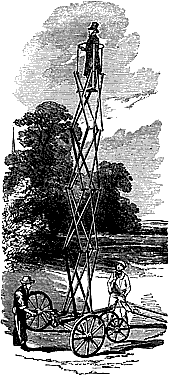
The device pictured is a superiorvator (circa 1827).

The word Panjandrum was invented by by Samuel Foote (1720-1777) in a piece of nonsense writing. This was composed to challenge actor Charles Macklin's claim that he could memorize anything:

"So she went into the garden to cut a cabbage-leaf to make an apple-pie; and at the same time a great she-bear, coming up the street, pops its head into the shop. "What! No soap?" So he died, and she very imprudently married the barber: and there were present the Picninnies, and the Joblillies, and the Garyulies, and the grand Panjandrum himself, with the little round button at top, and they all fell to playing the game of catch-as-catch-can till the gunpowder ran out at the heels of their boots."

Reference: "The Great Panjandrum"

76 years ago today: Al Capone gets a wrist slap

On 17 October 1931 mobster and mass murderer Al Capone was convicted of income tax evasion and sentenced to 11 years in prison. He was released in 1939.

74 years ago today: Einstein arrives in USA as a refugee

On 17 October 1933 physicist Albert Einstein arrived in the United States as a refugee from Nazi Germany.

14 years ago today: Harrison Ford takes down a drug company

On 17 October 1993 "The Fugitive" was a hit movie. Richard Kimble (Harrison Ford) is a vascular surgeon who returns home to find his wife murdered. Kimble finally confronts his academic colleague Nichols with evidence that a drug was causing hepatic failure. Nichols is working with a large drug company, and faked trial results. Not serious but still fun to see.

4 years ago today: Study sets off debate over conducting research "offshore"

On 17 October 2003 there was debate in the press over the ethics of conducting research in "far away" places in order to bypass rules and watchful eyes.

I suspect this will become more important.

From a report in the Baltimore Sun
Debate surrounds the practice of shifting experiments overseas to circumvent U.S. regulations., 17 Oct 2003
"When Chinese and American researchers reported this week that they had used a cutting-edge DNA transfer to impregnate an infertile woman in China, they set off an ethical, political and scientific debate."

"The reason: The American scientist turned his technique over to Chinese colleagues because they could try it without waiting for permission from the U.S. Food and Drug Administration."

"The announcement touched a nerve in the scientific community. Should a U.S. researcher move experiments overseas to avoid regulations designed to protect human research subjects?"

"To some, the answer is clear. "I think in this situation, doing research in another country where the regulations are less protective of patients is not ethical. And there have been many situations before where that's been made clear," said Mildred K. Cho, associate director of the Stanford University Center for Biomedical Ethics."

"In their experiment, researchers from New York University and Sun Yat-Sen University of Medical Science in Guangzhou, China, took DNA from a prospective mother and father and transferred it into a hollowed-out donor's egg whose own nucleus had been removed.
The reconstructed product was then transferred into the mother's uterus."

"Dodging regulatory hurdles is not unheard of in medical research. In the United States, for example, it is unethical for scientists testing an experimental therapy to use placebos (sugar pills or drugs with inactive ingredients) on fatally ill test subjects if there are proven treatments available. But in recent years, critics have attacked U.S. pharmaceutical companies for testing therapies in the Third World, where regulations concerning placebos are less strict."

"At NYU, Dr. Keith M. Krasinski, chairman of the medical school's Institutional Review Board, said the university normally reviews all research on humans that it sponsors or that its faculty members conduct.

But he said the university's approval wasn't necessary in the Chinese fertility experiment because Grifo "didn't conduct the research."

"He didn't supervise the research. He was never in China," Krasinski added. "He's not in trouble in any way." He said Grifo is listed as a co-author in the research findings as matter of academic "courtesy."

'Think very carefully'

That reasoning is unlikely to satisfy many critics. Scientists "should think very carefully and be sure of their moral position when they go to a place like China to conduct research," said Alan Colman, chief scientific officer of ES Cell International in Singapore, a biotech firm that does stem cell research."
Earlier|Later|Main Page

Thursday, July 26, 2007

Scientific Misconduct Word-of-the-Week: Neutralize

Word of the weekI introduce two new weekly features on this blog.
  • Word of the week (or concept of the week):
    The interesting language of integrity and accountability in science
  • Retro roundup:
    What happened this past week in the history of academic integrity, and what we haven't learned.
The language of debate about pharmaceutical and scientific integrity is very different from colloquial English. Instead of a few thousand commonly used words, we have a restricted lexicon of a few hundred words, many of which bear a superficial resemblance to common English. For example words or concepts such as "transparency", "independent", "public interest", "criminal investigation", "research misconduct" and "the free market" have quite different meanings from those normally encountered.

Today's word of the week is "NEUTRALIZE"

In the dictionary we read

neu·tral·ize
  1. To make neutral.
  2. To counterbalance or counteract the effect of; render ineffective.
  3. To declare neutral and therefore inviolable during a war.
  4. Chemistry : To cause (an acid or base) to undergo neutralization.
  5. Medicine: To counteract the effect of (a drug or toxin).
  6. Slang: To remove as a threat, especially by killing.
However, a brief reading of text in this area shows that this is in error.

Neutralize in fact means "to educate".

To trace the changes of form of these words is no easy task. I believe the word "neutralize" in it's current sense was first applied in 1962, but it's meaning was consolidated by Merck & Co. pharmaceuticals in 2005. Merck's marketing team targeted doctors viewed as unfriendly toward Vioxx to bring them into the fold (or to neutralize them).

In one written example Nancy Santanello, head of Merck's epidemiology department was questioned about an internal list of 36 doctors identified as:

"physicians to neutralize"

"Attached is the complete list of 36 physicians to neutralize with background information and recommended tactics. You will notice that some have already been neutralized".

In court, Santanello said the term "neutralize" was a marketing strategy to educate doctors about Vioxx
(first Vioxx trial 07/19/2005, Associated Press)

In other instances it could involve payment of money or threats of legal action - both good scientific methodologies.

The correspondence given to jurors was to or from Susan L. Baumgartner, who worked for Merck as a consultant. In videotaped testimony, she repeatedly said neither she nor anyone she knew at Merck intimidated anyone, and that the terms had nothing to do with intimidation, and were marketing jargon rather than dictionary terms

That, said Baumgartner, meant to provide correct information so those doctors would "come to a neutral or fair position". In a memo with "discredit" under a name, she said her recollection was that the doctor "discredited himself based on his own actions."

See also
http://www.dentonrc.com/sharedcontent/APStories/stories/D8BEMPE00.html
http://hcrenewal.blogspot.com/2005/07/neutralizing-doctors.html
http://hcrenewal.blogspot.com/2005/12/more-allegations-that-merck-executives.html

Earlier|Later|Main Page