Monday, January 14, 2008

BMJ Advertising Watch : 12 January 2008

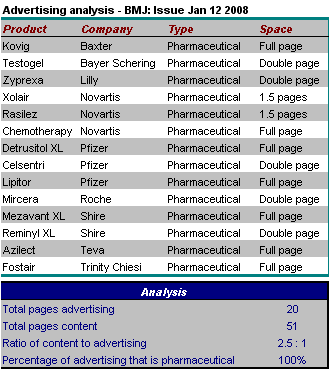
This new initiative follows my earlier post on the widening gap between the debate about science that is taking place in medical journals and the scientific/ethical discussion outside of those journals. Each week I will collate the advertising in the current issue of the British Medical Journal. I'll comment as we go along, and at the end of some period I'll collate the data, related scandals involving the advertised drugs and discussion taking place within the content pages of the BMJ. I'll also comment on any appearance of any discussion in the BMJ about questionable Ezetimibe research.

Rules: This is for the BMJ as delivered to subscribers in the UK (not to libraries). If anyone wants to help collate data for JAMA, Lancet and NEJM let me know. The classified advertisement section is excluded, as are pages advertising the BMA or products of the BMJ/BMA. Below is the analysis for this week
BMJ Advertising analysis 12 Jan 2008
Comment: 100% of the advertising was for pharmaceuticals. There was no advertising space devoted to other products doctors might be inclined to purchase (stethoscopes, expensive cars, medical devices, services, holidays, books, cosmetics or alcohol). The ratio of advertising space to content was 1:2.55.

The advertisement for Novartis about CML chemotherapy was particularly interesting. This was in essence a one page content-free scientific "review" raising the concept of targeted chemotherapy for CML based on Bcr-Abl.

Discussion about Ezetimibe research: None

Earlier|Later|Main Page

The case of Dr Z

The complaintA report in the British Medical Journal yesterday is fascinating:
Dyer, Clare (2008-01-12). "Whistleblower who was excluded from work for five years wins apology". BMJ 336 (7635): 63.

The bullying of doctors and patients who raise concerns, and the gagging of information about those concerns is the most fundamental element of clinical risk. The various "Clinical Governance" policies put in place to (ostensibly) control clinical risk take no account of what actually happens.

What we are allowed to know about this story is that:
  • A junior doctor (known only as Dr Z) was excluded from her job in Cambridgeshire Primary Care Trust for 5 years. Her apparent crime was that she objected to inclusion of medical records in a research database without patient consent. Those medical records included her own.
  • The reason we do not know her name is that she is under a gagging order.
  • Many years before Dr Z suffered from a rare "serious life threatening condition". She wanted the details kept private.
  • However her medical details were distributed as part of this research to Addenbrooke's Hospital, Cambridge and from there to personnel involved in her employment.
  • Despite giving no consent she was harassed by the researchers.
  • The interesting (but common) response of her employers was to suggest that she was ill and to refer her to an "occupational health consultant". She was then put on "special leave from her employment".
  • Her employers tried to suggest that her "fitness to practice was an issue" and seemingly tried to (or actually did) refer her to the General Medical Council to be struck off.
  • Her employers generated false accusations that she had given a wrong name and address to her own doctor, and had falsified sick notes.
  • Her employers maintained that it "was not possible" that her records were held in the research database.
  • In September 2006 her employment was terminated.
  • Acting on her own she brought a libel action against her employers. The Trust admitted that all the accusations that they had made in their apparent attempts at bullying were false, and that her records were indeed in the research database.
  • In this case the person bullied was not only a doctor raising concerns about patients but also a research participant who was apparently told lies.
What can we say of all of this? The same basic elements are played out in variable form over and over again.
  1. Individuals are gagged and neither our profession nor patients nor the general public discover the truth.
  2. There is abuse through accusations of mental illness.
  3. The very bodies who are charged with integrity in medicine (such as the General Medical Council) are used by medical leadership to obfuscate the truth. At the same time the GMC shows no intent to deal with the powerful liars, falsifiers and bullies. Those individuals are neither named nor sanctioned.
  4. False accusations are made to divert attention from the real problems.
  5. There is almost no support for abused individuals.
There are implications for the confidentiality of medical data. This is another timely incident given the foolish inclination of the Labour government to take control by force of our medical records in a central "database".

John M. Grohol at Psych Central has written an interesting article "Why Would You Lie to Your Therapist?". Patients tell half-truths for many reasons. Concerns that the state or others will abuse the relationship of confidentiality is a powerful one.

We are entitled to ask several questions of Addenbrooke's Hospital, Cambridge:

Why have the full details not been placed into the public domain? What is this research, and has it been published? What are the names of the researchers involved? Did the work receive ethical approval? Did any publication state that some participants had refused consent? What action has been taken to deal with the individuals who bullied Dr Z?

Did any of the various agencies who are supposed to ensure integrity in this context do anything at all to assist Dr Z? Perhaps the General Medical Council did something, or Public Concern at Work, or the British Medical Association, or the UK Panel for Research Integrity, or the Ethics Committee at Addenbrookes Hospital, or the local Medical Staff Committee?

And why did the BMJ use the word "whistleblower"? Dr Z was simply doing her job. It is the job of a doctor to tell the truth in the interests of our patients (and in this case Z was one of those patients). Instead of dealing with her concerns she was bullied, told lies (and probably made ill). Whistleblowing has nothing whatever to do with this -- particularly since everything that the scientific community has to know and has to discuss has actually been suppressed.

Have we learned anything since Bristol? Or Shipman? Or Chan? .... or any of the incidents which have placed our patients and clinical science at risk?

Dr Z said in a statement:
"I raised concerns relating to unethical research practices which threatened patient confidentiality and were being conducted in breach of the law. I was then excluded from work for a period of five years, on the basis of allegations which the trust now concedes were groundless.
See also comments by Ferretfancier and Longrider

Earlier|Later|Main Page

Friday, January 11, 2008

Ezetimibe - where are our medical journals?

The BMJ EzetimibeThe huge ethical and scientific problems with the drug Ezetimibe have been discussed widely in the lay press (especially in the New York Times and some excellent reporting in Forbes). The problems have been discussed by patients, on the internet and in the blogsphere. However as of today, a search of our key medical journals reveals no hint of any ethical discussion. No discussion of the principles of good science. Not even a worthy news report. Nothing at all.
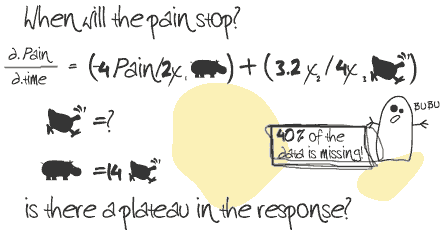
  • The British medical Journal : No discussion
  • The Lancet: On 24 November 2007 in the midst of the saga, the Lancet published a review entitled "The safety of statins in clinical practice" Jane Armitage, Vol. 370, Issue 9601 Pages 1781-1790. There was no relevant discussion or associated editorial in that issue or in any subsequent issue.
  • NEJM: No discussion
  • JAMA: No discussion
And the multitude was silent, not a voice, not a sound was heard upon the hillsides, across the valleys where they stood.'
Richard Bach, Illusions
One wonders how long our key medical journals will retain any credibility as honest impartial portals for discussion of science and the principles of good medicine. For the record, here is some of the discussion on the top 100 medical blogs collated in date order. Some have called for a boycott of Ezetimibe.Earlier|Later|Main Page

Thursday, January 10, 2008

The Ezetimibe fiasco - the excuses continue

Several bloggers have been following the saga of Ezetimibe (Zetia, Vytorin), the hidden data, and the threats to science which have resulted from the way in which Merck and Schering-Plough have thrown the usual safeguards of science into the gutter.

Earlier this week Schering-Plough CEO Fred Hassan spoke for 45 minutes at Morgan Stanley’s "Pharmaceutical CEOs Unplugged" conference. He tried to assert that the ENHANCE trial was unimportant anyway as it wasn't being counted on for anything. Also, it was a study conducted in a very rare population of patients and has no implications for the general population of patients with hypercholesterolemia.

Obviously, ENHANCE was THE study designed to demonstrate that ezetimibe has an impact on atherosclerosis. Any impact at all would be nice, since no clinically relevant benefit of Ezetimibe was demonstrated prior to licensing of the agent.

Scientific malfunction is fine when studies can be deemed (in retrospect) by important CEOs to "not matter anyway".

When individual scientists conduct themselves in such a way as to cause our understanding of science to be disturbed, then (unless they are very important people) they get thrown out of science, imprisoned, and their future "findings" are not believed. The rules of participation and believability are different for corporate "science".

Schering-Plough is of course the company that writes £10,000 checks to doctors in exchange for prescribing their drugs.

Schering-Plough clearly has a record, as does Merck. The examples are many. In 1999 it was reported that deaths in clinical trials involving gene therapy were being hidden on demand from companies who were worried that it would "have an impact on their business". The Washington post reported in that "Scientists and drug companies have failed to notify the National Institutes of Health about six deaths that occurred in gene therapy experiments in the past 19 months". Researcher Ronald Crystal "cited concerns about the impact on his business if the death were made public". "Schering-Plough also had demanded confidentiality for three recently filed reports of serious patient illness during gene therapy trials. The lead scientists in two of those studies determined that the complications "probably" were caused by the gene therapy; Schering-Plough officials had downgraded those assessments." It was then reported that Schering-Plough Corporation and the University of California had done preliminary trials in dying cancer patients, but "lowered the dose when two early participants experienced serious drops in blood pressure" (Nelson, Deborah, and Weiss, Rick. Hasty Decisions in the Race to a Cure? Gene Therapy Study Proceeded Despite Safety, Ethics Concerns. Washington Post November 21, 1999: A1, A26-A27 [Link]). These were not reported, and later trial participants were not informed.

Actual people died.

Wilson (the researcher) said: "If a mistake was made, we've got to own up to it and learn from it. Ultimately, the tragedy of Jesse's death would be if we don't learn anything."

What have we learned over 8 years Dr Hassan?

As Ben Goldacre writes in Bad Science, "the data belongs to the patients who gave it to you". Our patients deserve better Dr Hassan. Science deserves better.

Earlier|Later|Main Page

Wednesday, January 09, 2008

Bisphosphonate induced pain in osteoporosis - statistical analysis discovered

The FDA issued an alert yesterday warning of "severe and sometimes incapacitating bone, joint, and muscle (musculoskeletal) pain" sometimes induced by bisphosphonates used to treat osteoporosis. Bisphosphonates include Actonel (Procter and Gamble) and Fosamax (Merck).

The formal statistical analysis reportedly produced by one pharmaceutical company for the FDA is shown.

Formal pain analysis - bisphosphonate therapy

Reading:
According to today’s FDA warning, the severe musculoskeletal pain associated with bisphosphonates may occur within days, months, or years after starting a bisphosphonate. Some patients have reported complete relief of symptoms after discontinuing the bisphosphonate, whereas others have reported slow or incomplete resolution. The risk factors for and incidence of severe musculoskeletal pain associated with bisphosphonates are unknown. The FDA recommended that healthcare professionals should consider whether bisphosphonate use might be responsible for severe musculoskeletal pain in patients who present with these symptoms and consider temporary or permanent discontinuation of the drug.

Bisphosphonates have been linked to a variety of other safety problems. In October, the FDA announced that it was reviewing the drugs after studies showed patients taking bisphosphonates ran a higher risk of irregular heartbeat. Research published in the May 7 issue of the New England Journal of Medicine found that bisphosphonates appeared to increase the risk of irregular heartbeats in some older women. Researchers conducting a review of a 1997 study of postmenopausal women on Fosamax found that there appeared to be 50 percent more risk of the serious heart rhythm irregularities in women who took the daily pill than among those who didn’t take it. About half of the 6,459 women took Fosamax, and 47 developed atrial fibrillation, compared to just 31 cases among the other women.

Fosamax has also been linked to Osteonecrosis of the Jaw (ONJ), also known as Dead Jaw Syndrome, a condition in which the bone tissue in the jaw fails to heal after minor trauma such as a tooth extraction, causing the bone to be exposed. The exposure can eventually lead to infection and fracture and may require long-term antibiotic therapy or surgery to remove the dying bone tissue. In 2005, the Fosamax label was updated to include warnings about ONJ.
These are good drugs when used appropriately. However, I'm not sure that the risks and benefits (and possibility of unknown risk) have been appropriately weighed so as to allow correct, cost effective and safe targeting of therapy. We know nothing about the long term (30 year) benefits or risks of bisphosphonates.

Earlier|Later|Main Page

Tuesday, January 08, 2008

Bill Maher on Big Pharma


The government isn't your nanny....

"A long list of conditions which used to be rare and are now main-streamed.
Things like asthma, and autism and acid reflux and arthritis, allergies, acne, attention deficit disorder, .... and that's just the A's."

Great. Hat tip

Earlier|Later|Main Page

Friday, January 04, 2008

You owe the General Medical Council £5 - the case of Sushant Varma

Although not about medical scientific misconduct, this is directly related.

The General Medical Council (GMC) is one of several bodies in the UK charged with regulating aspects of integrity in clinical medical research. It also registers and regulates other activities of doctors. The functioning of the GMC is therefore of considerable public interest.

Also of interest is the approach of the GMC to their requirement that doctors should be truthful.

In response to a request, the GMC recently confirmed that it spent £175,000 (approximately $350,000) on external legal fees pursuing one medical student/junior doctor, Dr Sushant Varma of Sheffield (my home city).
Our ref: IAT/F1314/EH

Dear ______

I write further to your request made in accordance with the Freedom of Information Act 2000, as set out in your email below.

I can confirm that this case has cost the GMC £175,000. I should add that this does not include the time spent by GMC staff on case administration. We are unable to quantify this as we do not record the amount of time staff spend on individual cases.

If you have any concerns regarding the handling of this request please address these to:

Julian Graves
Information Access Manager
General Medical Council
Manchester M1 6FQ
Given the convoluted machinations of the GMC in this case, it's internal expenses are likely to have been a further £175,000, and considerable expenses were incurred by the Medical and Dental Defence Union of Scotland (who provided some legal support for Varma). Given the number of registered doctors in the UK (~100,000) this single case will have cost each doctor around £5.00. Meanwhile, doctors have noted the recent hike in GMC fees (from £290/year to £390). The GMC states this is "not related to revalidation reform", but rather to other "accumulated expenses" such as those incurred in this case.

Varma is a colorful character, and has certainly told some trivial lies. For example he lied on his CV about an appearance on a television show (Blind Date). He has freely admitted to those lies. He may have told a more serious lie, but the evidence for that is far from clear. The GMC apparently declined to examine relevant evidence. Varma was erased from the medical register and his career was destroyed.

Of broader importance are the precedents raised by this case, and the consistency of GMC action:
  1. When can a doctor lie?
  2. Are all lies of equal importance?
  3. Are the status and responsibilities of the lying doctor relevant?
  4. From the point of view of medical regulation, is there a difference between lies told in clinical research, lies in clinical practice, and private lies (which might reflect on the credibility of a doctor)?
To paraphrase Frank Zappa, the GMC is a body of rules, badly written and randomly enforced. What happened to Dr Varma merits some examination, as do the motives that might have led the GMC to spend such a considerable amount of our money on this one relatively trivial case.

Earlier|Later|Main Page