Showing posts with label Advertising watch. Show all posts

Saturday, March 22, 2008

BMJ Advertising Watch : 22 March 2008 (The fabric of civilization)

This is the British Medical Journal Advertising analysis for this week.

Rules: As usual this is for the UK version of the BMJ. The classified advertisement section is excluded, as are advertisements for the BMA, products of the BMJ/BMA/BNF or the government.

The Devils Dictionary Defiled defines Truth in Advertising thus:
Truth in Advertising - n. a fiction whose realization is impossible. Advertising's end is selling, and should truth enter the practice it would mean the end of selling. The end of selling is the end of civilization.
Stephen R. Brubaker, 2006
Truth in advertising would drain the advertising field of all creative talent and energy. All the talent would have to be absorbed by the fields of politics, journalism, and law. In several of these fields, good fiction writers would be welcome, as they would be able to raise the standards of the craft measurably. But once all fantasy has been removed from the process of product disclosure, there will be an expectation that product flaws be disclosed as well. When consumers discover the full extent by which goods and services are likely to fall short of their once fantasized ideal of function, durability, economy, and satisfaction, all commerce will cease. The white-hot economy will freeze solid, fracture, and shatter like glass. It would prove the undoing of civilization. Fabrication is the fabric of civilization.
- American Enterprise Trade Commission
Click here for collated BMJ Advertising analyses.

Earlier|Later|Main Page

Monday, March 17, 2008

BMJ Advertising Watch : 15 March 2008 (and summary of an important paper)

Before discussing the BMJ Advertising watch for this week, I thought I would summarize an excellent 2006 article in PLoS medicine about advertising in medical journals[1].
  • The amount of money involved is large. In 2003 drug companies spent US$448 million on advertising in medical journals [1]. The American Medical Association (AMA) receives at least US$40 million annually from advertising[2].
  • It is effective at increasing sales. Analysts calculate that the return on investment is about $5.00 for each $1.00 advertising spend [3].
  • Advertising in general medical journals is almost exclusively for pharmaceuticals, and not other medical products, or consumer products of interest to doctors (computers, holidays and so on). Many journals have statements which exclude general consumer advertising [1]. For example the JAMA states "products or services eligible for advertising shall be germane to, effective in, and useful in the practice of medicine". It is proposed that accepting advertising for consumer goods would help minimize the conflict of interest inherent in pharmaceutical advertising, and would free editors from threats[1] made by advertisers which leads them to participate in editorial scientific fraud. Another option is to eschew journal advertising altogether (as has PLoS Medicine).
  • "Military recruitment advertisements" were noted in JAMA as an important exception to pharmaceutical advertising[1]. During a single anomalous year (1997) JAMA ran advertisements for Land Rover vehicles, Steinway pianos, Wellcraft boats, pork, and Quaker oatmeal [1].
  • The exclusivity of pharmaceutical advertisements is not due to affordability. After adjusting for circulation rates, advertising rates in medical journals are far less expensive than rates in consumer magazines (such as Vogue) [1].
  • Various inappropriate "mottos" of journals are discussed [1]. The Journal of Clinical Endocrinology and metabolism states: "we use our know-how to help you reach the industry's thought leaders and maximize your return". The NEJM states "Place your ad in the New England Journal of Medicine and make our relationship with the medical community yours". The BMJ states "We protect our reputation by careful balance of editorial and advertising, which means your messages will always stand out".
  • Advertisements are not "educational". The American College of Physicians (publisher of Annals) colluded with this excuse by arguing in court that profits on pharmaceutical advertising should not be taxed because advertisements were educational. Justice Marshall judged "we are bound to conclude that the advertising in Annals does not contribute importantly to the Journal's educational purposes"[4]. The notion of advertisements as "educational" is easily rebutted. Although there are more than 10,000 drugs on the market, 50% of the advertising expenditure is on only 50 of these. Competing drugs regularly cohabit in the same journal. Reviews of pharmaceutical advertisements conclude that 44% would lead to improper prescribing [5], about 60% of cited research was company sponsored, and 30% of advertisements with medical claims contain no scientific references. 19% cited "data on file" that is not open to scrutiny [6], impossible to obtain [7][8] and therefore potentially false.
  • Apart from influencing doctors, advertising (or the threat of its withdrawal) is used to manipulate editorial decisions [1]. Several examples are given. In 1992, a study in Annals criticized the accuracy of advertisements in journals [5]. Large pharmaceutical companies subsequently withdrew advertising in that journal [7]. In 2004, an editor at Dialysis and Transplantation told an author that although the author's article had passed both editorial and peer review, the marketing department rejected it. The journal later reversed its decision, but the author refused to resubmit." [1].
References
  1. Fugh-Berman, Adriane; Karen Alladin, Jarva Chow (2006-06-01). "Advertising in Medical Journals: Should Current Practices Change?". PLoS Medicine 3 (6): e130. Retrieved on 2008-03-16.
  2. American Medical Association [AMA - 2004 Annual report]. AMA (2005). Retrieved on 2008-03-16.
  3. Neslin, Scott (2008-03-16). ROI Analysis of Pharmaceutical Promotion (RAPP) - An Independent Study. Retrieved on 2008-03-16.
  4. American College of Physicians v. US. 3 Cl.Ct 531 (1983)
  5. Wilkes, M S; B H Doblin, M F Shapiro (1992-06-01). "Pharmaceutical advertisements in leading medical journals: experts' assessments". Annals of internal medicine 116 (11): 912-9. PMID 1580449.
  6. Cooper, Richelle J; David L Schriger (2005-02-15). "The availability of references and the sponsorship of original research cited in pharmaceutical advertisements". CMAJ : Canadian Medical Association journal=journal de l'Association medicale canadienne 172 (4): 487-91. PMID 15710940.
  7. Mindell, J; T Kemp (1997-12-13). "Evidence based advertising? Only two fifths of advertisements cited published, peer reviewed references". BMJ (Clinical research ed.) 315 (7122): 1622. PMID 9437300.
  8. Hafeez, A; Z Mirza (1999-08-28). "Responses from pharmaceutical companies to doctors' requests for more drug information in Pakistan: postal survey". BMJ (Clinical research ed.) 319 (7209): 547. PMID 10463894.

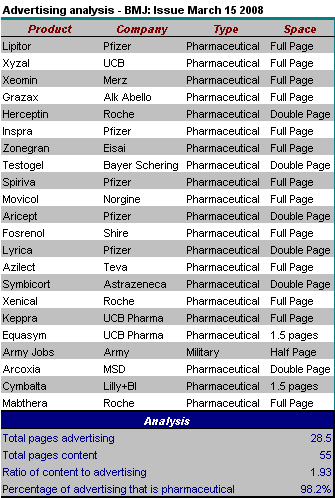
This is the British Medical Journal Advertising analysis for this week.

New records have been set for the amount of advertising, and the ratio of advertising to content. The single half page that was not devoted to pharmaceutical advertising was for the army. Unfortunately both the problematical (evidence free) advertisement for testosterone, as well as the Pfizer fireman (? a fake fireman) were back.

Rules: As usual this is for the UK version of the BMJ. The classified advertisement section is excluded, as are advertisements for the BMA, products of the BMJ/BMA/BNF or the government.

Click here for collated BMJ Advertising analyses.

Earlier|Later|Main Page

Saturday, March 08, 2008

BMJ Advertising Watch : 08 March 2008 (giving obfuscators a voice)

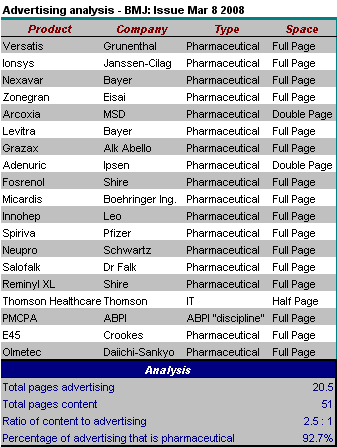
This is the British Medical Journal Advertising analysis for this week.


The 1.5 pages of advertising material that was not devoted to pharmaceuticals comprised:
  • An advertisement for an information technology company (half a page)
  • A report from the Association of British Pharmaceutical Industry (ABPI) listing their token wrist slapping of companies deemed to have breached the ABPI code of practice. The ABPI is of course the lobby group for Pharmaceutical companies in the UK.
These ABPI reports are always puzzling. They seem to choose a few slightly important examples of system malfunction -- while selectively ignoring all serious scientific misconduct or fraud that have led to significant human misery. I might be cynical, but perhaps the intent is to convey an impression that some self-policing is taking place.

This time we are told that ProStrakan promoted a medicine "in a way that was inconsistent with its summary of product characteristics" and UCB Pharma "failed to maintain a high standard". How about dealing with some of the real problems of misrepresented science ABPI, or perhaps that doesn't matter much to your members.

So, ABPI, I suggest that you start with GSK and the problems raised in the report by Harvard Psychiatrist Professor Joseph Glenmullen. Perhaps the ABPI and its members regard the following as good scientific practice:
a) selective publication of positive data,
b) counting of events during the washout phase of clinical trials as if they were events on placebo
c) "recoding" of study events to misrepresent what they are.
Some scientists would regard these actions as serious scientific misconduct, but perhaps the ABPI would not agree. If so, I would be curious to know their reasons.
ABPI, you could even slap a few wrists over the misrepresented data and untruths told to journals and doctors about Procter and Gamble studies in Sheffield. Please do feel free to discuss if you care.

There were a few other depressing features in the BMJ this week. At least the BMJ continue to employ some excellent journalists (Jeanne Lenzer and Shannon Brownlee) who do tell it as it is. One wonders how long this will continue.

Rules: As usual this is for the UK version of the BMJ. The classified advertisement section is excluded, as are advertisements for the BMA, products of the BMJ/BMA/BNF or the government.

Click here for collated BMJ Advertising analyses.

Earlier|Later|Main Page

Saturday, March 01, 2008

BMJ Advertising Watch : 01 March 2008 (another day another lie - perhaps)

This is the British Medical Journal Advertising analysis for this week.


Having retired the misrepresented Dr Jarvik, the back cover Lipitor advertisement (Pfizer) features a fireman. Is he really a fireman? See Pharma Giles and Health Care Renewal on the "mis-impressions and distractions" of the Jarvik campaign. Now who is this un-named fireman, does he exist, and did he really say "What's terrifying for them is everyday for me"? As a doctor of average intelligence I am obviously deeply impressed by a fireman telling me about lipidology. We shall see:
Medical Information
Pfizer Limited
Walton Oaks
Dorking Road
Tadworth, Surrey
KT20 7NS

1 March 2008

Dear Sir

I note the photograph of a fireman on the back cover of the BMJ this week (issue 1 March 2008).

I would appreciate it if you would let me know the name of this fireman, since certain statements are attributed to him. I would like to know whether this fireman exists, whether he is an accredited fireman, and whether he really made the statements attributed to him. If he is not a fireman, please let me know which parts of this advertisement are truthful and science-based.

Best wishes

Dr Aubrey Blumsohn
In the meantime, the BMJ continues to advertise itself to advertisers thusly:
"We protect our reputation by careful balance of editorial and advertising, which means your messages will always stand out".
The BMJ seemed short of advertising material this month. There was however an advertisement for books! Sadly the troubling testosterone advertisement was back.

Rules: As usual this is for the UK version of the BMJ. The classified advertisement section is excluded, as are advertisements for the BMA, products of the BMJ/BMA/BNF or the government.

Click here for collated BMJ Advertising analyses.

Earlier|Later|Main Page

Sunday, February 24, 2008

BMJ Advertising Watch : 23 February 2008 - More smoke

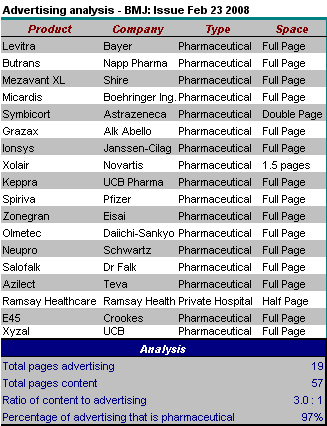
This is the British Medical Journal Advertising analysis for this week.

This issue includes an article by Andrew Jack of the Financial Times on the crisis of "Big Pharma" (BMJ 336:418-9 "Balancing Big Pharma's books). The article completely misses the point. If the point is missed there is no chance of solving the crisis. The real long-term problems facing "Big Pharma" (a science based industry) are not difficult to understand. They are:
  1. Multiple instances of overt scientific fraud
  2. Regulatory collusion with that fraud
  3. Attempts to cover-up that fraud and to redefine the meaning of science itself
  4. Provision of misinformation and malinformation to doctors and patients
  5. Government and regulatory collusion to subvert the free market and to prevent consumer litigation
  6. Refusal to allow science to be properly scrutinized
  7. Increasing evidence that the peer reviewed scientific literature cannot be trusted
  8. Internal incompetence and a lack of scientific interchange that prevents picking of even low-hanging fruit. Midgets cannot reach that high, especially when all the giants have been removed.
There is no real sense of this in the Jack article. Instead we read:
"It reflects public opinion that is risk averse, sparked by fears such as the reported patient deaths caused by merck's painkiller Vioxx, or GSK's diabetes drug Avandia. Cautious regulators have responded by imposing ever tougher barriers that must be overcome to approve new medicines."
Anyone who wishes this industry well (as I do) must realize that to summarize the problem as a public relations issue is not going to help anyone - least of all the industry itself. The health of this industry (including its long-term financial health) would benefit if a few of its leaders were sent to prison.

There was however a decent article by Ray Moynihan on the subversion of Medical Education by commercial companies. The "Better Together" advertisement for Ezetimibe did not appear this week. Neither did the problematical testosterone advertisement.


Rules: As usual this is for the UK version of the BMJ. The classified advertisement section is excluded, as are advertisements for the BMA, products of the BMJ/BMA/BNF or the government.

The BMJ continues to advertise itself to advertisers thusly:
"We protect our reputation by careful balance of editorial and advertising, which means your messages will always stand out".
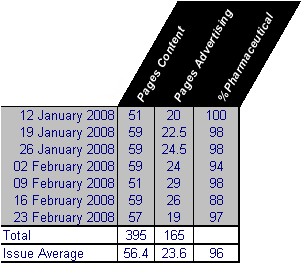
Here is an accumulated analysis


Click here for collated BMJ Advertising analyses.

Earlier|Later|Main Page

Sunday, February 17, 2008

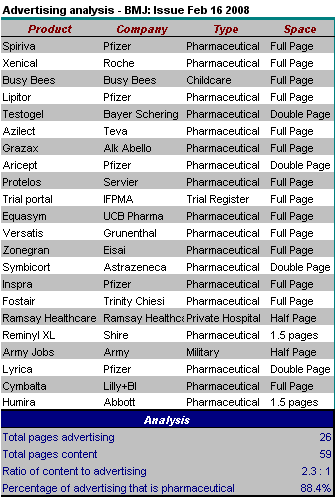
BMJ Advertising Watch : 16 February 2008 (All hail, Delusion)

All hail, Delusion! Were it not for thee
The world turned topsy-turvy we should see;
(Mumfrey Mappel)

This is the British Medical Journal Advertising analysis for this week. The BMJ continues to advertise itself to advertisers thusly:
"We protect our reputation by careful balance of editorial and advertising, which means your messages will always stand out".


Comment: A full three pages of advertising was devoted to something other than Pharmaceuticals (11.6% of total). The 11.6% comprises an advertisement for the army, half a page on Ramsay Healthcare (a private hospital network with links to the Labour Government), a clinical trials register, and child care provision. There is nothing at all in the BMJ about ongoing developments in the scandal of Ketek. There is not a word about the further findings of manipulated results in Seroxat/Paxil clinical trials. UK doctors seemingly have no interest in the recent revised estimates of the number of individuals who are likely to have died (22,000) as a result of the failure by Bayer to disclose trasylol data in September 2006. There is still nothing of any substance on the Ezetimibe scandal. The "Better Together" advertisement for Ezetimibe did not appear this week. The testosterone advertisement continues to appear.


Click here for collated BMJ Advertising analyses.

Rules: As usual this is for the UK version of the BMJ. The classified advertisement section is excluded, as are advertisements for the BMA, products of the BMJ/BMA/BNF or the government.

Earlier|Later|Main Page

Sunday, February 10, 2008

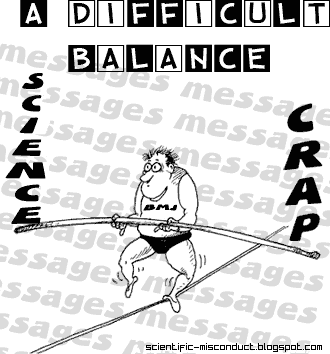
BMJ Advertising Watch : 09 February 2008 (a difficult balance)

Balancing the truth is a difficult task for a scientific journal. This is the British Medical Journal Advertising analysis for this week. The BMJ advertises itself to advertisers thusly:
"We protect our reputation by careful balance of editorial and advertising, which means your messages will always stand out".


Rules: As usual this is for the UK version of the BMJ. The classified advertisement section is excluded, as are advertisements for the BMA, products of the BMJ/BMA/BNF or the government.
[BMJ Ad Watch]
Comment:
  • The BMJ broke all records this week with a stunning balance of 29 pages of advertising (1.7 pages of content to balance each 1.0 pages of pharmaceutical advertising). The proportion of advertising devoted to pharmaceuticals was 98.3%. The other 1.7% was a half page advertisement for Ramsay Healthcare - a private hospital network with links to the Labour Government.
  • Discussion about the Ezetimibe scandal: Still -- nothing of any substance. At least the "Better Together" advertisement for Ezetimibe did not appear this week.
  • The double page testosterone advertisement (see last week) appears again. Still no mention in the advertisement of the actual science - which shows that testosterone supplementation does nothing much to anything. I wonder whether the BMJ expects that readers will believe the "messages" in their "scientific" pages or the "messages" in their "scientific" advertisements? Wonderful word that -- "messages".
Click here for collated BMJ Advertising analyses.

Earlier|Later|Main Page

Saturday, February 02, 2008

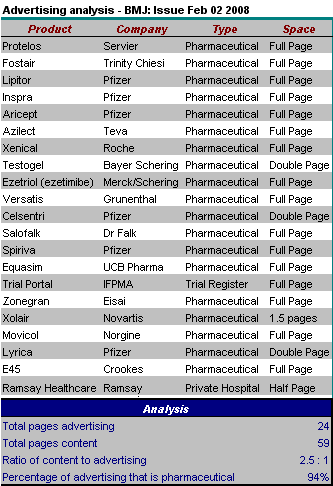
BMJ Advertising Watch : 02 February 2008

This is the British Medical Journal Advertising analysis for this week.

Rules: As usual this is for the UK version of the BMJ. The classified advertisement section is excluded, as are pages advertising the BMA or products of the BMJ/BMA/BNF.

Comment: There were 24.5 pages of advertising (1 page of advertising for each 2.5 pages of content). The proportion of advertising devoted to pharmaceuticals fell to an all time low of 94%. The other 4% was:
  • a half page advertisement for Ramsay Healthcare (for more about Ramsay and their cozy links with the Labour Government see here)
  • a one page advertisement for a register of clinical trials.
Discussion about the Ezetimibe scandal: Following the terse news snippet last week about the shonky research underlying the approval of Ezetimibe (Ezetriol, Vytorin, Zetia) there remains no entry in the BMJ about the precise way in which the scientific community were deceived, the delayed reporting, the attempts to circumvent investigators and to alter endpoints, the interesting sale of Schering shares ($25 million) by an executive, or any discussion of the principles of good science. However this issue had an advertisement for Ezetimibe ("Better Together"). The advertisement fails to mention that the only evidence available so far suggests that the drug has no clinical benefit. It also doesn't mention what happened to the data.

There were a few other notable items this issue:
  1. A letter from a reader (Jeremy Stone) complaining about discordance between a double page advertisement for testosterone supplements in the previous issue, and (on the very next page) a double blind RCT showing that testosterone supplements have no effect on functional mobility, muscle strength, cognitive function, bone mineral density or quality of life. I'll look out for proper referencing in the next appearance of this advertisement. They might even want to reference our paper showing that testosterone supplementation does nothing useful to anything (except plasma testosterone).
  2. There was a dismal letter signed by around 20 statisticians asserting that the EU regulatory agencies should employ more card carrying statisticians to "explore methods and data in real depth". The plea for employment and the special God-given powers of statisticians would carry more credibility if there were evidence that any of the signatories were regular commentators on instances of blatant fraud in clinical trials (no statistical expertise required) or on the fact that neither regulators nor scientific authors have genuine raw data to "explore" in any case. None (as far as I am aware) have commented on Ezetimibe. Statisticians would also do well to realize that only a few aspects of data integrity are within the special remit of complex statistics. All scientists require raw data.
  3. There was a detailed Obituary of Moses Judah Folkman (the "father of angiogenesis") by Jeanne Lenzer. In contrast to other Folkman obituaries it did at least mention that he had been forced to "apologise" over scientific fraud (false descriptions of methodology and falsified findings in an NEJM publication).

Click here for collated BMJ Advertising analyses.

Earlier|Later|Main Page

Saturday, January 26, 2008

BMJ Advertising Watch : 26 January 2008

This is the British Medical Journal Advertising analysis for this week.
I'll also continue to comment on any appearance of any discussion in the BMJ about questionable Ezetimibe research.

Rules: As usual this is for the UK version of the BMJ. The classified advertisement section is excluded, as are pages advertising the BMA or products of the BMJ/BMA/BNF.

Comment: This week the BMJ exceeded all records with 24.5 pages of advertising (giving 1 page of advertising for each 2.4 pages of content). Again 98% of the advertising was for pharmaceuticals. The other 2% was a single half page advertisement for Ramsay Healthcare (for more about Ramsay and their cozy arrangements with the Labour Government see here).

Discussion about the Ezetimibe scandal: Finally, the BMJ published a short news piece by the excellent Jeanne Lenzer on the shonky research underlying the approval of Ezetimibe (Ezetriol, Vytorin, Zetia). There remains no discussion in the BMJ about the precise way in which the scientific community were deceived, the delayed reporting, the attempts to circumvent investigators and to alter endpoints, the interesting sale of Schering shares ($25 million) by an executive, or any discussion of the principles of good science. However a belated and half-hearted congratulations. In contrast to the last issue, there were no advertisements for Ezetimibe.

Merck and Schering-Plough state:
"All of us at Merck and Schering-Plough proudly stand by the established efficacy and safety profiles of Zetia and Vytorin."
Define efficacy. Given the evidence of your behavior, why should we believe you?

Our profession remains mute.

Click here for collated BMJ Advertising analyses.

Earlier|Later|Main Page

Saturday, January 19, 2008

BMJ Advertising Watch : 19 January 2008

This is the British Medical Journal Advertising analysis for this week.

I'll also comment on any appearance of any discussion in the BMJ about questionable Ezetimibe research.

Rules: As usual this is for the BMJ as delivered to subscribers in the UK. The classified advertisement section is excluded, as are pages advertising the BMA or products of the BMJ/BMA/BNF.
BMJ Advertising analysis 19 Jan 2008
Comment: This week only 98% of the advertising was for pharmaceuticals (there was a single half page advertisement for a Private Healthcare company). As before, there was no advertising space devoted to other products doctors might be inclined to purchase (stethoscopes, expensive cars, services, holidays, books, cosmetics), or non-pharmaceutical healthcare products. The ratio of advertising space to content was about the same as last week (1 page of advertising for each 2.6 pages of content).

There were two rather good articles about osteoporosis in this issue. I'll discuss these over the next few weeks.

Discussion about the Ezetimibe scandal: Still none at all. There was however a full page advertisement for Ezetimibe (Ezetriol, Vytorin, Zetia). The advertisement states "Better Together", "For patients not controlled by initial statin alone". The advertisement doesn't mention that the only evidence available so far suggests that the drug has no clinical benefit at all. It also doesn't mention what happened to the data.

Click here for collated BMJ Advertising analyses.

Postscript: Matthew Holford posted an interesting commentary on this BMJ Ad-watch. He revealed correspondence with the BMJ asking about their reported rejection of a scientific paper criticising GlaxoSmithKline. This rejection was apparently on the basis of the legal costs of review rather than on factual content. He asked how much an advertisement costs in comparison with legal "peer review" of a manuscript (perish the thought). He received no reply. I'll say more about this next week.

Earlier|Later|Main Page

Monday, January 14, 2008

BMJ Advertising Watch : 12 January 2008

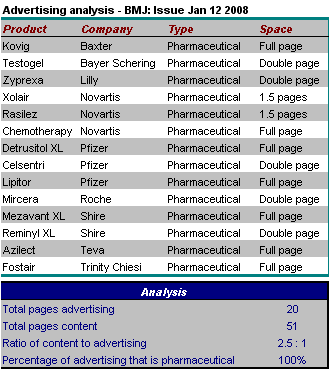
This new initiative follows my earlier post on the widening gap between the debate about science that is taking place in medical journals and the scientific/ethical discussion outside of those journals. Each week I will collate the advertising in the current issue of the British Medical Journal. I'll comment as we go along, and at the end of some period I'll collate the data, related scandals involving the advertised drugs and discussion taking place within the content pages of the BMJ. I'll also comment on any appearance of any discussion in the BMJ about questionable Ezetimibe research.

Rules: This is for the BMJ as delivered to subscribers in the UK (not to libraries). If anyone wants to help collate data for JAMA, Lancet and NEJM let me know. The classified advertisement section is excluded, as are pages advertising the BMA or products of the BMJ/BMA. Below is the analysis for this week
BMJ Advertising analysis 12 Jan 2008
Comment: 100% of the advertising was for pharmaceuticals. There was no advertising space devoted to other products doctors might be inclined to purchase (stethoscopes, expensive cars, medical devices, services, holidays, books, cosmetics or alcohol). The ratio of advertising space to content was 1:2.55.

The advertisement for Novartis about CML chemotherapy was particularly interesting. This was in essence a one page content-free scientific "review" raising the concept of targeted chemotherapy for CML based on Bcr-Abl.

Discussion about Ezetimibe research: None

Earlier|Later|Main Page