Showing posts with label stalking. Show all posts

Thursday, November 15, 2007

Memory Hole (10 November): What else happened

Scientific Misconduct Blog Memory Hole: Events of November 10th

1 years ago today: Statins decrease cholesterol by 0.13mmol/L

On 10 November 2006 a paper in the Journal of Internal Medicine (260; 551) reported that average cholesterol levels had fallen considerably in Swedish men between 1986 and 2006 - from 6.32 to 5.51 mmol/L. Almost none of this decrease was due to statins. Fewer than 10% of people were a lipid lowering drug, and these accounted for only 0.13 mmol/L of the population decrease.

2 years ago today: GSK: Our product is.......

On 10 November 2005 Chris Viehbacher, head of U.S. operations at GlaxoSmithKline Plc, was quoted as saying "In the long term Glaxo would like to spend a lot more on researching new medicines and a lot less on selling them".."So far we haven't found a more effective way of educating physicians."

The product is science.

Chris Viehbacher is an accountant. I have seen no comment from Viehbacher on any possible deception in GSK drug trials, or those trials that disappeared. Perhaps Silence is part of the "education".

Source: Hirschler, Ben. "Drug giants wary on cutting sales forces", Reuters, 2005-11-10.

The truth

3 years ago today: Pfizer and Bextra - optional truthfulness

On 10 November 2004 Pfizer entered the scientific debate over their hidden Bextra data - by abusing critics.

Cardiologist Garret FitzGerald reported a pooled analysis of clinical trial results showed patients taking Pfizer's arthritis drug Bextra were twice as likely to have a heart attack or stroke as those taking a placebo. When reports appeared in the New York Times, instead of addressing the science Pfizer attacked back. The report they said "draws unsubstantiated conclusions about the cardiovascular safety of" Bextra and "is based on information that has not been published in a medical journal or subject to independent scientific review."

Their product is science but there was no science in the response. Five months later on April 7, 2005, Pfizer withdrew Bextra from the U.S. market.

Pfizer has since disclosed that, at the time of those statements, it did indeed have studies that demonstrated heart problems among patients taking Celebrex or Bextra. When a Pfizer scientist said that there was no clear evidence that Celebrex posed a risk, members of the FDA committee stated: "That just doesn't pass the laugh test" (Dr. Alastair Wood, chairman of the hearing). Wood noted that Pfizer omitted from its presentation the key study that documented problems with Celebrex. One panel member accused Pfizer of hiding data. Dr. Curt Furberg of Wake Forest University stated "I'm troubled by some inconsistencies that I have found in the briefing document from Pfizer." Furberg suggested that all of Pfizer's mistakes seemed to benefit the company. "So I wonder how much trust can we put in these presentations" he said.

Professor Ralph D'Agostino told the committee "We really don't know what to make out of any long-term use" based on Pfizer's studies that lasted only a few weeks". Dr. Verburg of Pfizer responded simply, "We recognize all of the faults in what we are doing"

Dr. Byron Cryer of the University of Texas Southwestern Medical Center, described part of the Pfizer presentation as "misleading." Dr. Verburg of Pfizer responded simply, "Point taken."

But the point Dr. Verburg is that this is quackery and bad science. Perhaps it is not science at all. People die as a result.

Sources:
See FDA report 7 April 2005 http://www.fda.gov/cder/drug/InfoSheets/HCP/valdecoxibHCP.htm
Systematic review of Bextra in JAMA http://www.cox2drugreview.org/
Medical Panel Poses Pointed Questions to Drug Makers Over Risks of Painkillers, New York Times 17 Feb 2005

5 years ago today: UK Labour government brings integrity to the NHS

On 10 November 2002 the UK government Health Secretary Alan Milburn was criticized for hiring the American private insurer United Healthcare to help "cut costs in the NHS by keeping the elderly patients out of hospital".

As the Observer "discovered" without much difficulty "United Healthcare has been forced to pay millions of dollars in fines to settle charges that it had defrauded the US government, patients and doctors", had "falsely charged the US government for patients it claimed were in nursing homes" by inventing institutionalized patients, and had been fined for "cheating patients out of money". The firm had also been "failing to give proper notice of the right to appeal" when denying patients healthcare, and Michael Mooney, a United vice-president, was jailed for three and a half years for insider trading.

About time New Labour started saying the unthinkable and admitting their moral and intellectual bankruptcy in the area of healthcare and medicines regulation.

Milburn apparently holds a place on the board of PepsiCo. On 28 February 2007, he launched 2020 Vision, a website intended to promote policy debate (well debate then). There is a Chinese saying, "a fish begins to smell from the head down..."

Source: UK's elderly care plan run by US "cheats", the Observer, Nov 10

Spy vs Spy

4 years ago today: Another P&G spying case

On 10 November 2003 Procter and Gamble were exposed in the Chicago Sun Times for their involvement with Wallmart in an escapade which involved spying on customers. Briefly, Lipfinity lipstick was tagged with an electronic (RFID) tracking device between March and July 2003. Customers unwittingly left the store carrying the tag.

At the same time a live video camera trained on the shelf allowed Procter & Gamble employees (700 miles away) to observe and videotape the Lipfinity display and consumers interacting with it. "Given the players, the Wal-Mart Lipfinity trial probably isn't an isolated incident," says CASPIAN spokeswoman Liz McIntyre. "documents suggest that other products, including Huggies baby wipes, Pantene shampoo, Caress soap, Purina Dog Chow and Right Guard deodorant were also slated for live RFID field trials".

In P&G's defense it could be said that the video material was apparently not kept, and the videos were mostly of the back of customer's heads. Bizarrely, it was also stated that "the test was not secret. There was a sign near the Lipfinity display that alerted customers that closed-circuit televisions and electronic merchandise security systems are in place in the store."

In 2006 P&G's received first prize in the annual Most Trusted Company for Privacy Award. They consolidated their position that year by releasing the long-denied raw data to researchers who had "authored" schlonky publications about their osteoporosis drug Actonel. Onwards and upwards.

See: more on RFID devices

8 years ago today: Scientific fraud involving three drugs - prison anyone?

On 10 November 1999 an editorial in JAMA discussed ondansetron, a drug that was being studied to prevent vomiting. Researchers analyzing the literature found 84 studies involving 11,980 patients -- or so they thought. Some of the data had been published twice, and when the researchers sorted it out, they realized that there were really only 70 studies, in 8,645 patients.

Since the duplicated data was the good data, the reviewers estimated this double-counting would lead to a 23 percent overestimate of the drug's effectiveness.

Similarly data for the antipsychotic agent risperidone had been published multiple times in different journals, under different authors' names.

Other problems involving fluconazole (made by Pfizer) were reported. Fluconazole had been compared with Amphoteracin B, but on close inspection it appeared that the Amphoteracin had been given by mouth instead of intravenously (it is not at all effective orally and is supposed to be given by drip).

Dr. Michael O'Connell, deputy director of the Mayo Clinic Cancer Center in Rochester, Minn., an expert on clinical trials, said: "To publish the same data again with entirely different authorship, as if it were an entirely different data set, is reprehensible".

The problem is that the authors of the papers probably didn't even know, because they had almost certainly never seen the data, and were just brain-dead drones and fraudsters.

The reviewers tried to ask the authors about the design of the studies and for the data. Some ignored the requests, and others said they no longer had the data. Pfizer declined comment to JAMA.

Dr. Bert Spilker, senior vice president for scientific and regulatory affairs at PhRMA, the lobby group for drug manufacturers, said: "We don't have a perfect situation. It probably can be improved." Scientific fraud is not "a perfect situation" when your industry is supposed to be selling products under the banner of science. When patients die as a result of faulty misleading science it is obviously not "a perfect situation" either. As usual, nobody was held to account.

See: Medical Journal Cites Misleading Drug Research, NY Times, 10 Nov 1999

Spy vs Spy

16 years ago today: A company employs "traditional and standard" methods to avoid exposure

On 10 November 1991 the New York Times reported on the way in which one powerful industry thought it was the government, gestapo secret police and the law rolled into one. It raised questions about the lengths to which powerful individuals will go to silence critics and avoid embarrassing disclosures. Although not about scientific misconduct, it is related to the corporate scientific crimes discussed here.

When Trans Alaska Pipeline felt in 1990 that confidential company documents had been taken and conveyed to regulators it hired Wackenhut Corporation.

"For three years in the late 1980's, the owners and operators of the 791-mile-long pipeline had been a target of the unrelenting criticism of a former oil broker from Virginia named Charles Hamel. Mr. Hamel, who was battling several oil companies in court, became a conduit for leaked documents about lapses in Alyeska's environmental and safety programs. The documents turned up in the hands of regulators and the news media, resulting in large fines and millions of dollars in expenditures by Alyeska to fix the problems. With unlimited funds supplied by Alyeska, Wackenhut hired highly trained investigators, bought sophisticated eavesdropping equipment, and set up a sting operation to induce Hamel to disclose his sources."
  1. Wackenhut's investigative net stretched from Alaska to Florida to Washington
  2. Miniature cameras were installed in hotel rooms in Alaska.
  3. Trash was rifled at Mr. Hamel's home.
  4. Motorized vans with electronic devices intercepted conversations for recording.
  5. Using phony credentials from a fake environmental law group, Wackenhut's agents befriended Hamel, who invited them into his home, where they stole documents from his desk.
  6. When Hamel talked with the House Interior Committee and its chairman George Miller, Wackenhut's agents and Alyeska's lawyers considered targeting him as well.
George R. Wackenhut, the company's founder and chairman said the actions taken to prevent the public from finding out were entirely legal and "traditional and standard".

Source: "A Case of Heavy-Footed Gumshoes" New York Times, 10 Nov 1991

17 years ago today: Plagiarism at Boston University

On 10 November 1990 it was reported that substantial parts of the late late Dr. Martin Luther King, Jr's doctoral dissertation and other academic papers from his student years appeared to have been plagiarized.

"analysis of the papers by researchers working on the project had uncovered concepts, sentences and longer passages taken from other sources without attribution throughout Dr. King's writings as a theology student." "scholars who have seen the papers declined to say how great a percentage of the material had been plagiarized, but they said it was enough to indicate a serious violation of academic principles."

Officials at Boston University stated that it is not likely the Ph.D. would be revoked "because neither Dr. King nor his dissertation adviser is alive to defend the work".

Source: DePalma, Anthony. "Plagiarism Seen by Scholars in King's Ph.D Dissertation". New York Times, 10 November 1990.

Earlier|Later|Main Page

Sunday, July 29, 2007

Procter and Gamble goes dumpster diving

procter and gamble goes dumpster divingI tape recorded Procter and Gamble and other "researchers" involved in some problematical sponsored clinical research. That was an important thing to do. I have been waiting a while for an honest response. I have been waiting for permission to make available the hidden (and now revealed) raw data upon which P&G relied in their three scheduled Actonel ghostwritten publications. I have been waiting for a few other refused things (like the text of consent forms from patients upon whom I performed measurements).

Here is the correct analysis for one of the publications. Here is the correct analysis for another of the publications (Eastell et al., 2003). Here are the Data underlying all three publications (encrypted).

So far all involved have been a little evasive, giving artful answers to "questions" that had not in fact been asked. That seems to be to be a bad idea John Eisman.

While being politely patient, I found some most interesting old news reports about P&G's own spying tactics.
New York Times Page C7, September 7, 2001
P.& G. Said to Agree to Pay Unilever $10 Million in Spying Case
By JULIAN E. BARNES (NYT); Business/Financial Desk
DISPLAYING ABSTRACT - Procter & Gamble will pay Unilever about $10 million and agree to unusual third-party audit to settle dispute that arose after P&G acknowledged that it had taken documents from trash cans outside Chicago office of Unilever; Unilever had made demand to ensure that Procter & Gamble did not change its marketing or product development plans for its hair care business after reviewing about 80 pages of confidential Unilever plans
Procter & Gamble Admits to Spying on Unilever

In a disclosure that shines a light on the shady world of corporate espionage, FORTUNE magazine recently reported that Procter & Gamble, one of the nation's largest and most admired corporations, has "recently engaged in a corporate espionage program against competitors in its hair care business that even the company itself admits spun out of control."

P&G claims it did not break any laws, but a spokeswoman conceded that spying activities undertaken by a "corporate intelligence" company that was hired by P&G "violated our strict guidelines regarding our business policies."

DEFINITION: Corporate or industrial espionage is the practice of spying on business competitors to steal proprietary information, including product designs and marketing plans. While corporate espionage sometimes includes computer hacking, it is just as likely to involve non-technology-related practices, such as rummaging through a competitor's trash ("dumpster diving") or simply interviewing disgruntled employees.

P&G has confirmed that at least one competitive intelligence company it hired engaged in dumpster diving to find information on rival Unilever's hair-care business. The competitive intelligence operatives are also said to have lied to Unilever employees - claiming they were market analysts in a further effort to gather information.
Procter & Gamble vs. Unilever
In 2001, P&G undertook a corporate-espionage program by hiring a "consulting firm" to rummage through Unilever's trash and steal the secret formula for a new hair-care product. The two companies eventually reached a settlement; P&G agreed to pay Unilever $10 million. The firm hired to do the dirty work is headed by a former Green Beret and U.S. government intelligence operative who served in the Phoenix Program, a covert operation during the Vietnam War.

Remarkably this isn't the first time P&G has gotten caught in corporate espionage against Unilever. In 1943, a Procter & Gamble executive bribed an employee of Lever Brothers (as Unilever was then called) to steal prototype bars of a new soap Lever was developing. P&G used the stolen formula to rework its own Ivory Soap, which soon became one of the most familiar brand names in America. P&G ended up having to pay Lever $5 million for patent infringement.
One year later, P&G Pharmaceuticals signed a research agreement.

See also
The Ethics of Competitive Intelligence

The moral:
Before you criticize people, you should walk a mile in their shoes.
That way, when you criticize them, you've got a mile-long head start.
And you have their shoes.

The Lion (in The Wizard of Oz)

(Thank you John - a medical publication professional - for the tip)

Earlier|Later|Main Page

Monday, July 16, 2007

Intimidation by patient advocacy groups: More on the Gillberg Affair

Much has been written about the problem of "astroturf" patient advocacy groups (1,2,3,4,5,6). These are patient "support" groups with a facade of grassroots advocacy - but with real interests that lie elsewhere (7).

It isn't hard to discern fake advocacy. The cracks show when concerns are raised about scientific dishonesty, hiding of evidence, and regulatory malfunction. Patients rely on honest independent science. Legitimate advocacy groups (such as MIND ) show concern and outrage when there is evidence of threat to the integrity of science upon which their patient "clients" depend. Mute behavior of an "advocacy" group provides evidence of illegitimacy.

Less widely discussed is the inclination of some "advocacy" groups to intimidate individual scientists, clinicians or patients who wish to discuss concerns about scientific integrity.

Dr Leif ElinderFor a good example of this, I return to my ongoing investigation of the Gillberg Affair. Dr Leif Elinder (left) is one of the two individuals who raised serious concerns about the veracity of the study findings and patient consent in studies reported by the Gillberg team in Sweden. Elinder is an Uppsala pediatrician specialising in the care of children with complex educational needs. He also expressed concerns about poor science and industry influence underlying the diagnosis of ADHD (as have many others). During these events the Gillberg team destroyed all their raw data, preventing any exploration of alleged research misconduct (for details see here and here). This followed a court order to allow proper and confidential scrutiny of the records by investigators. The Gillberg team provided a laughable rationale for their destruction of those data and their prevention of scrutiny. A key aspect of the science involving the diagnosis of ADHD was thereby placed into considerable doubt. Any legitimate advocacy group would have been outraged (likewise all honest psychiatrists).
The Attention Society (Riksförbundets Attention) is the Swedish society supposedly advocating for children with ADHD (UK equivalent of ADDISS, or the US CHADD).

What did these advocacy groups do?

Well the facts stand for themselves:

1) Riksförbundets Attention did not criticize the actions of the Gillberg team. Neither to my knowledge did ADDISS or CHADD.

2) Riksförbundets Attention instead started a financial collection on their website in support of legal expenses for Christopher Gillberg [Insamling till stöd för Christopher Gillberg]

3) Riksförbundets Attention on their website resorted to the dismal technique of implying that Elinder is a Scientologist, which (even if relevant) he is not. They state: "När det gäller medicinering som är det stora svarta skynket för dessa personer, vars åsikter ligger nära scientologerna" [which is the real bad thing for these people, whose views are close to the Scientology movement].

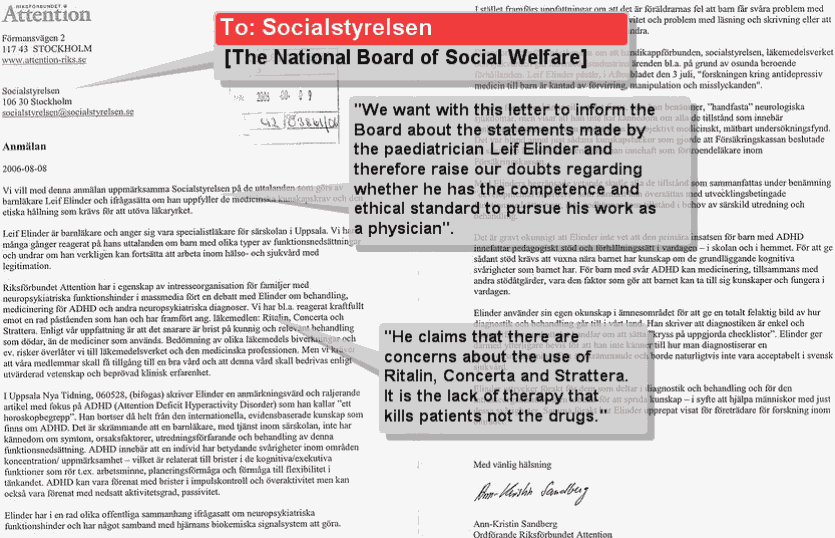
4) They then placed a formal complaint with the National Board for Education and the body that licenses doctors in Sweden about Elinder (not Gillberg).

Swedish Radio 17 Aug 2006 reported that:
Ann-Kristin Sandberg, Chairman for the Riksförbundet Attention had approached both The National Board of Social Welfare (Socialstyrelsen, the body that registers doctors in Sweden) to "investigate whether the Uppsala physician Leif Elinder, known for his controversial views on ADHD should be allowed to keep his doctors certificate". "The organisation has the view that the National Board of Social welfare (Socialstyrelsen) should investigate Elinders suitability as a physician" "This spring he wrote an article for the newspaper in Uppsala where he called ADHD concept a horoscope. This was the final straw and it was taken as an insult towards our members who are suffering from the symptoms."

5) Similarly the Swedish newspapers (Publicerad: 2006-06-08) reported that:

"The view of the Attention society who strongly attacks Leif Elinder who calls ADHD a horosope concept. For this reason the Attention society, an interest organisation for people with neuropsychiatric disabilities such as ADHD have sent a petition to Skolverket to attempt to consider whether Elinder can pursue his work in his field"

6) Riksförbundets Attention wrote to Socialstyrelsen in an attempt to get Elinder struck off. That letter is here (click on images for larger versions):

Click to expand

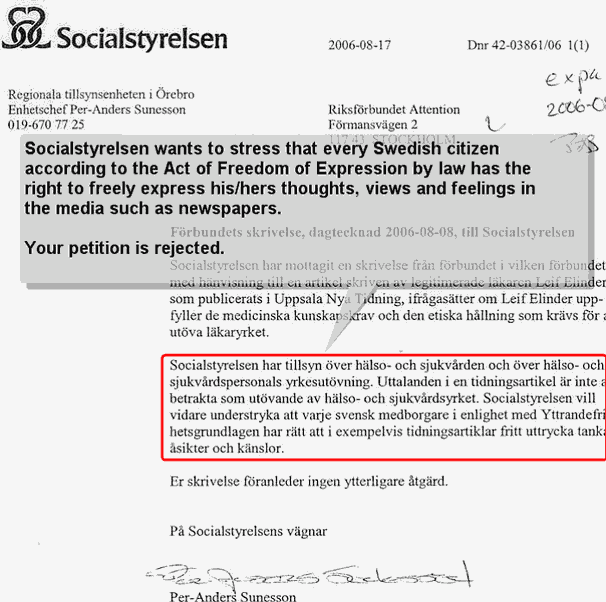
Socialstyrelsen replied quite appropriately telling Riksförbundets Attention to get lost:

Click to expand

7) Gillberg as well as his wife (Carina) wrote intimidating letters to about a dozen member's of Elinder's family, but Riksförbundets Attention didn't comment on the appropriateness of this either.

Click to expand

8) In the meantime the website of Riksförbundets Attention states that they get extensive funding from a variety of pharmaceutical companies. Dr Björn Kadesjö is one of three members of their medical advisory board. This same Kadesjö has co-signed commercial pharmaceutical confidentiality agreements with Gillberg (link). Kadesjö has published 14 papers with Gillberg about ADHD (link) constituting Kadesjö's entire research output.

Woe be to all of us.

Earlier|Later|Main Page

Sunday, March 11, 2007

The Olivieri case: The Drug Trial debunked

obscuring the truthProgress in medicine relies on honest science. The bullying of scientists who have attempted to raise issues of integrity in medicine is a stain on our profession. So is the silence of colleagues.

Whistleblowers swim in shark-infested waters. They quickly learn about the iniquities of a system which protects the wrongdoers instead of patients. There is overt collusion between universities, professional regulatory bodies, drug licensing authorities and medical journals to obscure problems of science and scientific procedure. Often this is done to protect pharmaceutical patrons.

These stories expose the paranoid lengths our profession will go to keep scientific misconduct out of sight. Manipulation of the truth, whitewash, protectionism and lack of accountability are the standard response. We have ended up with pharmaceutical "science" that is in part a house of cards glued in place by vested interests.

The case of Nancy Olivieri at the University of Toronto continues to raise many worrying issues. The bullying of Olivieri was intense. Amongst the most awful things to happen to Olivieri was publication of a book which concentrated on her supposed personal attributes while ignoring the ethical principles she raised. Unfortunately the author of this book (Miriam Shuchman) failed to declare her conflicts of interest. Shuchman has now been exposed as mis-citing her anonymous sources, several of whom have complained. The University of Toronto have not distanced themselves, nor has it protected Olivieri from these attacks - there has been silence.

Sometimes the small sub-stories are most enlightening. The University of Toronto failed to take proper action against a malicious and very senior colleague who wrote anonymous threatening correspondence to Olivieri and several others. This individual, Professor Gideon Koren, repeadly denied doing so, until entrapped by DNA evidence. He remains an active researcher producing research "findings" which have relevance to patients. It is not clear whether our profession should accept such findings without question. The layer of Teflon coating some senior medical "thought leaders" is very thick.

I have previously written about this book [Link]. Now Arthur Schafer, a Canadian philosopher has written a scathing indictment of Shuchman's book and of her ethics (Bioethics , Vol. 21 (2) 2007, pp 111-115). The full review is here here. Extracts are below.

Review of the Drug Trial - by Arthur Schafer - Extracts
Full text here

The use of anonymous quotations, and the mis-citing of sources

The heavily biased manner in which Shuchman assembles her material seriously undermines The Drug Trial's credibility. Credibility is an especially important issue when evaluating the claims made in this book, because most of the hostile quotations are attributed to doctors and patients who are not identified. One of the few clearly identified patients, "Howard", has now gone on record as saying that his words, as quoted in the book, were twisted beyond recognition. He insists that, so far from being critical of Olivieri's patient care or ethics, he considers Dr. Olivieri to be a highly ethical doctor who is utterly dedicated to her patients.

A brief excerpt from Howard's letter of protest to Shuchman, which has now been made public, raises deep ethical concerns about the integrity of Shuchman's journalism: "Dear Miriam: You've used a smoke-and-mirrors approach to spinning my statements to inaccurately portray Nancy by misquoting me, attributing quotes to me that I didn't make, omitting portions of my comments that would alter the effect and taking these comments out of context."

My confidence in Shuchman's journalistic reliability, already shaken by numerous factual errors and skewed descriptions of key events was further eroded when I came across a passage in which she "quotes" from a commentary I published in The Globe and Mail. I wrote none of the words she attributes to me.

The problem with Gideon Koren

Many of Shuchman's other allegations of ethical misconduct, directed against Olivieri, rely on the testimony of Olivieri's leading foe at Sick Kids, Dr. Gideon Koren. Koren, then a senior scientist and scientific administrator at the Hospital, has been found guilty of and severely disciplined for both professional and research misconduct, first by the hospital and the university, and later by the Ontario medical licensing body. The hospital and the university found that his actions, including persistent "lying" in connection with his efforts to discredit Dr. Olivieri, "constitute gross misconduct and provide sufficient grounds for dismissal."

The CAUT Report found that Dr. Koren "attempted to discredit Dr. Olivieri by dishonest means". In the words of the Discipline Committee of the College of Physicians and Surgeons of Ontario, Dr. Koren was guilty of "conduct unbecoming a physician". "His actions were childish, vindictive and dishonest", authoring "vicious diatribes" contained in anonymous "poison pen letters" against Dr. Olivieri. Koren was stripped by the University of his Endowed Chair, required to arrange that his ethically suspect research be deleted from the scientific record, publicly reprimanded by the licensing body, and required to pay substantial fines by the hospital, the university and the licensing body.

Shuchman has great admiration for Koren and devotes almost a full chapter of her book to trivializing his misconduct and praising his stellar virtues and research accomplishments. Unfortunately, she omits to inform her readers of the full extent of Dr. Koren's publicly reported misconduct.

Institutional obfuscation

Olivieri's hospital, The Hospital for Sick Children, and her university, the University of Toronto, have also taken a public drubbing for failing to provide her with effective support as she struggled with Apotex. Actually, not only was Olivieri denied effective support, she was fired from her position as the director of the Hospital's hemoglobinopathy programme, and both she and those colleagues brave enough to support her experienced harassment of many kinds. In the words of the CAUT Report: "Neither HSC nor the University …took effective action to defend principles of research ethics, clinical ethics and academic freedom." When it was discovered that the university was negotiating with Apotex for a huge financial donation, well, some people drew their own conclusions, and these were not flattering to the university

The veritable cornucopia of discredit which Shuchman heaps on Nancy Olivieri is, I'm sorry to say, standard punishment for those who have the temerity to challenge powerful vested interests. In the popular imagination David bravely slays Goliath. Alas, in the real world, the whistle-blower's issue of principle is easily re-described as an act of private disloyalty and, worse, as evidence of professional incompetence and psychological disturbance.

For every Erin Brockovitch, rewarded with fame and fortune (when Julia Roberts was cast by Hollywood to portray her brave struggle), there are a dozen other whistle-blowers consigned by employers and colleagues to professional oblivion. Typically, those who challenge authority find that their professional competence, personal lifestyle and mental stability are all brought into question. Most whistle-blowers are also labeled malcontents and publicity seekers, as Shuchman stigmatizes Olivieri. They are duly punished with demotion, suspension, and/or dismissal. The case of Dr. Aubrey Blumsohn, recently suspended from his job by Sheffield University after he blew the whistle on one of that University's major research funders, Proctor and Gamble, fits the same pattern. Few whistleblowers escape this fate.

Demonstrably false charges

To fill out her story, Shuchman compiles a lengthy charge sheet against Olivieri. The most serious accusation is that Olivieri negligently delayed the implementation (at Sick Kids Hospital) of proper guidelines for the treatment of sickle cell patients. Shuchman claims that this delay led directly to the death of a young patient, Sanchia Bulgin. Shuchman is unmoved by the fact that Olivieri was not one of the physicians treating this patient, and that the responsible physicians were found (by two official inquiries) to have violated established guidelines which had been in place for years. It's a bizarre accusation.

Reading The Drug Trial I was repeatedly struck by how often Shuchman's account of events is contradicted by the findings of a series of independent inquiries - all public documents, all easily obtainable. Almost all of the anti-Olivieri "revelations" presented in Shuchman's book are warmed-over versions of allegations already disproven by one or more of these impartial inquiries, and the others are undocumented hearsay. In short, Shuchman's way with well-established facts would have brought a smile to the face of Procrustes.


Related Links
Gideon Koren - misconduct [Link]

Earlier|Later|Main Page

Monday, February 19, 2007

Querulous Paranoia, bullies and the British Psychological Society

querulous paranoiaFollowing my last posting on the abuse of science and of an individual - Lisa Blakemore Brown - by the British Psychological Society, I thought it appropriate to launch into a more general rant about the abuse of psychiatric diagnosis to suppress scientific discussion. For collated posts on the case of Lisa Blakemore Brown see here.

King's College London claim to know whether individuals are mentally "normal". See this fascinating study - Am I normal? - from King's College. Norms were reported for the 21-item PDI psychometric test for delusional ideation. Although the deluded sample of schizotypal inpatients scored significantly higher than "normal" individuals, the range of scores overlapped considerably, with 11 percent of healthy adults scoring higher than the mean of the deluded group.

Other silly research reported from King's College London suggests that "one in three people in the UK regularly suffers paranoid or suspicious fears" based on the King's College definition of paranoia that runs along the lines of "Paranoid thinking is the suspicion that other people intend to do us harm." According to this wonderful research (and the accompanying book "Overcoming Paranoid and Suspicious Thoughts"):
  • 40 per cent of people regularly worry that negative comments are being made about them
  • 27 per cent think that people deliberately try to irritate them
  • 20 per cent worry about being observed or followed
  • 10 per cent think that someone has it in for them
  • 5 per cent worry that there's a conspiracy to harm them.
Watch for the promotion of drug therapy any time soon (perhaps by the Mental Health Research Network - see last post - also coordinated by King's College London).

But what if people really do "intend to do us (or society) harm"? Paranoia (as incorrectly defined above) is a normal human defense mechanism designed to protect us against harm. So is fear. Protective mechanisms can be influenced by disease. But it is necessary to know the normal range of human response to bullying, and to confirm that paranoid "delusions" are in fact false before diagnosing mental illness. Sadly the British Psychological Society appear unconcerned about reality in their assertions of paranoia (read). Psychiatric labelling (such as querulous paranoia) can be a potent form of abuse. Querulous paranoia is the disease of asking too many difficult questions.

The British Psychological Society appear to endorse tests for paranoia along the lines of those discussed by Dr Rita Pal when she faced accusations of mental illness after pointing to deaths on a geriatric ward and the subsequent cover-up. After causing the target some considerable stress by obfuscating and ignoring concerns, a test along the lines of the one below can sometimes prove diagnostically helpful.

BPS stress textLook at the picture of two dolphins jumping out of the water in tandem. Research has shown that the more differences you notice between the two dolphins, the more paranoid you are. This is attributed to the concentration on minute details, distress and preoccupation induced by those in power pretending not to hear what you are saying. It also serves as an excellent test to divert attention from fiddled research involving drugs.

Such highly useful tests to detect, treat and remove the "mentally ill" from the population derives from the same highly developed system of scientific psychology and psychiatry that gave us Teenscreen (imposed screening tests in the USA to detect, drug and sometimes kill normal children - Link), hidden information about the antipsychotic drug Zyprexa, and the despicable attempts to hide away information about suicide in antidepressant drug trials [Link] [Link].

It is both notable and shameful that the neither the General Medical Council nor the British Psychological Society have uttered a peep about these scandals. They have instead colluded to hide away concerns about the science upon which we as doctors rely [Link] [Link]. The UK drugs regulator, the MHRA has colluded with industry attempts to pervert science, and has failed to address many important matters brought to their attention [Link] [Link] [Link]. Instead they bully and abuse those who raise concerns, while never dealing plausibly with the concerns raised. Our patients and the public suffer in the process - but these professional bodies have little interest in honest science, honest debate or the welfare of patients.

The British Psychological Society need to do some serious explaining.

For some good essays on brilliance and madness see The Icarus Project.

Earlier|Later|Main Page

Wednesday, July 12, 2006

Public relations versus public interest

This blogger wonders why Ketchum, a public relations company had 375 hits on this blog? Watch this space.

"Ketchum’s European presence covers all major commercial, political and media centers and regionally services Kodak, Procter and Gamble, Roche, Whirlpool, Samsonite and FedEx."

http://www.slate.com/id/2133061/

Earlier|Later|Main Page

Monday, July 10, 2006

'The Drug Trial' by Miriam Shuchman - an exercise in logical fallacy

Intimidation of researchers and corporate distortion of scientific debate has become part and parcel of pharmaceutical "science". The consequences for patients and for public trust in science have been calamitous. Much thought is required to resolve the crisis. This disappointing book is not part of that debate.

It begins with a story. A researcher, Nancy Olivieri, obtained funding from Apotex to research a drug. She asserted her right (and obligation) as a researcher to publicise findings which she believed to be correct. Apotex and the University of Toronto responded by sacking, threatening and gagging. Properly independent inquiries were held into the way in which Olivieri was treated, each one exonerating her. And she was reinstated.

Shuchman relies heavily on a spurious form of argument that attempts to give the impression that Olivieri was somehow responsible for the academic freedom debacle.

Through adept use of the "straw man" fallacy Shuchman ignores the actual ethical problem, and substitutes a distorted and misrepresented version of a different problem. It is an evasion tactic, but on whose behalf? Certainly not on behalf of patients who rely on proper debate in science.

Secondly Shuchman relies on ad hominem attack. Selective and anonymous insulting of Olivieri is not ad hominem - it is simply insult. To make matters worse it has been suggested that much of the gossip Schuchman reports is false. To reject the principles raised by Olivieri based on such personal attack is ad hominem, and no argument at all. One wonders what forces might have motivated Schuchman?

The fallacies are discussed eloquently in the review by Professor David Healy

"Again and again the events are seen through a prism of sympathy for those who have been portrayed elsewhere as the villains ... Take Gideon Koren .......In the midst of this saga, Koren sent a string of anonymous hate mails to Olivieri’s colleagues. ..Koren was disciplined for misconduct in sending the anonymous letters, and in then repeatedly denying responsibility until he was identified as author by DNA evidence. 'His actions were childish, vindictive and dishonest.’ I’ll leave it to the reader to guess how Miriam Shuchman might portray this episode in a manner that generates sympathy for Dr Koren."

"Starting right from the subtitle, The Drug Trial dodges the key issues by claiming that this is a scientific rather than an ethical scandal. If Olivieri got the science wrong, she ipso facto got the ethics wrong ........If it turns out that Apotex’s drug has some benefits for the heart in some patients with thalassemia, as the book suggests, this would no more invalidate the call that Nancy Olivieri made than recent findings that thalidomide is an excellent treatment for leprosy now invalidate the efforts of Siegfried Lenz to raise concerns about its teratogenic effects.... The key issue is whether in the face of ambiguous clinical trial data, a clinician treating patients should err on the side of the patient or on the side of the corporation that hopes to make money out of future patients. Shuchman glides over this..."


In the British Medical Journal Martyn rates the book 1 star and writes:

It is disappointing that Shuchman's book hardly touches on these issues. Instead, it retells the story from a worm's eye view, dwelling on the personalities of the people involved, what they said about each other, who was sleeping with whom, and the tricks they got up to to blacken each other's reputations.

Earlier|Later|Main Page