Showing posts with label Threats. Show all posts

Saturday, October 06, 2007

Elsevier , IBM, Academic freedom and public health

corporate social responsibilityAn important article by Bailar and colleagues has just been published in the International Journal of Occupational and Environmental Health (Bailar et al., IBM Elsevier Science and Academic Freedom Int. J. Occup. Environ. Health, 2007;13:312–317 PDF here).

The publication is timely. We know that several scientific journals have recently rejected manuscripts following legal threats. We also know that several manuscripts have been rejected on the grounds that "we feel we don't have the resources for the legal work required to check it all". Rejected manuscripts commonly contain information perceived to be against the interests of a corporate sponsor, an advertiser, or powerful colleagues within the scientific discipline.

It would seem important that journals should disclose these instances. When journals appear to be rejecting (or not reviewing) manuscripts based on factors other than science, it should cause us to place a red flag against the work they do publish. Although journals sometimes claim legitimate fear of litigation, such fear cannot extend to mere publication of the fact of intimidation. It would seem a simple matter for a journal to publish that they had been intimidated through legal threat to prevent consideration of a manuscript. The failure of journals and editors to publicize and condemn such threats would seem to me to suggest complicity.

There is also the small paradox that while journals express concerns about "libel" this is not generally matched by any great desire to correct inaccuracies in the science they publish (take JAACAP for example) - even inaccuracies which are likely to have resulted in patient deaths.

In their article Bailar and colleagues document a case of attempted suppression involving Elsevier and IBM. I have summarized/extracted the incident below:

The story started in 1985 when a chemist in a particular IBM research facility in California wrote to IBM Corporate Headquarters about a cluster of cancers amongst employees. In response, IBM commissioned a study of brain cancer mortality among electronics workers, to be conducted by researchers at the University of Alabama. The investigators reported that:

"...mortality from brain cancer among male electronics workers increased as the duration of employment in “technical jobs” lengthened. This was consistent with a trend previously reported, that the risk of dying from brain cancer is highest among electrical and electronics workers with long-term work histories—specifically, those of ten years or more—and with probable exposures to solders and organic solvents." Eleven years later (in 1996) this IBM sponsored study relating to brain tumors was published (Epidemiology. 1996;2:125-30).

In 2003 IBM was forced to provide the raw data underlying the study to plaintiffs in litigation who had other (non brain) cancers. IBM attempted to block plaintiffs’ attorneys access to the file, maintaining that it contained no helpful data. The employee data was eventually passed to epidemiologist Richard Clapp of Boston University. The researchers found excess incidence of other tumors, and patterns of mortality in the IBM workforce consistent with occupational exposures to solvents and other carcinogenic materials used in IBM manufacturing processes. Proportionate mortality ratios were found to be significantly elevated compared to a matched U.S. population. The types of cancers that were increased were consistent with the findings of other studies of semiconductor workers.

Judge Robert A. Baines ruled that the analysis of IBM’s Corporate Mortality File data contained in Dr. Clapp’s public Court declarations was inadmissible as evidence in the trial stating that:

“This same study, again, assuming that it is a valid study, could be used to show any number of things, such as if . . . everyone in manufacturing drank coffee in the company cafeteria . . . coffee served in the company lunch-room causes cancer.”

So much for the understanding of Judges and the legal system. The legal "misunderstanding" of basic epidemiology in this case was discussed in the Journal Science (Science law and the IBM case. Science. 2004;305:309) and elsewhere.

The analysis also revealed that IBM had failed to disclose evidence of risks to IBM workers, while at the same time maintaining a Corporate Mortality File that included relevant data and was the best available dataset from which to determine whether the claims by the plaintiffs against IBM were correct. Given that the premise of the plaintiffs’ claim was corporate fraud and concealment, exclusion of these data from the jury’s deliberations was of critical importance.

After losing the case (while being unable to discuss the best available data) a plaintiffs’ attorney said that the prohibition of using Clapp’s analysis of IBM’s Corporate Mortality File data in the trial had meant that, “I fought the case with one hand tied behind my back.”

Clapp then submitted his analysis to the journal Clinics in Occupational and Environmental Medicine. IBM lawyers sent a letter cautioning Clapp not to publish the details of his analysis, stating that it was protected by a court order. IBM then stated that the data were “incomplete and inadequate for reliable study.” Clapp disputed this by saying that the data he received from IBM were close to 100% complete, and that in any event IBM’s own research contractors had previously published an article based on mortality in the same dataset. IBM lawyers then labeled the analysis “junk science.”

In a tour de force of epidemiological misunderstanding IBM then stated that: “In a workforce as large as IBM’s, many workers will, by simple chance, contract unusual diseases.” “There’s no evidence that any workers’ illnesses were caused by their work at IBM.”

In March 2004, in a letter to plaintiffs’ attorney Steven Phillips, IBM attorney Michael Templeton wrote that publication of the study would represent “a misappropriation of data that Dr. Clapp has no right to use for such purposes,” and that “IBM expressly reserves all of its rights to take any appropriate action.”

Clapp withdrew his manuscript submission following these threats.

In November 2004, the IBM Medical Director sent a message to employees. The message began, “Safeguarding employee health, safety and well-being in the workplace is core to our values and woven into every aspect of who we are as a company. This includes rigorously evaluating our business practices and work environments.” 25 The message went on to state that preliminary evidence from the UAB study revealed that IBM employees had fewer cancers than expected.

This appeared to have been based on an IBM analysis of those data that looked at cancer "incidence" (instead of cancer mortality as had their own previous manuscript and the manuscript of Clapp), apparently failed to take account of exposure or exposure time and excluded some workers. Clearly cancer incidence is a different endpoint (and probably a less reliable one). Several other criticisms were made of this alternative and completely different study (which IBM then proceeded to submit for publication).

Clapp then wrote again to the editor of Clinics in Occupational and Environmental Medicine (and Elsevier Journal) asking to publish the mortality data, and re-submitted the manuscript.

The manuscript was refused.

Elsevier spokesperson Eric Merkel-Sobotta, when asked whether IBM had contacted Elsevier about the study, said, “There’s been no coercion and no threats.”

One commentator stated : "A nod is as good as a wink to a blind horse, and threats are unnecessary when the media are prepared to apply self censorship rather than make waves.”

Other instances involving other Elsevier Journals are discussed: "the journal “serves as a convenient venue for the publication of industry research.”

In March 2006, after more than two years of intimidation and delaying tactics by IBM, plaintiffs in New York got that state’s court to declare the Clapp and Johnson study non-confidential. That motion removed any residual basis for objection to publication of Clapp and Johnson’s detailed study. The court in New York issued an injunction prohibiting IBM from interfering with Dr. Clapp’s efforts to publish his corporate mortality study. Accordingly, Dr. Clapp submitted his paper and it was accepted and subsequently published in the journal Environmental Health. (Clapp et al., Environ Health. 2006;5:30 (PDF here).

"The actions of IBM and of Elsevier Science point up the need for speedy government action to obtain non– industry-funded studies of many workplace hazards and a wider commitment of all journals, editors, and their publishers to ensure that important research findings that may affect public health or social justice reach both the scientific community and the public as rapidly as possible."

Personal opinion: If IBM has a casual relationship to the truth involving it's own workers, can I trust information it provides me as a consumer? If IBM is confident in it's scientific statements it needs to be able to defend these based on science and the data it provided. Threats and meaningless accusations of "junk science" are never appropriate. Is our medical medical leadership saying anything at all? Are we teaching our medical students about this? This episode is a disgrace.

Individuals and corporations named are: IBM, Elsevier, Judge Robert A. Baines, Eric Merkel-Sobotta (Elsevier)

Notes
  • See also: Wadman M, Scientists cry foul as Elsevier axes paper on cancer mortality, Nature 2004, 429, 687 (subscribers)
  • The case bears similarities to the case of Betty Dong. The Dong affair also involved an attempt by a science-based corporation to publish a diversionary data analysis while threatening a scientist to force withdrawal of a valid analysis.
  • Elsevier claims to be "the undisputed market leader in the publication and dissemination of literature covering the broad spectrum of scientific endeavors" and "to supply the information you need in the most convenient format".


Earlier|Later|Main Page

Monday, July 16, 2007

Intimidation by patient advocacy groups: More on the Gillberg Affair

Much has been written about the problem of "astroturf" patient advocacy groups (1,2,3,4,5,6). These are patient "support" groups with a facade of grassroots advocacy - but with real interests that lie elsewhere (7).

It isn't hard to discern fake advocacy. The cracks show when concerns are raised about scientific dishonesty, hiding of evidence, and regulatory malfunction. Patients rely on honest independent science. Legitimate advocacy groups (such as MIND ) show concern and outrage when there is evidence of threat to the integrity of science upon which their patient "clients" depend. Mute behavior of an "advocacy" group provides evidence of illegitimacy.

Less widely discussed is the inclination of some "advocacy" groups to intimidate individual scientists, clinicians or patients who wish to discuss concerns about scientific integrity.

Dr Leif ElinderFor a good example of this, I return to my ongoing investigation of the Gillberg Affair. Dr Leif Elinder (left) is one of the two individuals who raised serious concerns about the veracity of the study findings and patient consent in studies reported by the Gillberg team in Sweden. Elinder is an Uppsala pediatrician specialising in the care of children with complex educational needs. He also expressed concerns about poor science and industry influence underlying the diagnosis of ADHD (as have many others). During these events the Gillberg team destroyed all their raw data, preventing any exploration of alleged research misconduct (for details see here and here). This followed a court order to allow proper and confidential scrutiny of the records by investigators. The Gillberg team provided a laughable rationale for their destruction of those data and their prevention of scrutiny. A key aspect of the science involving the diagnosis of ADHD was thereby placed into considerable doubt. Any legitimate advocacy group would have been outraged (likewise all honest psychiatrists).
The Attention Society (Riksförbundets Attention) is the Swedish society supposedly advocating for children with ADHD (UK equivalent of ADDISS, or the US CHADD).

What did these advocacy groups do?

Well the facts stand for themselves:

1) Riksförbundets Attention did not criticize the actions of the Gillberg team. Neither to my knowledge did ADDISS or CHADD.

2) Riksförbundets Attention instead started a financial collection on their website in support of legal expenses for Christopher Gillberg [Insamling till stöd för Christopher Gillberg]

3) Riksförbundets Attention on their website resorted to the dismal technique of implying that Elinder is a Scientologist, which (even if relevant) he is not. They state: "När det gäller medicinering som är det stora svarta skynket för dessa personer, vars åsikter ligger nära scientologerna" [which is the real bad thing for these people, whose views are close to the Scientology movement].

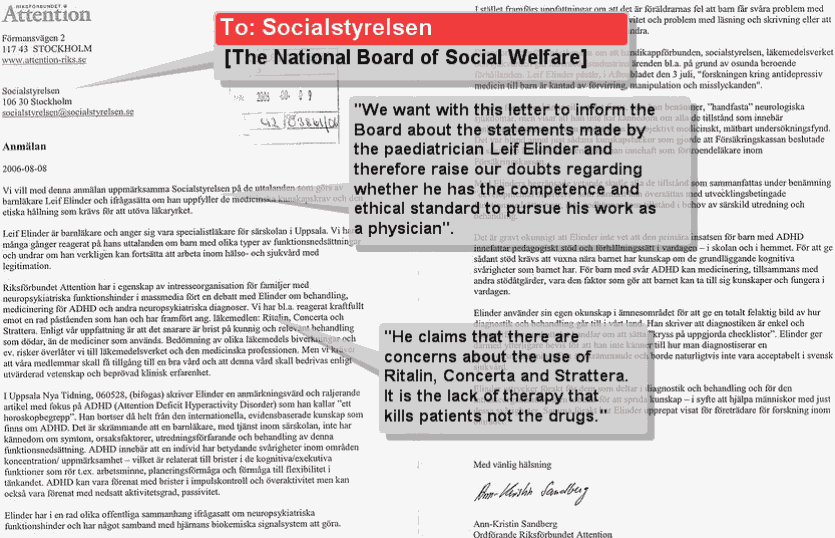
4) They then placed a formal complaint with the National Board for Education and the body that licenses doctors in Sweden about Elinder (not Gillberg).

Swedish Radio 17 Aug 2006 reported that:
Ann-Kristin Sandberg, Chairman for the Riksförbundet Attention had approached both The National Board of Social Welfare (Socialstyrelsen, the body that registers doctors in Sweden) to "investigate whether the Uppsala physician Leif Elinder, known for his controversial views on ADHD should be allowed to keep his doctors certificate". "The organisation has the view that the National Board of Social welfare (Socialstyrelsen) should investigate Elinders suitability as a physician" "This spring he wrote an article for the newspaper in Uppsala where he called ADHD concept a horoscope. This was the final straw and it was taken as an insult towards our members who are suffering from the symptoms."

5) Similarly the Swedish newspapers (Publicerad: 2006-06-08) reported that:

"The view of the Attention society who strongly attacks Leif Elinder who calls ADHD a horosope concept. For this reason the Attention society, an interest organisation for people with neuropsychiatric disabilities such as ADHD have sent a petition to Skolverket to attempt to consider whether Elinder can pursue his work in his field"

6) Riksförbundets Attention wrote to Socialstyrelsen in an attempt to get Elinder struck off. That letter is here (click on images for larger versions):

Click to expand

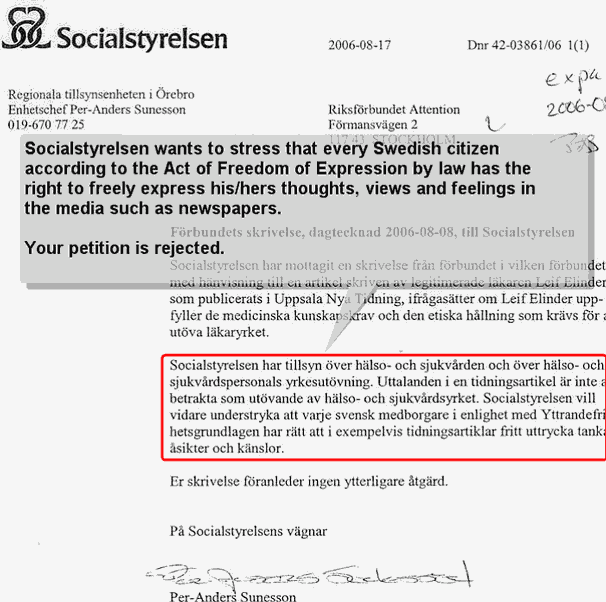
Socialstyrelsen replied quite appropriately telling Riksförbundets Attention to get lost:

Click to expand

7) Gillberg as well as his wife (Carina) wrote intimidating letters to about a dozen member's of Elinder's family, but Riksförbundets Attention didn't comment on the appropriateness of this either.

Click to expand

8) In the meantime the website of Riksförbundets Attention states that they get extensive funding from a variety of pharmaceutical companies. Dr Björn Kadesjö is one of three members of their medical advisory board. This same Kadesjö has co-signed commercial pharmaceutical confidentiality agreements with Gillberg (link). Kadesjö has published 14 papers with Gillberg about ADHD (link) constituting Kadesjö's entire research output.

Woe be to all of us.

Earlier|Later|Main Page

Sunday, April 29, 2007

Dr David Kern's "dilemma" - learning from history

In November 1996 Dr David Kern, Professor of Occupational Health Medicine at Brown University in Rhode Island received a letter.

Dr Kern's dilemma

The integrity of medical research is under threat. Many cases have arisen which have demonstrated the inclination of our profession to act in a way that damages both science and the interests of the patients we serve. In many instances, organizations charged with maintaining integrity have colluded, almost routinely, to pervert science, to bully those raising concerns, and to obscure problems. These organizations include our medical Journals, professional regulatory bodies, drug regulators and even formal bodies devoted to maintaining "integrity".

The story of Dr David Kern and the "dilemma" of flock workers' lung is one of many such stories. The letter mentioned Kern's "dilemma". The problem was that Kern had no dilemma. Kern knew that the integrity of a doctor is paramount. The dilemma was one for Brown University.

What happened to David Kern is a stain on the reputation of Brown University. In 1994 Kern reviewed a patient with unusual lung disease. He wondered whether the disease might be due to occupational exposure. Kern visited the patient's place of work - Microfibres Inc. Before visiting he signed a standard confidentiality agreement forbidding the disclosure of any "trade secrets" he might discover during his visit. Over the next two years at least 6 more cases arose, and Kern believed he had sufficient evidence to prove the existence of a new lung disease. He informed the company of his decision to publish his findings, initially in the form of an abstract at the annual meeting of the American Thoracic Society in May 1997.

In response to this, Microfibres Inc., threatened to sue citing the confidentiality agreement prohibiting disclosure of any "trade secrets". However occupational lung disease is not such a "trade secret". The associate Dean of Medicine, Paul Shank attempted to force Kern to withdraw his abstract, and to prevent publication of the findings. Kern refused. He next received correspondence from Francis Diez, president of Memorial Hospital instructing him to withdraw. The hospital, the letter added, was shutting down his entire program "effective immediately". Shamefully, six months after the actions of Shank and Diez, Brown University pretended in a duplicitous statement that they had supported Kern's academic freedom and integrity all along. Less than a week after that, Kern received a letter informing his that his teaching and research positions had been eliminated. Brown University appeared to see nothing to gain from honest research or medicine. Microfibres’ owner and two relatives sat on the hospital’s board, and the company had helped to fund the hospital’s facilities.

University obfuscation in the Kern case was damaging both to our profession and to our patients: In the words of Dr Kern:
Extracts from speech delivered at MIT March 29, 1999

"A small group of Brown University faculty members rallied and called for university administrators to take a principled stand. Instead, the Dean of Medicine hand-picked a Committee of Inquiry comprised of two associate deans whose subsequent report side-stepped nearly every critical issue."

"Moreover, far more important issues such as the suppression of scientific findings critically important to public health and interference with a physician's responsibilities to care for his patients were not addressed at all."

The ATS [American Thoracic Society] admonished: "Barriers to the open communication of scientific information must be resisted. In particular, the threat of litigation and/or elimination of financial support to prevent the open communication of scientific information is abhorrent."

Democracy can coexist with the belief that all humans are sinners but not with the belief that all sins are equal. Democracy has within each of its camps, not excluding the civilitarian camp, thugs in number. And when you're in an argument with a thug, there are things much more important than civility."

I do not like incivility. Yet, I like thugs even less. What I am asking, rather, what I demand of us all is honesty and truth. For without honesty and truth, there is nothing.

In my case, representatives of the company, the hospital, and Brown University have gone to great lengths to distort the truth. Yet, even were their claims true, their points of contention are irrelevant to the critical issues that remain (a) their attempts to suppress the dissemination of scientific findings critically important to the public health, (b) their interference with my professional responsibilities to care for patients, and (c) their immediate termination of the state's only occupational health program.

And so, we are left confronting arrogance, dishonesty, and a callous disregard for the health of workers. While our medical school and university administrators continue to proclaim their dedication to truth, to the search for knowledge, and to the advancement of civilization, it is all pretense as wordsmithing triumphs over truth and as knowledge is buried. What makes such pretense infuriating goes beyond hypocrisy to the failure of these administrators to realize that people's lives hang in the balance. They either fail to appreciate or are unwilling to acknowledge that their words and actions have jeopardized the health of individual workers, have contributed to the potentially irrevocable loss of an opportunity to advance both scientific understanding and the public health, and have undermined the collective sense of trust and mission in our academic community.

For more information about David Kern see:

  1. New Disease, Old Story. Annals of Internal Medicine 15 August 1998 129(4) Pages 327-328 (by Frank Davidoff, Editor)
  2. Transcript of a speech by Dr Kern, Delivered at MIT, Cambridge, MA, March 29, 1999
  3. Objectivity Lost: University Industry Science Collaborations
  4. David G. Kern, Robert S. Crausman, Kate T.H. Durand, Ali Nayer, Charles Kuhn III. Flock Worker's Lung: Chronic Interstitial Lung Disease in the Nylon Flocking Industry. Annals of Internal Medicine 15 August 1998 Volume 129(4) 261-272 [Full Text]

Earlier|Later|Main Page

Tuesday, February 13, 2007

Suppression of dissent - the British Psychological Society turns off the lights

British Psychological Society in troubleWhat exactly is the role of the British Psychological Society (the representative body for psychology and psychologists in the UK)? Bloggers have been writing about the apparent attempt by the BPS to discredit the respected psychologist Lisa Blakemore-Brown and to have her officially pronounced "mentally disturbed" and "unfit to practice" (1,2,3,4,5,6,7,8, 9,10,11,12,13,14,15,16,17,18).

Blakemore Brown has unpopular views about autism, drug use, some powerful paediatricians, accusations of parental child abuse, some paediatric research, vaccines and the manipulation of patient "support" groups by the pharmaceutical industry. The BPS are attempting to declare her "paranoid" for believing things which are quite evidently believable to all of us who have examined the evidence in her case. Blakemore Brown appears as sane as the next person working in this controversial area.

For an example of her "controversial" writing see here: [Link].

The BPS have also allowed the nature of the "charges" to be misrepresented in public while refusing to allow her to i) discuss her own case, ii) present her case at an international meeting, or iii) publish the transcripts of her trial. The BPS have threatened legal proceedings if Blakemore Brown breaks their "copyright" on what they have done to her.

If Blakemore-Brown did do anything seriously wrong in terms of patient care, then charges should be examined in detail, and criticism should be transparent - but we have seen no evidence of this in the charges she faces. Nor has Blakemore Brown been allowed to address the misrepresentation of the charges in the only way possible - by discussing what they are.

These procedures have been likened to a 21st Century Salem Witch Trial and threaten to shut down all debate. I don't have to agree with her in order to be repelled by what is happening. This is not how debates about policy or science should work.

The BPS have reportedly spent a half a million pounds of members money and public funds on Blakemore Brown. Given our reading of the transcripts it is hard to work out how they perceive this to be in the interests of the public, their members, or scientific discussion.

Other complaints about the BPS are surfacing. The BPS have a strangely selective approach to integrity. While psychology and psychiatry are convulsed with problems of a very serious nature (see AHRP Blog, Furious Seasons, Clinical Psychology blog) the BPS has nothing at all to say about them - from the hiding of documents about the antipsychotic drug Zyprexa [Link Link] to the ongoing concerns about manipulation of information about suicide risk with SSRI antidepressants [Link]. However when Blakemore Brown asserts that that a certain pharmaceutical company is influencing a patient support group the BPS take this as diagnostic of "paranoia". Some education seems in order.

In the meantime an interesting letter appeared in the February 2007 issue of the Psychologist. I reproduce the writer's E-mailed version of it:
The BPS - value for money in the public service?
The Psychologist, February 2007


Sir

The BPS regularly refers to its duty to the public when defending itself against i) accusations of failure to support its members, ii) ostentatious advertising of members under a cloud and iii) being over-expensive.

I no longer subscribe to such a defence. Three times, spread over some years, I have sought either support or guidance on ethical matters. On none of these occasions was I offered any.

In the last instance, when I told officials that I was being repeatedly and overtly pressurised to falsify research findings for a public project, I was told that 'we don't give legal advice' and that I should consult the Code of Ethics. Apart from the fact that there is little in the Code of Ethics about corruption, other than an urging of the practitioner to behave professionally, I don't see why some guidance was not forthcoming. I was in touch with members of the BPS with responsibility for regulations and ethics; if all that is necessary is already on the web site, then I think there is a certain amount of redundancy in the organisation.

In short, I don't think members' subscriptions are benefiting the public and I think reorganisation, rethinking and refunds are in order.

Yours Sincerely

Cole Davis
Chartered Occupational Psychologist, London NW2

Now this is an organisation which spends vast amounts of money pursing bizarre charges of paranoia against Blakemore Brown yet fails to engage with serious problems that are widely discussed or presented to them.

The BPS is not the only professional body that has a problem with integrity. The General Medical Council is an interesting organisation which takes selective action against some (often Asian) doctors for doing silly things, while very serious "indiscretions" of senior members of the old-boys club are quietly ignored by powerful colleagues through a process of deceit, delay and secrecy (see my own complaint here, and further discussion here and here)

The actions of the British Psychological Society are especially reprehensible given the many mothers Blakemore Brown has helped, and that they were fully aware of the tragedies in her personal life. I end with three quotations as tribute to the courage of Lisa Blakemore Brown.

"If they can get you asking the wrong questions, they don't have to worry about the answers."
(Pynchon T, 1995 Gravity's Rainbow. ISBN 140188592)

""It's hard to get someone to believe something when their job is dependent on not believing it"
(Al Gore, An inconvenient Truth)

"The greatest evil is not now done in those sordid 'dens of crime' that Dickens loved to paint. It is not even done in concentration camps and labour camps. In those we see its final result. But it is conceived and ordered (moved, seconded, carried, and minuted) in clean, carpeted, warmed, and well-lighted offices, by quiet men with white collars and cut fingernails and smooth-shaven cheeks who do not need to raise their voices. Hence, naturally enough, my symbol for Hell is something like the bureaucracy of a police state or the offices of a thoroughly nasty business concern."
(Preface to The Screw Tape Letters, C. S. Lewis)

Earlier|Later|Main Page

Wednesday, January 31, 2007

A statement from Lisa Blakemore Brown

I have already posted about the victimization of Lisa Blakemore Brown by the British Psychological Society. Since then the case has been discussed by many concerned bloggers, and commentators on those blogs (See for example here here here here here here here). Here is a statement from Lisa dated today, 8am, the day of her "trial".

PUBLIC STATEMENT - LISA BLAKEMORE BROWN
31 January 2007 8:00 am


It is my view that the British Psychological Society have pursued vexatious complaints against me from sources of dubious credibility. This year will mark 10 years since I first encountered harassment from the British Psychological Society. I will not discuss this harassment here in detail, because it is obvious.

Instead of investigating my concerns, the Society sought to use an aged method of discrediting the messenger - abuse the stigma of mental illness. I find the accusations against me to be insulting, defamatory and malicious. Many members of the public believe it is comparable to the method used in a Totalitarian Regime. The BPS has a mandatory role to investigate the serious issues raised in the public's interest. Yet, as a authority it has been misled by various individuals, some with a criminal past and has sought to victimise me for expressing my honest views on the ethical issues affecting the public.

Over more than a decade I have raised a number of issues surrounding the management of children with ADHD, Asperger syndrome and Autism. I have discussed the difficulty of pigeonholing children into these diagnostic categories through my metaphor of the tapestry. Each child is different. I have also discussed Munchausen’s syndrome by proxy. I have challenged academic thinking about some of these problems in my writings, in court, in helping individual families facing legal challenge, and in my professional practice. I have mentioned that all is not well with our scientific evidence underlying the issue of vaccines and their potential side effects. I know that many people agree with my views. Some of my views may well be wrong. But that is what academic debate is all about.

The British Psychological Society will know full well that many of the things I have raised are correct. They will also know full well that many of the matters I have raised with regard to the manipulation of these procedures are correct, and have been shown to be so. And yet you have accused me of being paranoid based on my stating of the obvious. That was the charge panel members.

I believe that the BPS has behaved very badly. They have misused psychiatric assessment. They have contributed to the distortion of academic debate, and they will have contributed to the fear that professionals feel of challenging the unknown. In so doing the BPS has also failed the public. This is Soviet psychiatry at it’s worst, and we do not expect that in 21st Century Britain.

Thank you


Addendum: 1pm 31 January 2007: I am informed that the British Psychological Society have threatened legal injunction to prevent publication of the transcripts of these hearings. Having read the case transcripts, I find them most extraordinary. They read like an encyclopaedia of legal and psychological abuse. They also represent the most fundamental manifestation of the abuse of science and suppression of dissent. The British Psychological Society should be ashamed. The BPS should immediately make them available for public scrutiny. A.B

Earlier|Later|Main Page

Thursday, January 11, 2007

Actonel hamburgers and cows - a reply from the P&G Vice President

Larry Games, Vice President at Procter and Gamble Pharmaceuticals has replied. For previous correspondence and the letter to which he is replying see Let's take the high road Dr Games and Letter to Dr Games. For an executive summary of the background see AAAS Professional Ethics Report or Slate or Press reports or the rest of this blog.

These issues go to the heart of science and the responsibility of scientific authors. His reply and my reply to his reply are below. Dr Games has promised to write back again to explain what Procter and Gamble mean by "access to data" given repeated refusal to provide it to authors (see some part of that here). One approach might be to redefine the meaning of either the word "access" or "data" to fit with statements made to journals. We await his further reply with interest.

In this case the data was randomization codes. Access to data means that you have those codes. Its as simple as that. And we are talking here about access to data by authors not random other interested scientists. Access does not mean that someone else has told you as author what those codes might mean. In the words of one blogger its like being offered a hamburger when what you need is the original cow. PloS medicine blog has a useful interchange on access to data. Readers may wish to comment here as to what "access to data" means to an authoring scientist.

The relationship between the hamburger purporting to represent data (P&G's graphs and statistical analysis in one paper, two draft papers, and at least 5 meeting abstracts) and the actual cow (when data was finally revealed to authors in 2006) is interesting.

Dr Games's further definition of access to data is awaited. He might also explain again why he thinks anyone will be satisfied by this ongoing hamburger when journal editors and all other investigators out there who have expressed interest are still not allowed to see that cow (apart from me and a few other statisticians of course who have seen that beast). Of course its that proprietary right to represent that proprietary data in whatever half cocked manner one likes, and then to use the academic authors who generated it to front it for you. Never mind that this involves a critical aspect of science involving a licensed drug and the original studies used to gain approval for that drug.


To: Aubrey Blumsohn
Subject: Re: Actonel Studies Sheffield
From: games.lm@pg.com
Date: Wed, 20 Dec 2006 15:44:54 -0500

Dear Dr. Blumsohn,

Thank you for your letter of November 23, 2006. The following responds to your questions in that letter. In reference to your December 15 note attached below, you can send the abstracts and statistical reports to me.

You have asked that we permit you to share with third parties the data that we recently provided to you (and to which you were provided access prior to your presentation of the research at scientific meetings in 2003). As noted in my previous letter to you, this proprietary data was provided to you in good faith to allow you to repeat your original research, and should not be shared with third parties without our consent. However, as I indicated earlier we would be willing to discuss the need with the organization to whom you are submitting the abstracts. If you forward any request for the data to me, I can ensure legitimate needs are met while protecting our proprietary rights. I would of course copy you on that transmittal, so that you could verify that the correct data was provided.

Since you were not involved in the research related to the article that appeared in the Journal of Bone and Mineral Research in 2003, it would not be appropriate to provide you with the data used in that publication. Some of that data (e.g., CTx data) was not part of your research with us. However, we have in response to your allegations provided that data to the academic authors of that article, to allow them to respond appropriately. It is our understanding that the original authors are working with the JBMR and would presumably publish their findings. If you have questions about that article I suggest that you contact them or the editors of the JBMR.

Sincerely,

Larry Games
Vice-President R&D
P&G Pharmaceuticals


Dr Larry M Games
Vice President
Procter and Gamble Pharmaceuticals
Health Care Research Center
8700 Mason-Montgomery Road
Mason, Ohio, 45040
USA 21 December 2006

[Attachment here]

Dear Dr Games,

Thank you for your response (below).

  1. Although predictable, I am disappointed that the wrong road appears to have been taken.
  2. I will shortly transmit several meeting abstracts written using the randomization and event codes you provided in April 2006.
  3. You state data "should not be shared with third parties without our consent". The point of my letter of 23 November was precisely to request such consent. The message conveyed by refusal is obvious.
  4. It is now known that P&G mis-described that data in my name in an obvious way. Some of that was admitted in 2003/4 but corrected publication was impossible without data. P&G then tried to alter the hypothesis and mode of analysis in retrospect. P&G also mis-described the subset of that data which forms the NTX component of the Eastell 2003 paper. Two further publications mis-describing that data (in my name) would have been transmitted to journals in 2004 had I been willing to sign the draft publications written by P&G. Under such circumstances commercial confidentiality has little place.
  5. I was intrigued by the image you provided of the editor of JBMR "working with" the authors of the first of the three papers to deal with the issue of pharmaceutical research misconduct (having first declined to scrutinize the evidence or statistical reports related to that paper and other abstracts). I am aware that P&G's looming presence might well have led to this unbelievable situation. Quite what questions he is expecting the authors to answer I have no idea. Perhaps not the questions asked?
  6. Apart from limited public access, I repeat that refusal to allow an author to transmit data to a journal editor is unreasonable, particularly under the current circumstances. It is also not appropriate to suggest that a commercial company would interact with that editor directly to "resolve" any difficulties. Should there be any attempt to avoid proper description of these data I would be inclined to instruct my legal representative to release the version of the data provided to him.
  7. I am interested in your comment with regard to the meaning of "access to data". Attempts to distort and confuse language and events has no place now. You continue to state: "and to which you were provided access prior to your presentation of the research at scientific meetings in 2003".

Some of Professor Eastell's correspondence about the denial of data is attached to provide some reality-check for those copied in here. [Attachment here]

Kindly define the meaning of the word "access" so that we can be certain we are speaking the same language. If you mean access to data in the usual scientific (and linguistic) sense, and in the sense conveyed by Journal declarations, please share with me how this accords with the following examples:

  • Richard Eastell's correspondence with Ian Barton on 27 May 2002 complaining about absence of access to data (4 weeks after submission of the Eastell paper to JBMR).
  • Ian Barton's correspondence of 14 June 2002 refusing data (6 weeks after submission of the Eastell paper to JBMR).
  • Mike Manhart correspondence of 13 July 2002 refusing data (8 weeks after submission of the Eastell paper to JBMR).
  • Ian Barton's correspondence of 10 June 2003 about refusal of data
  • Ian Barton correspondence of 19 June 2003 and associated communication with Richard Eastell about refusal of data
  • Communication with Ian Barton on 1 Sept 2003 about refusal of data
  • Communication with Richard Eastell on 10 September 2003 about refusal of data
  • Failure of any data provision in response to my letter of 24 May and 26 May 2004 about refusal of data.
  • Professor Eastell's letter to me of 13 December 2004 (also conveyed by him to McKay Law and the General Medical Council) attempting to rationalize why P&G/Aventis were denying data [Attachment here].
  • Response of Professor Eastell to letter from McKay law of 25 May 2005 (transmitted to McKay law and also by Professor Eastell himself to the General Medical council) stating that he too was unable to get access to the data, and was aware that I had been asking for it repeatedly [in attachment].
  • Your own response to a letter from McKay Law of 25 May 2005 asking for data.
  • The legal "threats" conveyed to the University of Sheffield in March 2006 and from them to myself and my British Medical Association representative that I apparently had "information in [his] possession" that "belongs to Proctor and Gamble" and that it was the view of P&G and the University that I "may have taken data from Proctor and Gamble without their consent" and that "Following contact from Proctor and Gamble's lawyers it is clear that he does not have their consent to retain this information" and that I had to return it to Procter and Gamble "including any copies he has taken".

Of course we all know I did see some tabulated and graphical summaries of data produced in a meeting with Ian Barton in 2003 (and produced three simplistic graphs myself under scrutiny during that meeting) --but those analyses raised substantial questions, several of which were admitted by Ian Barton. None of these questions were amenable to being addressed (until your provision of data in April this year).

This does not in any way constitute access to data.

Nor was it possible to publish the corrected findings (until your provision of data this year). Instead there was an attempt to hide the worrying findings by altering the mode of analysis and the study hypothesis to look at t-scores!

In summary I have three specific questions

A) Please explain what you mean by "access" to data in the light of these correspondences and P&G's Bill of Rights of February 2006?

B) Please explain why P&G felt it appropriate to issue legal threats to return data as conveyed by the University of Sheffield to me and my BMA representative in March 2006?

C) You reiterate that the data "should not be shared with third parties without our consent". Please respond to my request for such consent.


That high-road is still there Dr Games.

Kind Regards

Dr Aubrey Blumsohn
MBBCh, PhD, MSc, BSc(hons), MRCPath
Earlier|Later|Main Page

Thursday, November 09, 2006

Operation Sisyphus

Sisyphus is a hero of Greek mythology (1), condemned to roll a large rock up a hill. Upon reaching the top the rock rolls back, and the task has to be repeated - endlessly. The story appears to be one of eternal and pointless labor.

One reader suggests that raising issues of pharmaceutical research misconduct is a pointless Sisyphean task (2) - that this whole field of science is already kaput. It sometimes feels that way (3,4). But the story of Sisyphus is not one of unending misery. Despite the best efforts of the gods, they cannot beat him (1).

Fellow medical bloggers are writing about the way in which the pharmaceutical industry is preventing proper understanding of the science upon which our patients rely (5,6,7,8,9). They write about the way in which industry has subverted those organizations whose task it is to act for our patients to preserve integrity.

But we are attacking the wrong beast.

The beast is not the industry - it is ourselves.

Pharmaceutical companies sell products under the banner of science. But their raison d'être is to make money. Industry has to balance genuine hypothesis testing and transparency against commercial interests and the financial consequences of dishonesty. This is not in itself a criticism - it is a simple fact.

We, as doctors, have created the atmosphere which has allowed lethal system malfunction. We have allowed industry to subvert the rules of science and the free-market. We have watched quietly as governments and academics have colluded with industry to hide information critical to our patients. We have remained silent as our medical schools churn out graduates who have no knowledge of the dilemmas and scandals of medicine. We have allowed our medical journals to become corrupted and timid. We have remained silent as our General Medical Councils have taken action against brave doctors for raising questions of integrity (10). We have said nothing while these old-boys' clubs have selectively ignored serious concerns brought to their attention (10) - apparently based on the status and race of those criticised (10,11). We have failed to support our colleagues who have raised concerns. We have said nothing.

I have been waiting very patiently. It is now seven months since Procter and Gamble provided previously suppressed data underlying three intended "ghosted" publications to myself, to the University of Sheffield and to other authors in whose names "science" was ghostwritten (12). The discordance between the data and the ghosted interpretations of that data (in our names) will have been obvious even to the most incompetent of statisticians. The unethical nature of the scientific process will also have been obvious to any observer.

Yet the first of these papers that was published in the names of others (J. Bone. Miner. Res. 2003; 18:1051-6) has not yet been retracted. There has been no comment about the attempts by a senior academic to force a colleague to sign journal declarations in the absence of data - even more important given the status of that senior academic as guardian of research governance within a prestigious medical school. There has been no comment about the ethics of denial of access to data, and about the signing of incorrect declarations to journals about access to such data.

The University of Sheffield has admitted that legal threats were made by Procter and Gamble about return of data that the company "owned" and which had been "obtained without their consent", but have otherwise not commented upon the principles involved

The obvious (and comparatively painless) step of declaring a wrong, and of correcting it, has not yet taken place. There has been no comment at all from those who should comment.

I have waited quietly as the various bodies to whom the matter was referred have done nothing of any relevance.

Once in a while Sisyphus shrugs (13).

How
(John Lennon)

How can I go forward when I don't know which way I'm facing?
How can I go forward when I don't know which way to turn?
How can I go forward into something I'm not sure of?
Oh no, oh no

How can I have feeling when I don't know if it's a feeling?
How can I feel something if I just don't know how to feel?
How can I have feelings when my feelings have always been denied?
Oh no, oh no

You know life can be long
And you got to be so strong
And the world is so tough
Sometimes I feel I've had enough
  1. The Myth of Sisyphus by Albert Camus
  2. Resistance is futile
  3. http://www.slate.com/id/2133061/
  4. http://www.thejabberwock.org/presshw.htm
  5. Health Care Renewal
  6. Pharmagossip
  7. Clin Psych
  8. Pharma Watch
  9. Peter Rost
  10. The General Medical Council - a Personal View (Wilmshurst)
  11. Wikipedia General Medical Council
  12. AAAS: http://www.aaas.org/spp/sfrl/per/per46.pdf
  13. http://www.amazon.co.uk/Atlas-Shrugged-Ayn-Rand

Earlier|Later|Main Page

Wednesday, July 12, 2006

Public relations versus public interest

This blogger wonders why Ketchum, a public relations company had 375 hits on this blog? Watch this space.

"Ketchum’s European presence covers all major commercial, political and media centers and regionally services Kodak, Procter and Gamble, Roche, Whirlpool, Samsonite and FedEx."

http://www.slate.com/id/2133061/

Earlier|Later|Main Page