Thursday, October 05, 2006

Drug watchdog fails the public

The highly respected UK publications Which (formerly the Consumer's Association) and its sister publication Drug and Therapeutics Bulletin (DTB) have long pointed out the failure of the MHRA (the UK drugs regulator) to act in a transparent manner or to provide reliable and timely information to doctors. DTB has always been wholly independent of the pharmaceutical industry, Government and regulatory authorities. Earlier this year, the Labour government pulled funding for distribution of DTB to doctors without any consultation (Hansard) attenuating this reliable information source. Why it did so can only be guessed.

Which? (October 2006 issue) continues to highlight the problems, touching also on the Sheffield MHRA "investigation". At least someone is stating the obvious.


Earlier|Later|Main Page
Tuesday, October 03, 2006

Union of Concerned Scientists Cartoon Competition

A winner has been announced.


Please support the Union of Concerned Scientists

Earlier|Later|Main Page

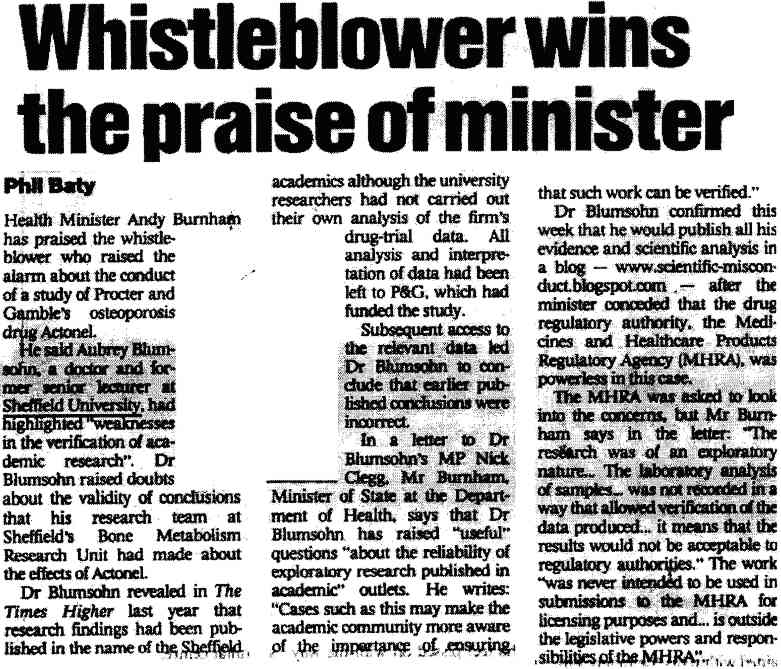
Thank you for the praise Health Minister Burnham

To: Mr Andy Burnham
Minister of State, Department of Health
The House of Commons

blumsohn gets praise from ministerI don't really need praise Health Minister Burnham. I would however be appreciative if you could reassure me you are doing all you can to ensure that the system designed to ensure integrity in medicine is operating as doctors and patients would imagine it should: - honestly, without intimidation and in a transparent manner. You will be aware of serious concerns that have been raised by others about the Medicine and Healthcare Products Regulatory agency - MHRA (1, 2, 3, 4) the General Medical Council, and the influence of the pharmaceutical industry on scientific debate (3, 5).


For your information I reproduce a paragraph of text from a forthcoming Journal article (6) about the functioning of the MHRA in the Sheffield case. It has also appeared in abbreviated form in Healthwatch (7) this week. I will be writing to you about this with further details shortly.

"The Sheffield dispute was discussed in the UK parliament in December 2005 and was transmitted by the Health Minister to the UK drugs regulator (the Medicine and Healthcare Products Regulatory Agency, MHRA) for "investigation". The MHRA is itself accused of failing to examine or to secure raw data in drug licensing applications, simply accepting the word of industry with blind faith (8,3). Since this was precisely the problem in Sheffield, its disinclination to investigate was hardly surprising.

No investigation (or at least anything fitting that definition) took place. The MHRA failed to produce any report, declined to accept any documentary evidence (9, MHRA response to FOI request #06/115), stated that the matter was of "low priority" (9), and that the agency does not have any procedure for investigating research misconduct (MHRA response to FOI #06/188). Further, it claimed that the drug regulator has no remit, nor any necessary obligation to be interested in the integrity of the scientific literature about drugs (9, MHRA FOI #06/188) unless related to licensing (and collected using documentation appropriate for licensing). It even argued that it is "illegal" for a scientist to have data pertaining to information written in his name without the consent of the company "owning" that data (9,MHRA FOI #06/115). It refused to compare data it was sent from Sheffield with the original data it should have received and examined as part of the licensing process for Actonel. Initially, this refusal was on the basis that it would be "too much work" (MHRA FOI #06/059). Later, it admitted that that it had not in fact seen or retained raw data prior to approving the drug (MHRA FOI #05/404). With governments setting the standard for scientific conduct, it is hardly surprising that independent science has encountered such difficulties. "


Yours Sincerely

Dr Aubrey Blumsohn
MBBCh, PhD, MRCPath

References
  1. MHRA continues to duck weave and delay
  2. MHRA -Why is the government not acting
  3. House of Commons Health Select Committee Report, April 2005
  4. Did MHRA Collude over SSRI's
  5. Evans and Boseley, The Guardian, September 28, 2006
  6. To follow
  7. Healthwatch Highlights
  8. Healy,D. Did regulators fail over selective serotonin reuptake inhibitors? BMJ 2006:(333):92-5
  9. Collated media reports, Sheffield case

Earlier|Later|Main Page

Friday, September 29, 2006

This is what we are up against - The fall of pharmaceutical medicine

The integrity of the scientific literature relating to pharmaceutical products is heading, like the Titanic, towards an iceberg of enormous size [ref, ref]. If you are wondering why, here is a primer. In an astonishing article in the Guardian this week, journalists Boseley and Evans reveal what has been happening at the heart of British government.
burnhamDrug firms' lobby tactics revealed
Evans and Boseley, The Guardian, September 28, 2006

"In May, the health minister Andy Burnham met Peter Dolan, then chief executive of Bristol-Myers Squibb and chairman of the Pharmaceutical Research and Manufacturers of America (PhRMA), the powerful industry body in the US." "Over the eight months from October to May this year, senior executives from 10 drug companies met ministers to press for favourable decisions on their products."

"Documents obtained by the Guardian under Freedom of Information legislation reveal that": The world's biggest drug company, Pfizer, warned ministers that it could take its business elsewhere. "Pfizer ... noted that there is complacency in some quarters of Whitehall regarding their continued investment in the UK," the minutes of the meeting record." That sounds like blackmail to me.

A memo also reports the summing-up of the view of Johnson & Johnson: "NICE should take into account what the companies see as the overwhelming views of patients, carers and clinicians on the efficacy of the drugs." "Pfizer asked for more public support from the government for a robust pharmaceutical industry in the UK."

Bristol-Myers-Squibb director of external affairs stated "companies want to invest in countries with a 'favourable environment.'"

I wonder who pays those those patient groups and those clinicians? I wonder who pays those academics and journals who publish selective or distorted findings? I wonder who funds the whole system of thought in medicine? I wonder who pays those guideline writers and even kids and teachers for that supposedly "overwhelming view"? Pfizer and its friends perhaps?

It stinks. The scientific method, that supposed cornerstone of Western civilization, has been replaced by the political method. This is characterized by a fuzzy relationship with reality, conflicts of interest and outright lies.

The statement, from the preface to C. S. Lewis's "The Screw Tape Letters" could serve as a summary of all that that is wrong:

"The greatest evil is not now done in those sordid 'dens of crime' that Dickens loved to paint. It is not even done in concentration camps and labour camps. In those we see its final result. But it is conceived and ordered (moved, seconded, carried, and minuted) in clean, carpeted, warmed, and well-lighted offices, by quiet men with white collars and cut fingernails and smooth-shaven cheeks who do not need to raise their voices. Hence, naturally enough, my symbol for Hell is something like the bureaucracy of a police state or the offices of a thoroughly nasty business concern."

That is what we are up against. It is not about that overwhelming view of "patients careers and clinicians". It is not about the free market or about innovation. It is not even about honest science, honest Universities, honest government or honest drug regulation. It is about power and the golden rule in a monopolistic and distorted market - he who holds the gold and the ear of government rules.

See also the excellent discussion at Health Care Renewal about the Guardian report.

Earlier|Later|Main Page

Wednesday, September 06, 2006

What have they got to hide? The Famciclovir case

ghost writingPending further description of methodology in Sheffield Actonel studies, my attention was drawn to a similar scandal in another parallel scientific universe. It involves the drug Famciclovir (Famvir) and is discussed at Pharmawatch and Healthcare Renewal.

Famvir is used for treatment of herpes zoster, and genital/labial herpes. The case involves a nine year delay before partial publication of findings which had adverse implications for the sponsor. As in the Actonel case, it also involved protracted denial of raw data to academic authors. The study and editorial were finally published a few weeks ago (1,2).

The authors relate that (1):
"....companies are understandably wary of devoting resources to a report that is not in favor of their product. Although we received data tables and listings for this study, we were not able to obtain data tapes to verify the analyses and to conduct what we consider the most clinically relevant analyses"
Dr Wald, the first author, notes in correspondence that:
"We asked for raw data and we were not given it. Initially, we were told that the company has other priorities and that they have not looked at the data. Then company has changed hands and we were told that they no longer had it. But we were given the summary tables and report from which i wrote the paper. The whole process took several years."
Should we as clinicians really be prescribing Famciclovir given this corporate approach to science, and given that we don't really know what was hidden from the authors?

The response of the medical profession and medical ethicists to such problems has been feeble. EBM specialists who collect Clinical Evidence scrupulously fail to document attempts to control, suppress or delay that evidence. It is also puzzling that the drug regulators have no interest in contamination of the scientific literature upon which doctors and patients rely. The malaise is reflected in the recent puzzling assertion in the UK that the drug regulatory body (MHRA) has no remit to investigate or to be concerned about allegations of scientific misconduct or contamination of the scientific literature after a drug is licensed. What then are they for?

We would do well to remind ourselves of the story of Betty Dong and the "thyroid storm" (3, 1996 Editorial in Science, another Editorial)
In 1990, Dong, a researcher at UCSF was funded by Boots to carry out research on a widely use thyroid treatment (Synthroid). She discovered the Boots drug was no more effective than three much cheaper competitors. When she tried to publish, Boots threatened to sue. The publication was withdrawn. She received no institutional support. Company executives attempted successfully to publish an inaccurate version of the findings while excluding Dong and threatening legal action. Nine years later the sordid details were exposed in the press and Dong’s paper was published. In 1999/2000 the company paid $170 million to settle class action lawsuits. However it is estimated that the company made a profit of $3billion in inflated costs during the nine year delay. No company executives were prosecuted. The regulators turned a blind eye.
  1. Wald A, Selke S, Warren T et al. Comparative efficacy of famciclovir and valacyclovir for suppression of recurrent genital herpes and viral shedding. Sex Transmitted Dis 2006; 33: 529-533.
  2. Fife KH. Are the antiherpes nucleosides really all the same? Sex Transmitted Dis 2006; 33: 534-535
  3. Rennie D, "Thyroid storm" JAMA, Apr 1997; 277: 1238 - 1243

Earlier|Later|Main Page

Saturday, September 02, 2006

Procter research shenanigans 8: A lawyer writes to Eastell

For background to allegations of research misconduct involving the drug Actonel see here , here and here. There were three elements to the problem:
  1. A pharmaceutical benefactor (Proctor & Gamble) repeatedly refused to provide raw data including randomization codes to academic "collaborators". Codes were required by the academics to interpret data they had generated. The academics were unable to verify statistical analyses, meeting abstracts, one published paper and two draft publications "ghost written" in their names.
  2. Study data was provided to authors 3 years later (in early 2006) following press exposure. "Fair" analysis of the data would not have yielded findings desired by the sponsor.
  3. There were multifaceted and intriguing attempts to prevent the problem from being raised or discussed.
This entry summarizes another of the many noteworthy excuses for refusal of access to data.

The legal request:

On May 25 2005 McKay LAW wrote to Professor Richard Eastell. Eastell was the supposed author of the first of three intended P&G publications related to the work. He was senior author on meeting abstracts (1,2) and two related draft publications intended for submission. The legal letter requested raw data underlying the abstracts and the two related draft publications which were "on the table". It also requested data underlying Eastell's previous publication based on a subset of the same data.

law to eastell

The reply:

The reply received from Eastell's legal representative is below: It reiterated that he too had requested the data and had been refused. It justified the denial of data on the basis that "It belongs to the pharmaceutical companies".

eastell admission 4
See original copies of letter and reply in Acrobat format.
  • This ignores the difference between supposed ownership and access.
  • It ignores that the Inability of an author to supply raw data would constitute prime facie evidence of research misconduct.
  • It ignores the explicit conditions of submission to any respectable medical journal.
  • It ignores that statements had already been made to a journal confirming full access to data (see appendix to JBMR 2003 18(6) 1051-6 and BBC broadcast ).

References - Abstracts underlying intended publications
  1. A. Blumsohn, IP Barton, A Chines, R Eastell Relative Contributions Of The Early Changes In Bone Resorption And Later Changes In Hip Bone Mineral Density To The Reduction In Vertebral Fracture Risk With Risedronate. [J Bone Miner Res 2003;18(S2):S157 Abst#SA337
  2. A. Blumsohn, IP Barton, A Chines, R Eastell. Relationship Of Early Changes In Bone Turnover To The Reduction In Vertebral Fracture Risk With Risedronate - The HIP Study. J Bone Miner Res 2003;18(S2):S89 AbstF338
Earlier|Later|Main Page

Tuesday, August 29, 2006

Procter research shenanigans 7: Share your secret

Procter & Gamble are proud winners of the 2006 "TRUSTe and Ponemon Institute" most trusted company for Privacy Award.

So secret that prior to March 2006 P&G wasn't happy to allow authors of scientific papers about P&G drugs to see the raw data about which they were "writing" (backstory here and here).

Fortunately P&G have a deodorant for that.

Visit Secret.com and Share Your Secret with P&G.


Earlier|Later|Main Page