Showing posts with label Raw_data. Show all posts

Sunday, March 23, 2008

A Researcher's Credo - Two important letters in the BMJ

A letter in the British Medical Journal this week goes to the heart of the problems facing clinical medical research (authors Antonuccio and Healy). It discusses the critical status of raw data, the rights of study participants, and proposes a new credo for researchers. Patients who take part in clinical trials expose themselves to risk in the interest of all of us. They have a right to know that the information derived from their assumption of risk will not be misused, suppressed or distorted. The problem of cheating in commercial clinical trials will not be solved by any clinical trials register. Another letter by Geisler reinforces the point. Neither letter discusses the fact that raw data may not be accessible to "authors" either - a further layer of complexity. Both letters are in response to an excellent paper by Lenzer and Brownlee ( Lenzer, Jeanne; Shannon Brownlee (2008-03-08). "An untold story?". BMJ 336 (7643): 532-534 - PDF here). The adoption of such a credo will go a far way towards solving many of the problems of falsified clinical research.

Both letters are reproduced below:

Letter 1: The researcher’s credo
Antonuccio, David O; David Healy (2008-03-22). "The researcher's credo". BMJ 336 (7645): 629.

Lenzer and Brownlee hit the nail on the head regarding the important issue of data access.[1] We owe all human subjects who volunteer for behavioural and medical research more than they have been getting. For years, the top scientific journals have required that all clinical trials be publicly registered before data collection begins, in order to be eligible for publication. This was an important step designed to reduce publication bias, but it did not go far enough. The recent FDA Amendments Act mandating public access to data summaries is another step in the right direction, but, as Lenzer and Brownlee say, this too may not go far enough. Several examples from the psychopharmacology literature have shown that nothing short of total public access to raw human subject data on efficacy and safety will be enough to ensure that data are independently and thoroughly evaluated.[2,3] Issues of distorted or selective publication continue to corrupt our ostensible scientific database.[4,5]

We urge all institutional review boards to require that, in exchange for the privilege of doing human subject research, researchers make their raw data (not just summaries of the data) accessible (without identifying information) within a reasonable period of time via the internet or in some other suitable fashion. We believe scientists owe this unfettered access to all participants who have ever volunteered for a scientific study with the hope, belief, and promise that their sacrifices would help science advance. We offer the following brief universal commitment to human subjects that can be used by any institutional review board in the world:

"I agree, in exchange for the privilege of doing research with human subjects, to not only register the trial in a publicly accessible clinical trials database, but also to make summaries of the primary results and the actual raw data internet accessible (without identifying information) within 1 year of collecting data on the last human subject, or within 2 years after the start of the study, whichever is sooner. This is my commitment to all human subjects who volunteer with the hope, expectation and promise that their efforts and sacrifices will result in independently verifiable contributions to science. I recognize that failure to follow through on this commitment may jeopardize approval for any future research protocols in which I may participate."

David O Antonuccio, Professor of psychiatry and behavioral sciences, University of Nevada School of Medicine
David Healy, Professor, North Wales Department of Psychological Medicine, Cardiff University
References
  1. Lenzer J, Brownlee S. Antidepressants. An untold story? BMJ 2008;336:532.
  2. Antonuccio DO, Danton WO, McClanahan TM. Psychology in the prescription era: building a firewall between marketing and science. Am Psychol 2003;58:1028-43.
  3. Healy D. Let them eat Prozac: the unhealthy relationship between the pharmaceutical industry and depression. New York: New York University Press, 2004.
  4. Kirsch I, Deacon BJ, Huedo-Medina TB, Scoboria A, Moore TJ, Johnson BT. Initial severity and antidepressant benefits: A meta-analysis of data submitted to the Food and Drug Administration. PLoS Med 2008;5:260-8.
  5. Turner EH, Matthews AM, Linardatos E, Tell RA, Rosenthal R. Selective publication of antidepressant trials and its influence on apparent efficacy. N Engl J Med 2008;358:252-60.

Letter 2: Excessively closed science hurts
Geisler, Fred H. (2008-03-22). "Excessively closed science hurts". BMJ 336 (7645): 629-a.

I would like to add to Lenzer and Brownlee’s reporting of my comments on how excessively closed science can hurt physicians and patients.[1]

Statistician Michael Bracken led the NASCIS 2 and 3 studies of high dose steroids in acute spinal cord injury.[2] The National Institute of Neurological Disorders and Stroke conducted a public campaign in advance of the scientific publication of NASCIS 2 on 17 May 1990. The institute sent a fax on 13 April 1990 to some 19 000 emergency room physicians and hospitals, after a press release had resulted in coverage by the New York Times and the Chicago Tribune on 31 March 1990, by Science News on 7 April 1990, by Newsweek on 9 April 1990.

This led to widespread use of steroids, off label. No application for regulatory approval for this indication was completed, and no agency ever approved it. Surgeons report that methylprednisolone is administered from fear of litigation, not belief in efficacy.[3] Bracken reinforced this fear by testifying against physicians; he was deposed on 9 June 1998 in Civil Action File No 96A-7768-6, Superior Court of Fulton County, GA.

We have criticised NASCIS science.4 The later guidelines for the management of acute cervical spine and spinal cord injuries from the American Association of Neurological Surgeons and the Congress of Neurological Surgeons (AANS/CNS)[5] rated the NASCIS publications as evidence class III, citing flaws in study design, data presentation, interpretation, and analysis. They listed steroid treatment only as an "option."

The lack of demonstrated benefit must be weighed against documented risks. The CRASH trial showed a 3% greater mortality when corticosteroids were given to a multitrauma group with head injury.[6] If this increased death rate held in SCI, then 5000 extra patients may have died in the US since 1990.

Yet it’s difficult to stop the momentum—especially when primary data are unavailable for independent review.

Fred H. Geisler, Director, Illinois Neuro-Spine Center

References
  1. Lenzer J, Brownlee S. Antidepressants. An untold story? BMJ 2008;336:532. (8 March.)[Free Full Text]
  2. Bracken MB, Shepard MJ, Collins WF Jr, Holford TR, Baskin DS, Eisenberg HM, et al. A randomized, controlled trial of methylprednisolone or naloxone in the treatment of acute spinal-cord injury. Results of the second national acute spinal cord injury study. N Engl J Med 1990;322:1405-11.
  3. Eck JC, Nachtigall D, Humphreys SC, Hodges SD. Questionnaire survey of spine surgeons on the use of methylprednisolone for acute spinal cord injury. Spine 2006;31:E250-253.
  4. Coleman WP, Benzel E, Cahill DW, Ducker T, Geisler F, Green B, et al. A Critical appraisal of the reporting of the NASCIS II and III studies of MPSS in acute spinal cord injury. J Spinal Disord 2000;13:185-99.
  5. Hadley MN, Walters BC. Pharmacological therapy after acute cervical spinal cord injury. In: Guidelines for the management of acute cervical spine and spinal cord injuries. Neurosurgery 2002;50:S63-S72.
  6. Edwards P, Arango M, Balica L, Cottingham R, El-Sayed H, Farrell B. Final results of MRC CRASH, a randomised placebo-controlled trial of intravenous corticosteroid in adults with head injury-outcomes at 6 months. Lancet 2005;365:1957-9.

Earlier|Later|Main Page

Thursday, November 22, 2007

Memory Hole (11 November): What else happened?

Scientific Misconduct Blog Memory Hole: Events of November 11th

9 years ago today: New laws and missing raw data

On 11 November 1998 new congressional laws were enacted to deal with access to raw scientific data. This followed refusal by Harvard to release raw data based on a spurious excuse of participant "confidentiality".

"When tax dollars pay for a scientific study, should the public be allowed to see the results? Of course. And now it can, thanks to a provision in the new federal budget law". Read on....

That's good law, but why should it apply only to publicly funded research? Withholding of raw data means that the work is not science in any conventional sense, and should not be published or publicized as science. Science that cannot be scrutinized is not science at all.

3 years ago today: The MHRA: "Shake-up" vs "inaction and cover-up"

On 11 November 2004 the following item appeared on BBC News about the UK drug "regulator". It is reproduced in full.

BBC NEWS: [Link] Shake-up for drug licensing body, November 11, 2004

A reform of the way drugs are regulated has been outlined by ministers to make the system more independent. A new code of conduct has been drawn up for the Medicines and Healthcare products Regulatory Authority (MHRA) body responsible for licensing. It proposes not allowing the members of the body, the Commission for the Safety of Medicines (CSM), to hold interests in the pharmaceutical industry. It also calls for more patient involvement in the process. Two lay representatives will sit on the CSM, the new name for the Committee for the Safety of Medicines, as well as patient representatives on every expert advisory group under the plans. The MHRA has also written to pharmaceutical companies to demand more action on their agreement to publish their clinical trial data. The move comes after heavy criticism at the way the MHRA operates. On Wednesday in a Westminster Hall debate Dr Ian Gibson, chairman of the Commons science and technology select committee, said the MHRA had an image problem. He said it was "gaining a reputation for not giving out information". "I think it is time the culture of secrecy was addressed.

"The damage done by the public believing they have been lied to or defrauded is difficult to repair. "It is the only regulatory agency that is fully industry funded. "It is a difficult task to convince people that a regulatory body entirely funded by the industry is impartial." Last month BBC's Panorama programme criticised the MHRA over its handling of anti-depressant drug Seroxat. The Panorama investigation claimed vital information relating to Seroxat was overlooked.

It suggested the drug could be addictive and increase suicidal feelings in young adults. Health Minister Lord Warner said it was important the MHRA was "open and transparent". He said the changes meant that "everyone can be confident in the impartial and independent expert advice given on the safety of medicines". Professor Sir Alasdair Breckenridge said: "Proposals for the new commission incorporating strengthening of patient and lay involvement, tightening of the rules of interest and increased transparency will move the MHRA forward in its aims of improving public health." And Harry Cayton, the government's patients tzar, welcomed the increased involvement of patients, saying it would increase the agency's "expertise and strengthen its ability to take account of the public interest". "I hope that following these reforms the MHRA will be more active in communicating with the public about its processes and decisions."

No shake-up ever took place. See also:
The MHRA : Why is the government not acting?
1463 days to nothing - the GlaxoSmithKline Criminal Investigation

1 year ago today: Medical Leadership in action

On 11 November 2006 Elizabeth Paice, Chair of the medical forum charged with delivering MMC (Modernising Medical Careers) in the UK stated "MMC is going to be really, really good". (From BMA News 11 Nov 2006)
Medical Leadership
And it was good, really good.

Read on:


Earlier|Later|Main Page

Thursday, November 08, 2007

Memory Hole (4 November): What happened this day

Scientific Misconduct Blog Memory Hole: Events of November 4th

hat tip

19 years ago today: If you won't supply raw data we won't publish

This is about the status of raw data (Hat Tip - Al Higgins). On this day, 4 November 1988, the Editor of the journal Cell (Benjamin Lewin) stated that it is the policy of Cell that if authors are unwilling to share raw data, they should not publish (in Cell or presumably anywhere).

It is hard to know why anyone honest would disagree. Presumably we agree that a large part of the research published by the pharmaceutical industry should not be published either, and is not science in the conventional sense.

What made Lewin's statement odd was that Cell had published the infamous paper by Baltimore, et. al. in 1986. When asked by concerned scientists to supply the raw data, Baltimore et al., refused.

Bowledge, Tabitha M. "Getting Serious About Fraud and Misconduct," AAAS Observer, Science supplement (4 November 1988), pp. 1ff.

19 years ago today: The Phillip Berger case

On 4 November 1988 it was reported that a Stanford Inquiry had cast doubt on 11 papers. Very prominent scientist Phillip Berger was involved. He had resigned in May 1987.

Stanford had earlier been criticized for sham internal procedure, delay, secrecy and attempts to minimize the problem. More to follow.

"Stanford Inquiry Casts Doubt on 11 Papers," Science 242, 4 Nov 1988

9 years ago today: Chris Chapman died

On 4 November 1998 Dr Chris Chapman, a biochemist in Leeds (UK) died at age 56 after drawing attention to serious research fraud and financial misconduct at Leeds University. The persistent but failed internal attempts at whitewashing had taken their toll. He was also dismissed (one day before he could legally receive an employer's pension).
See: Earlier post

1 years ago today: Angry whistleblowing doctor fired

I have included this mainly for the quotation. On this day, 4 November 2006 a news report discussed the plight of "whistleblower" Dr Phillip O'Dowd who had dared to discuss financial fraud involving the CEO of a US hospital. He was fired. The CEO (Robert Urcuioli) was later convicted of fraud.

In the article O'Dowd relates that the cited reason for his firing was "anger-management problems". Asked whether he had anger issues, he said:

'I did have anger-management problems. I was very angry at the management.'

Earlier|Later|Main Page

Sunday, October 21, 2007

Memory Hole (21 October): Vioxx and a quacking duck

The scientific process

8 years ago today: A story of ducks and a single death in a Vioxx clinical trial

On 21 October 1999 a 73-year-old woman died. That death and our response to it tells volumes about the health of our profession.

In medicine we sell our wares under the banner of science. The technique of science (the "scientific method") consists of a number of steps. For a double blind randomized clinical drug trial those steps might be:
  1. State a meaningful hypothesis
  2. Design a study and statistical methods to test it
  3. Do the study in a double blind randomized way
  4. Unblind the study AFTER deciding what happened to each patient and locking the database
  5. Study authors analyze the results
  6. Share the results with everyone
That is the usual way of science. This method is not used by the practitioners of any system of quackery.

So that takes us to the Merck Advantage trial of Vioxx, and a single 73-year-old female participant in that trial who died on this day - Oct. 21, 1999. She died a few minutes after calling her son to tell him she felt short of breath.

The Advantage trial was a very short (12-week) clinical trial in 5,500 patients. If you want to avoid showing up long term side effects, you keep your clinical trials short and scientifically irrelevant (that's about the meaningful hypothesis part).

Now eight people taking Vioxx suffered heart attacks or sudden cardiac death in the Advantage trial, compared with just one taking naproxen, according to data released by the F.D.A. in 2005. The difference was statistically significant, but Merck never showed the data that way.

In the published study, Dr. Lisse (University of Arizona) reported that five patients taking Vioxx had suffered heart attacks during the trial, compared with one taking naproxen, a difference that did not reach statistical significance. But the paper never mentioned the other cardiac deaths of patients taking Vioxx, including the 73-year-old woman.

Dr. Lisse said that while he was listed as the paper's first author, Merck actually wrote the report (that's the authoring bit). "Merck designed the trial, paid for the trial, ran the trial," Dr. Lisse said. "Merck came to me after the study was completed and said, 'We want your help to work on the paper.' The initial paper was written at Merck, and then it was sent to me for editing."

Now, the other thing in usual science is not to allow company technocrats with a vested interest to decide themselves what happened to individual 73 year old women after the study is unblinded.

Neither patients nor their doctors were aware whether patients were receiving Vioxx or naproxen. Results from the trials were also supposed to be blinded when they were examined, so that Merck researchers could not bias the results. After examining the case, Dr. Eliav Barr, a Merck employee judged that the woman had probably died of a heart attack."

"Common things being common, the clinical scenario is likely to be MI (heart attack)" Dr. Barr wrote in an E-mail message in November 2000 to Dr. Reicin, the Merck clinical research executive.

Dr. Reicin quickly shot back: "I think this should be called an unknown cause of death." A few hours later, she wrote, "I would prefer unknown cause of death so we don't raise concerns."

Interesting science"A fatal event not being treated as objectively as possible surprises me," said Dr. Myerburg, a prominent cardiologist. "It looks like they're playing around with this death."
In November 2001, an F.D.A. reviewer who had examined all the company's data concluded in a report to other agency officials that Merck had misclassified the death. But the F.D.A. never told anyone either.

Dr. Lisse, the study "author" said he had never heard of the case of the woman who died, until told of it by a reporter.

So can we really believe anything at all, and how to distinguish this from the worst type of quackery? As the old saying goes, ...If it looks like a duck, and it quacks like a duck...it's a bloody duck.

What is even more amazing is that the leadership of medicine says nothing -- nothing at all. Medical students learn none of this in any of their pseudo-ethics training.

Sources:
  1. Correspondence in the Annals of Internal Medicine on the problem: Deeply disturbing evidence of medicine run amok
  2. New York Times, April 24, 2005: "Evidence in Vioxx Suits Shows Intervention by Merck Officials"
Earlier|Later|Main Page

Saturday, September 01, 2007

Gottlieb pronounces on pharmaceutical research integrity


Roy poses has a thoughtful piece about the recurrent ramblings of Dr Scott Gottlieb (medical doctor, apologist in chief for creative commercial pharmaceutical science, and columnist for the Wall Street Journal).

Gottlieb just wrote an opinion piece in the WSJ in which he expressed the opinion that government funded researchers must somehow be forced to provide their raw data to the pharmaceutical industry ---- just so industry can check the honesty of what those researchers are doing.

All I can say is that sounds very interesting Dr Gottlieb. I fully agree - of course science should be transparent. Science that cannot be scrutinized is not science at all.

Perhaps Gottlieb will join us in a campaign to get GSK to place "their" Seroxat data in the public domain (that's raw data we're talking about), to get P&G to do the same with their Actonel data from Sheffield, and to get Lilly to put out all the raw numbers from the Zyprexa studies.

The list is endless.

That would be fun Dr Gottlieb. Doctors might actually be able to make prescribing decisions based on complete and non-combobulated numbers instead of the far more interesting company version of events.

The free market may be able to operate at last, and industry might be able to start selling their products under the banner of science. I'll send along a copy of the petition for you to sign immediately Dr Gottlieb. I see a new world dawning.

And by the way Gottlieb is resident fellow at the American Enterprise Institute. He was made Deputy Commissioner of the FDA (2005 to 2007) despite being described in the press as "a Wall Street insider, promoting hot biotech stocks to investors", and having "consulted for, and written positively about, a major matchmaking firm that links doctors with Wall Street investors, the Gerson Lehrman Group", an advisor to Novartis and with host of other conflicts of interest, none of which are declared. He is even a medical doctor, or did I forget to mention that.

For another excellent commentary see http://www.scienceblogs.com/denialism/ by Mark Hoofnagle.

Earlier|Later|Main Page

Thursday, August 30, 2007

The case of Prism: Open science and hypocritical publishers

Hidden DataI was amused to see a report this week on copyright violations by the organization Prism which promotes secrecy on behalf of scientific journals. Secret science which is not open to scrutiny is not science at all.

When Procter and Gamble mumble about findings based on hidden raw data, prohibit a study investigator from making those raw data available to others for scrutiny, prohibit provision of data to a journal, and disallow open examination of the "copyright" company "analysis" of those raw data --- that isn't science.

Medical Journals bear much of the responsibility for allowing this sort of corruption of scientific norms. Many Journals collude with corrupted science and the hiding of data, but also oppose policies that make scientific reports (based on those "copyright" raw data) accessible.

I was therefore amused to see the report on copyright violations by Prism which promotes secrecy on behalf of journals. Prism describes itself as an organization to "protect the quality of scientific research", by opposing policies "that threaten to introduce undue government intervention in science and scholarly publishing." An example of a policy they oppose is this one from the NIH which recommends that NIH-funded research results be made freely available to the public.

Prism has now been extensively criticised for stealing proprietary images and placing those images on its website. In the words of one commentator:
"Clearly PRISM was too cheap, or in too much of a hurry, to bother with copyright ... however, they're happy to make it expensive and inconvenient for taxpayers to access the research they've paid for."

Further reading

http://yro.slashdot.org
http://www.earlham.edu
http://scienceblogs.com

Earlier|Later|Main Page

Wednesday, July 04, 2007

The Gillberg affair and the fall of a scientific journal (JAACAP)

Journal of the American Academy of Child and Adolescent PsychiatryProfessor Christopher Gillberg was Professor of child psychiatry at Gothenburg University, in Sweden. He is visiting Professor of psychiatry at the University of Strathclyde in Glasgow. He is involved in patient care at the National Centre for Young People with Epilepsy and is registered as a Child Psychiatrist in the UK as of 21 April 2004 (Medical Qualification Lakarexamen 1973 Goteborg, Specialist Register Child and Adolescent Psychiatry from 21 APR 2004, GMC number 6095760). Notably, this registration with the General Medical Council occurred after the events referred to below.

I have much to say about this affair, but I will concentrate only on the role of a medical journal, and my discussions with that journal.

For detailed discussion, original documents and references relating to this incident see here. Briefly, in 2002 Gillberg was accused of research misconduct in critical research involving a psychiatric concept known as "DAMP". This is part of the ADHD spectrum of diagnoses, and an area of medicine which is under intense scrutiny. Evidence to support the allegations of research misbehavior seem to be substantial (here). The authors refused to allow anyone to inspect their data properly. A court ordered that the data be made available to investigators. Before that could be enforced, though, the data was deliberately destroyed --100,000 pages, covering 16 years of research on children. The approach of Gothenburg University was subject to extensive criticism (as detailed here). Despite the destruction of data under such circumstances, the relevant publications purporting to represent those data have not yet been retracted. Such a situation is untenable.

The intention of this post is not to discuss Christopher Gillberg or the precise alleged misconduct. The mechanics of the affair are of considerable interest but are not directly pertinent here. However, the Gillberg affair raises a number of issues that are pertinent to this blog
  • the failure of structures designed to maintain integrity in medical science
  • the collusion of institutions, medical journals and commercial entities with scientific misbehavior
  • convenient manipulation of language and definition to obscure distortion of the scientific literature
Perhaps the most critical implicated publication is the following:

Rasmussen P, Gillberg C. (2000) Natural outcome of ADHD with developmental coordination disorder at age 22 years: a controlled, longitudinal, community-based study. J Am Acad Child Adolesc Psychiatry. 2000 Nov;39(11):1424-31 Pubmed Link.

Now this prestigious journal, the Journal of the American Academy of Child and Adolescent Psychiatry is already under considerable international fire over another paper which has not yet been retracted. In particular, in a widely discussed recent television broadcast the editor of JAACAP displayed no concern when presented with evidence that an important paper about GSK's antidepressant drug Paxil and the infamous study 329 published in JAACAP - a) might have reported "findings" that misrepresented the underlying data, b) that this should have been known to the writers, and c) that reviewers had been ignored. It is possible that this publication might have contributed to the death or injury of some children. For discussion of this JAACAP affair see here, here, here, here, here and here.

In that instance, Editor Dr Mina Duncan simply stated on a Panorama Television Broadcast [Link, Link] that:

"I don’t have any regrets about publishing [the study] at all – it generated all sorts of useful discussion which is the purpose of a scholarly journal."

As previously discussed according to this logic, we should publish studies with as many flaws as possible so that we can “usefully discuss” them.

With that in mind, I reproduce my trail of correspondence with the Editors of JAACAP about this other Gillberg publication (Child Adolesc Psychiatry. 2000 Nov;39(11):1424-31) and the shocking dismissive response.

It is not clear to me that JAACAP should any longer be considered as a legitimate scientific journal.

Date: Wed, 23 May 2007 15:17:50 +0100
From: Aubrey Blumsohn
To: Sherri Willoughby, Editor JAACAP

Subject: Gillberg Publication in JAACAP

Dear Dr. Willoughby,

I write further to some information that has been circulating about a 2000 publication in JAACAP about a putative psychiatric disorder in children (Rasmussen & Gillberg, 39: 1424-1431).

It is apparent that the raw data underlying this (and perhaps other) publications has been destroyed by the authoring scientists and their team. Refusal of a scientist to reveal raw data would normally provide prime facie evidence of scientific misconduct. Destruction of such data while questions were being asked about the veracity of the research would constitute a very serious breach of scientific norms.

I am therefore writing with two simple questions:

  1. Is the journal aware that the raw data underlying this manuscript was destroyed by the authoring scientific team?
  2. This manuscript and it's conclusions are clearly unsafe. I am concerned that this manuscript has not yet been retracted. Please let me know what steps have been undertaken to do this or explain why this has not yet been done.
Kind Regards

Dr Aubrey Blumsohn
MBBCh, PhD, MSc, BSc(hons), MRCPath

Subject: RE: Gillberg Publication in JAACAP
Date: Thu, 24 May 2007 13:29:56 -0500
From: "Sherri Willoughby" JAACAP
To: "Aubrey Blumsohn"


Dear Dr. Blumsohn,

Policies regarding the retention of raw data are not under the purview of the Journal. These are typically set by the academic institution where the investigators work and/or by the funding agency (or regulatory body, in the case of medications, although that does not apply to this study).

Sincerely,

Sherri Willoughby, Managing Editor
Journal of the American Academy of Child and Adolescent Psychiatry

At the same time Doug Keenan, a mathematician, received a similar "reply"

From: "Sherri Willoughby" JAACAP
To: "D.J. Keenan"

Subject: RE: JAACAP data request policy

Dear Dr. Keenan,

Thank you for your interest in the Journal and its policies.

JAACAP has a longstanding policy that unpublished instruments and manuals be made available by the author to interested readers (but we do not require that this be free of charge).

We do not have a policy on access to data, but if we should receive a request (e.g. for purposes of a meta-analysis), we would refer the requester to the corresponding author of the paper. We do not obligate the author to provide the data. If the Journal did, in the future, develop such a policy, it would apply only to papers published after the policy was established and to authors who were informed of the policy before submitting to JAACAP (by having it in the Instructions for Authors).

Sincerely,

Sherri Willoughby, Managing Editor
Journal of the American Academy of Child and Adolescent Psychiatry
I replied as follows:
Date: Thu, 24 May 2007 20:23:09 +0100
From: Aubrey Blumsohn
To: "Sherri Willoughby" Editor JAACAP

Subject: Re:Gillberg Publication in JAACAP

Dear Dr Willoughby

I am sorry but your reply appears to me to be wholly inadequate. This paper involves a putative psychiatric disorder in children.

You seem to be suggesting that the destruction of data, under conditions where that data is being questioned isn't (nor should be) of any concern to you as an editor of a Journal.

I wish to publish your response, but I thought I would give you the chance to further clarify your position on this.

Kind Regards

Dr Aubrey Blumsohn
MBBCh, PhD, MSc, BSc(hons), MRCPath
Having received no further reply, I wrote again....
Date: Tue, 5 Jun 2007 15:36:51 +0100
From: Aubrey Blumsohn
To: "Sherri Willoughby" Editor JAACAP
Subject: Re:Gillberg Publication in JAACAP

Dear Dr Willoughby,

Thank you again for your illuminating response.

I have been reading your instructions for authors that would have pertained at the time this manuscript was submitted. http://edmgr.ovid.com/jaacap/accounts/ifauth-before-April1.htm

1) Firstly I note that you subscribe to ICMJE guidelines in terms of data. You therefore import into your guidelines for authors clear guidelines with regard to data.

2) I further note that the web address to ICMJE within your guidelines has an error (a space) which suggests perhaps it is has not been referred to recently.

3) Perhaps some aspects of editorial practice and good science are so obvious that they do not require explicit mention in guidelines.

4) I also note that you hold copyright on the publication. This must surely imply that you vouch for its contents.

Might I ask whether you have enquired of the institution concerned whether they have completed their analysis of these data to check the veracity of the reported findings. If not, this may be appropriate at this juncture.

Your response would be appreciated.

Best wishes

Dr Aubrey Blumsohn
MBBCh, PhD, MSc, BSc(hons), MRCPath
and again ......
Date: Sun, 10 Jun 2007 10:46:25 +0100
From: Aubrey Blumsohn
To: "Sherri Willoughby" Editor JAACAP
Subject: Re:Gillberg Publication in Journal of the American Academy of Child and Adolescent Psychiatry

Dear Dr Willoughby

I have not received an acknowledgment of my last communication below.

Please therefore accept this communication as a formal letter of concern to you as Editor with regard to the veracity of the paper:

Rasmussen & Gillberg (2000) JAACAP 39: 1424-1431

I must admit that I also have serious concerns about potential Editorial misconduct in this instance.

I believe JAACAP was also somehow involved in publishing disputed research involving Seoxat/Paxil, and I would have serious concerns about the plausibility of JAACAP given such repeated instances of apparent disconcern about scientific integrity.

Best wishes

Dr Aubrey Blumsohn

The problem extends beyond questions of ADHD, child psychiatry, Gillberg or the JAACAP. By ignoring such problems, the integrity of all research involving human subjects is put into jeopardy. When journal editors behave in this manner, it raises questions about the entire research enterprise in medicine.

Such behavior on the part of a journal editor is also unfair to the many authors who have published respectable and legitimate science within their pages. It means that all manuscripts published in JAACAP should be viewed with suspicion. It is also unfair to the many psychiatrists and psychologists who are involved in honest clinical practice, and whose profession has been brought into disrepute.

What exactly is the function of a scientific journal beyond serving as a laundering operation?

Earlier|Later|Main Page

Saturday, May 19, 2007

On the redefinition of research misconduct

Research misconduct (scientific fraud) is the violation of the standard codes of scholarly conduct and ethics in scientific research. It includes all forms of intentional distortion of the research process or reckless disregard of that process that place the scientific record at risk. It also includes the violation of informed consent, and improper use of information derived from the assumption of risk by other humans.

Honest scientists can recognize inappropriate research behaviors when they see them. Consider the following:

This was the portion of a 1983 Pfizer document that reported that one patient had been taken off Zoloft (an antidepressant) during a clinical trial. The portion of the report that had been in the public domain (and presumably also with the FDA) from 1983 to 2004 indicated only that the patient was taken off the drug because of treatment failure and nausea, anorexia and painful urination.


The true clinical trial record indicated that the patient had been withdrawn at day 11 of the trial because of thoughts of killing himself and others : "[The patient] began to verbalize feelings of killing other people and then himself."


Anyone who cares at all about honest medicine will understand the significance of the subtle redrafting of this and many other records in clinical trials. See original documents here. Read also here for details of the court case that led to release of this particular record.

Why should companies be allowed to maintain the records of clinical trials when human lives and so much money are at stake, and where there have been so many instances of misconduct? The design of a research protocol or system that allows for this form of corporate control is in my view scientific misconduct in and of itself.

And the response from Pfizer at the time: "This is anecdotal patient information," said Bryant Haskins from the company's New York office. A clinical trial is the systematic collection and honest statistical description of anecdote. When each bit of that information is distorted, what we end up with has the mere appearance of science. In medicine, research misconduct leads to death, incorrect decision making, ineffective therapy and misery.

Has anyone been punished for the misery caused? We feel smug self-satisfaction when we send an individual scientist such as Eric Poehlman to prison for scientific misconduct while we ignore even the most severe instances of corporate scientific misconduct.

See also Pharmagossip: Those who forget history for a discussion of the retrospective massaging of one individual patient event in Merck Vioxx trials.

Much of what we call "science" in pharmaceutical medicine doesn't pass the most basic sniff test.

Take the survey. Do these instances represent scientific misconduct? If you answer no, please leave a comment justifying your opinion.

Research misconduct?
Yes
No
  
pollcode.com free polls

Earlier|Later|Main Page

Wednesday, September 06, 2006

What have they got to hide? The Famciclovir case

ghost writingPending further description of methodology in Sheffield Actonel studies, my attention was drawn to a similar scandal in another parallel scientific universe. It involves the drug Famciclovir (Famvir) and is discussed at Pharmawatch and Healthcare Renewal.

Famvir is used for treatment of herpes zoster, and genital/labial herpes. The case involves a nine year delay before partial publication of findings which had adverse implications for the sponsor. As in the Actonel case, it also involved protracted denial of raw data to academic authors. The study and editorial were finally published a few weeks ago (1,2).

The authors relate that (1):
"....companies are understandably wary of devoting resources to a report that is not in favor of their product. Although we received data tables and listings for this study, we were not able to obtain data tapes to verify the analyses and to conduct what we consider the most clinically relevant analyses"
Dr Wald, the first author, notes in correspondence that:
"We asked for raw data and we were not given it. Initially, we were told that the company has other priorities and that they have not looked at the data. Then company has changed hands and we were told that they no longer had it. But we were given the summary tables and report from which i wrote the paper. The whole process took several years."
Should we as clinicians really be prescribing Famciclovir given this corporate approach to science, and given that we don't really know what was hidden from the authors?

The response of the medical profession and medical ethicists to such problems has been feeble. EBM specialists who collect Clinical Evidence scrupulously fail to document attempts to control, suppress or delay that evidence. It is also puzzling that the drug regulators have no interest in contamination of the scientific literature upon which doctors and patients rely. The malaise is reflected in the recent puzzling assertion in the UK that the drug regulatory body (MHRA) has no remit to investigate or to be concerned about allegations of scientific misconduct or contamination of the scientific literature after a drug is licensed. What then are they for?

We would do well to remind ourselves of the story of Betty Dong and the "thyroid storm" (3, 1996 Editorial in Science, another Editorial)
In 1990, Dong, a researcher at UCSF was funded by Boots to carry out research on a widely use thyroid treatment (Synthroid). She discovered the Boots drug was no more effective than three much cheaper competitors. When she tried to publish, Boots threatened to sue. The publication was withdrawn. She received no institutional support. Company executives attempted successfully to publish an inaccurate version of the findings while excluding Dong and threatening legal action. Nine years later the sordid details were exposed in the press and Dong’s paper was published. In 1999/2000 the company paid $170 million to settle class action lawsuits. However it is estimated that the company made a profit of $3billion in inflated costs during the nine year delay. No company executives were prosecuted. The regulators turned a blind eye.
  1. Wald A, Selke S, Warren T et al. Comparative efficacy of famciclovir and valacyclovir for suppression of recurrent genital herpes and viral shedding. Sex Transmitted Dis 2006; 33: 529-533.
  2. Fife KH. Are the antiherpes nucleosides really all the same? Sex Transmitted Dis 2006; 33: 534-535
  3. Rennie D, "Thyroid storm" JAMA, Apr 1997; 277: 1238 - 1243

Earlier|Later|Main Page

Saturday, September 02, 2006

Procter research shenanigans 8: A lawyer writes to Eastell

For background to allegations of research misconduct involving the drug Actonel see here , here and here. There were three elements to the problem:
  1. A pharmaceutical benefactor (Proctor & Gamble) repeatedly refused to provide raw data including randomization codes to academic "collaborators". Codes were required by the academics to interpret data they had generated. The academics were unable to verify statistical analyses, meeting abstracts, one published paper and two draft publications "ghost written" in their names.
  2. Study data was provided to authors 3 years later (in early 2006) following press exposure. "Fair" analysis of the data would not have yielded findings desired by the sponsor.
  3. There were multifaceted and intriguing attempts to prevent the problem from being raised or discussed.
This entry summarizes another of the many noteworthy excuses for refusal of access to data.

The legal request:

On May 25 2005 McKay LAW wrote to Professor Richard Eastell. Eastell was the supposed author of the first of three intended P&G publications related to the work. He was senior author on meeting abstracts (1,2) and two related draft publications intended for submission. The legal letter requested raw data underlying the abstracts and the two related draft publications which were "on the table". It also requested data underlying Eastell's previous publication based on a subset of the same data.

law to eastell

The reply:

The reply received from Eastell's legal representative is below: It reiterated that he too had requested the data and had been refused. It justified the denial of data on the basis that "It belongs to the pharmaceutical companies".

eastell admission 4
See original copies of letter and reply in Acrobat format.
  • This ignores the difference between supposed ownership and access.
  • It ignores that the Inability of an author to supply raw data would constitute prime facie evidence of research misconduct.
  • It ignores the explicit conditions of submission to any respectable medical journal.
  • It ignores that statements had already been made to a journal confirming full access to data (see appendix to JBMR 2003 18(6) 1051-6 and BBC broadcast ).

References - Abstracts underlying intended publications
  1. A. Blumsohn, IP Barton, A Chines, R Eastell Relative Contributions Of The Early Changes In Bone Resorption And Later Changes In Hip Bone Mineral Density To The Reduction In Vertebral Fracture Risk With Risedronate. [J Bone Miner Res 2003;18(S2):S157 Abst#SA337
  2. A. Blumsohn, IP Barton, A Chines, R Eastell. Relationship Of Early Changes In Bone Turnover To The Reduction In Vertebral Fracture Risk With Risedronate - The HIP Study. J Bone Miner Res 2003;18(S2):S89 AbstF338
Earlier|Later|Main Page

Tuesday, August 29, 2006

Procter research shenanigans 7: Share your secret

Procter & Gamble are proud winners of the 2006 "TRUSTe and Ponemon Institute" most trusted company for Privacy Award.

So secret that prior to March 2006 P&G wasn't happy to allow authors of scientific papers about P&G drugs to see the raw data about which they were "writing" (backstory here and here).

Fortunately P&G have a deodorant for that.

Visit Secret.com and Share Your Secret with P&G.


Earlier|Later|Main Page

Thursday, August 24, 2006

Procter research shenanigans 6: Who stands behind the word?

As of April 2006 the Journal of Bone and Mineral Research has placed an undated "Statement of Concern" on its home page (Not on Pubmed though).

The statement relates to one of the three intended Procter and Gamble publications about change in bone turnover and fractures in patients taking Actonel (Eastell et al. 2003 JBMR 18:1051-6). The other two publications based on overlapping data have only been published in abstract form. The intended first author declined to sign journal declarations while being refused access to underlying raw data.

Medical journals face a crisis of credibility (1-15). Collated correspondence with the JBMR over 2 years provides some insight into the real concerns underlying their "Statement of Concern".

And from (11) a quotation that provides an excellent summary of the crisis facing medicine.


  1. 23 August 2006: Why Today's JAMA Editorial Doesn't Go Far Enough
  2. PLoS takes a stand
  3. NEJM and Vioxx
  4. Manipulating a Journal Article: NYT
  5. Audio interview with NEJM Editor Drazen -(the call from Hrachovec begins at 44:30)
  6. For Science's Gatekeepers, a Credibility Gap
  7. Just how much 'new research' can we trust?
  8. Incident raises questions of editors' and publishers' corporate connections
  9. Why you can't trust medical journals anymore
  10. Commercial influence and the content of medical journals
  11. Presentation by Gavin Yamey
  12. A Story Involving JAMA, Harvard Medical School, Baxter International, Cytyc
  13. More on lessons from Neuropsychopharmacology
  14. Won't Get Fooled Again, Again, Again
  15. About the paper in Am J Psychiatry 163:34A (2006)

Earlier|Later|Main Page

Friday, August 18, 2006

Procter research shenanigans 5: Research misconduct summarized in one graph

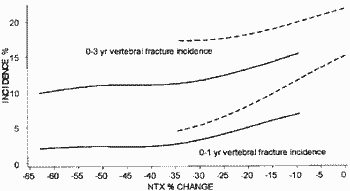
This is the key graph from Richard Eastell et al. (2003) J. Bone. Miner. Res. 18:1051-6.

The solid lines supposedly show the relationship between the change in bone turnover (NTX) and new spine fractures in patients taking Actonel (Risedronate) at 1 year and at 3 years. The dashed lines show patients taking placebo. The purpose of this posting is simply to show that the scale of graphs in ghost-written papers by P&G had been drawn so that a proportion of the data simply "fell off" the left hand end of plots. I was supposed to have signed off on two further publications containing similar graphs and opaque statistical analysis ...... all while being refused access to underlying data codes held by P&G.

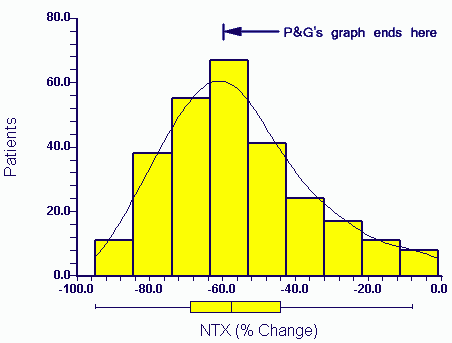
The first step of any statistical analysis is to PLOT THE DATA. Following press exposure P&G eventually released the raw data to authors in April 2006. The distribution of the actual data for NTX change (the X axis variable) in the above paper (Eastell et al 2003) for patients taking Actonel is:
A third of the data would not have appeared within the range of the Procter and Gamble graph as plotted by them (P&G's graph ends at -60%). Strange that.

The relevance of the missing end of the plot will be discussed in later postings. Suffice to say that these patients show responses more typical of the drug produced by P&G's competitor (Merck, Fosamax).

Earlier|Later|Main Page

Monday, August 14, 2006

Procter research shenanigans 4: Befriending the red herring

Pharmaceutical companies are accused of overturning the safeguards of science. The accountability of authors is the most fundamental of these safeguards. Readers expect that authors are the authors, that they vouch for the work and would be able to defend their findings if challenged. They expect that authors would be able to provide underlying raw data.

One of the many "red herring" excuses provided by Procter & Gamble to justify refusal to supply data codes underlying ghostwritten material (statistical reports, abstracts, two draft publications) to me as first author and to the Sheffield authors of a previous publication based on a subset of the same data (Eastell et al., 2003 JBMR 18:1051-6) is discussed here. The backstory is here and here.

This particular excuse (see correspondence here) was that they :
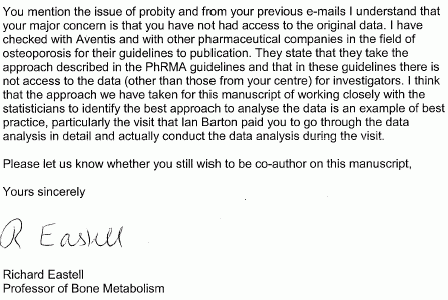
"use the approach described in PhRMA guidelines and that in these guidelines there is not access to the data (other than those from your center) for investigators".
So, what's wrong with this excuse:
  1. PhRMA (the Pharmaceutical Researchers and Manufacturers of America) is the lobbying organization for the industry. It is recipient of recent awards: The Fox Guarding the Hen House Award (for pushing toothless voluntary guidelines) and The Truth is Stranger Than Fiction Award (for a scandal involving the bribing of authors to produce a thriller as a stealth marketing tool to frighten the public (see Karasik Conspiracy). PhRMA has no authority to override ethical guidance.
  2. Even PhRMA does not suggest research findings should be closed to scrutiny by authors, or that authors should lie to journals. The cited PhRMA suggestion is that some paid recruiters of patients in multiple-center studies might not get to share in complete data access. This has nothing to do with the rights and obligations of a principal investigator or first author.

  3. Inability of a scientist to supply raw data constitutes prime facie evidence of research misconduct. Ability to provide data is an explicit condition of submission to any respectable Journal.

  4. Innumerable guidelines make the obligations of authors perfectly clear. For example:
    • The European charter for researchers: "details of the data should be open to internal and external scrutiny"

    • The Association of American Medical Colleges affirms right of "investigator to receive, analyze, and interpret all data generated in the research, and to publish results, independent of outcome" and affirms "an investigator’s accountability for the integrity of any publication that bears his or her name", and "Institutions should not enter, nor permit a covered individual to enter, research agreements that permit a sponsor ..to interfere with an investigator’s access to the data or ability to analyze the data independently".

    • The International Committee of Medical Journal Editors (ICMJE) requirements: "researchers should not enter into agreements that interfere with their access to the data and their ability to analyze it independently" Editors may request that authors of a study funded by an agency with a proprietary interest in the outcome sign a statement, “I had full access to all of the data in this study and I take complete responsibility for the integrity of the data and the accuracy of the data analysis.

    • The World Association of Medical Editors (WAME) state : "Authors should be asked to affirm in writing that they have not entered into an agreement with the funding organization that limited their ability to complete the research as planned and to publish the results". "Authors should state in writing that they have had full control of all primary data. Authors' should agree in writing to allow the journal to review their data if requested."

    • CIOMS state: "investigators should not enter into agreements that interfere unduly with their access to the data or their ability to analyze the data independently, to prepare manuscripts, or to publish them."

  5. Concealment of raw data is contrary to the rules of any respectable University. Guidance at the University of Sheffield states:
    "research evidence should be made available to other researchers on request, prior to or following the publication of results".
    "Publication of research results does not negate the need to retain original records of research evidence"
    "evidence for research based on clinical samples or relating to public health be retained for twenty years."
    "Errors detected following the publication of results could be mistaken for research misconduct if a researcher could not subsequently provide valid corroborative research evidence.
    "

Scientists may disagree about the presentation of data. There can be no legitimate debate when that data is not available for scrutiny even to authors.

Earlier|Later|Main Page

Monday, August 07, 2006

Procter research shenanigans 3: Research misconduct explained in one letter

Background to the dilemma involving Actonel research in Sheffield is here, here and here. The research involved a secondary endpoint in randomized trials used to demonstrate the efficacy of risedronate (Actonel) for regulatory approval. The company violated the norms of science under whose banner they claim to sell their products.

There were three elements to the problem:
  1. A pharmaceutical benefactor (Proctor & Gamble) repeatedly refused to provide raw data including randomization codes to academic "collaborators". Data was required by the academics to verify scientific reports, statistical analyses, meeting abstracts (1,2), and draft publications "ghost written" in their names.

  2. Data was provided to authors 3 years later, in early 2006, following press exposure. "Fair" analysis of the data would not have yielded findings desired by the sponsor.

  3. There were multifaceted and intriguing attempts to prevent the problem from being raised or discussed.

A single letter summarizes problem 1:

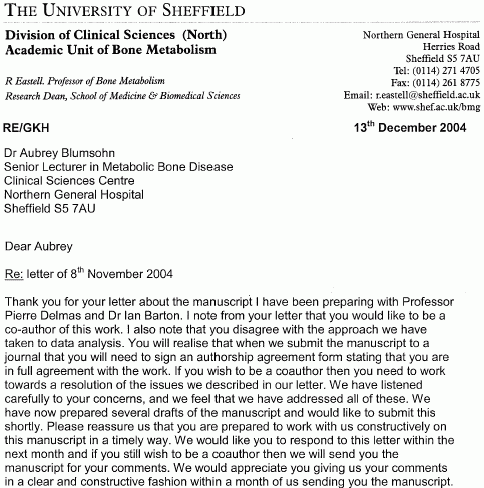
The writer is Professor Richard Eastell, collaborator in this research, and then Research Dean of Sheffield Medical School. It was written after numerous attempts to gain access to data from the company, and after some information had emerged to suggest that the analysis performed by P&G was implausible. A publication based on overlapping data had already appeared in press (Eastell et al., 2003 J. Bone. Miner. Res. 18:1051-6) - the raw data underlying this overlapping paper had also not been disclosed to Sheffield authors (BBC broadcast).

This letter from Professor Eastell was written in response to two letters from myself here and here. Eastell's "response":

  1. attempts to rationalize why it was appropriate for authors to be refused access to critical raw data

  2. suggests that the first author (Blumsohn) would be removed even as a coauthor unless prepared to sign a journal declaration in the absence of data


Click here for PDF version of letter or on images above to enlarge.

Abstracts underlying intended publications
  1. A. Blumsohn, IP Barton, A Chines, R Eastell Relative Contributions Of The Early Changes In Bone Resorption And Later Changes In Hip Bone Mineral Density To The Reduction In Vertebral Fracture Risk With Risedronate. [J Bone Miner Res 2003;18(S2):S157 Abst#SA337

  2. A. Blumsohn, IP Barton, A Chines, R Eastell. Relationship Of Early Changes In Bone Turnover To The Reduction In Vertebral Fracture Risk With Risedronate - The HIP Study. [J Bone Miner Res 2003;18(S2):S89 Abst#F338

Earlier|Later|Main Page

Tuesday, July 25, 2006

Procter research shenanigans part 1: The origins of misconduct

It's all down to money


Alternative MP3 player and download here.

Conversation Eastell and Blumsohn 10 September 2003

Blumsohn: So far as the plenary poster if we go through all the things I said I would be comfortable with that.
Eastell: Mmm
Blumsohn: ... and for the other poster I am comfortable with the poster but I have still never seen the data... which to give an oral presentation at the ACR meeting I would find a difficult thing to do.
Eastell: The only thing that we have to watch all the time is our relationship with P&G. Because we are ... because we have the big Sheffield Centre Grant [from P&G] which is a good source of income, we have got to really watch it. So.... the reason why I worry is the network within P&G is like lightening. So if Ian is unhappy it goes to Arkadi, it goes from Arkadi to Nora and before we know it, there is an issue, there is a problem... and it has to be addressed and so forth. and so I was getting worried that the whole thing might be activated and that would affect our relationship.

Earlier|Later|Main Page

Wednesday, July 19, 2006

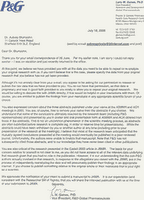
Dr Games replies about P&G Research Misconduct

Dr Games (Vice President at Procter and Gamble Pharmaceuticals) has replied to my letter. The meaning of this reply will become apparent. Some aspects have already been discussed in the media.

Click on letter for larger version.


Earlier|Later|Main Page

Monday, July 17, 2006

An open letter to Dr Games about Procter and Gamble research misconduct


Dr Larry M Games
Vice President
Procter and Gamble Pharmaceuticals
Health Care Research Center
8700 Mason-Montgomery Road
Mason, Ohio, 45040
USA

17 July 2006

Dear Dr Games

Re: Actonel Studies / Sheffield Situation

In view of Procter and Gamble's stated intent to now deal with this matter in an open and honest fashion, I am writing to express concern that I have received neither acknowledgement of nor reply to recent correspondences.

My last communication of 26 June 2006 is repeated on the following page for your convenience. Points 1-3 and point 6 required no response. However points 4 and 5 were requests for further information. In particular, although I am happy that P&G has now provided the main data underlying material presented
in my name, I remain concerned over the failure to provide confounding variables and information about non-vertebral fracture.

Clearly these publications (one full paper and three meeting abstracts) have to be retracted.

The correct findings (per the two draft publications already written in my name, but with corrected results) have to be published.

I would appreciate a response at your earliest convenience.

Yours sincerely
Dr Aubrey Blumsohn
MBBCh, BSc (hons), MSc, PhD, MRCPath


[Previous correspondence]

Dr Larry M Games
Vice President
Procter and Gamble Pharmaceuticals
Health Care Research Center
8700 Mason-Montgomery Road
Mason, Ohio, 45040
USA

26 June 2006

Re: Sheffield scenario

Dear Dr Games,

1) Per my last letter/request I am writing to confirm that Professor ------------- and Professor ------------- have been involved in statistical analysis.

2) The interpretation of data previously presented in the Eastell 2003 paper, meeting abstracts presented in my name, and two draft publications intended for submission (with me as first author) cannot be sustained (using any of a variety of relevant statistical methodologies, including simple visual inspection).

2) Professor ------------- has agreed to coauthor the publication, with intent to submit to JAMA. Clearly other involved parties may wish to coauthor. I will forward the manuscript when complete.

3) I have requested (and received) permission from the Journal of Bone and Mineral Research to reproduce Figure 1 of the Eastell JBMR 2003 paper a) as it stands, and b) with overlying data and data analysis, c) on a website.

4) Under the circumstances I would wish to submit via JAMA the raw data underlying the intended manuscript, and for this to be made publicly available. I request your permission to do so, since this relates only to data generated in Sheffield in a subset of the VERT and Hip trials (with accompanying randomisation and fracture codes) I trust that this will be satisfactory.

5) I note that data relating to the two key confounding variables (as previously requested) has not been provided. I would appreciate it if you would reconsider this. Please note my email of the 7th of April with regard to these.

6) I will be making a separate evidence based submission to JBMR with regard only to the procedure in these studies along the lines of my current meeting presentations.

Yours Sincerely

Dr Aubrey Blumsohn
Sheffield


Earlier|Later|Main Page

Tuesday, July 11, 2006

The MHRA : Why is the government not acting?

The UK Medicine and Healthcare Products Regulatory Agency (MHRA) is widely accused of tying itself into knots trying to accommodate commercial scientific misconduct. Criticisms include failure to properly scrutinise data before licensing drugs (watch this space), and an unhealthy inclination to accept "scientific" reports from companies with blind faith without reviewing or retaining raw data.

No meaningful steps have been taken by the UK government to implement critical recommendations of the House of Commons Health Select Committee Report of 2005 despite a barrage of problems (e.g. here).

The key recommendation of the Select Committee Report of 2005 was:

"In view of the failings of the MHRA, we recommend a fundamental review of the organisation."

Yet nothing has happened. Extracts of the report are below:


"practices have developed which act against the public interest." Page 4: The MHRA has failed to adequately scrutinise licensing data .... The organisation has been too close to the industry, a closeness underpinned by common policy objectives, agreed processes, frequent contact, consultation and interchange of staff. We are concerned that a rather lax regime is exacerbated by the MHRA’s need to compete with other European regulators ....

Page 5: The Government, like the MHRA, has tended to assume that all is for the best... Page 30: The MHRA is ...funded entirely by fees derived from services to industry

Page 31: The MHRA relies on company data, presented as a series of detailed assessment reports, in its decision whether or not to licence a drug. Raw data is very rarely analysed.

Page 49: The consent forms do not inform patients that the raw data may be maintained by the industry, not made available to the general public or even reviewed by the regulatory authorities.

Page 52: ... longstanding convention, vigorously upheld by the regulators, whereby clinical trial results were regarded as company property and commercially confidential.

Page 52: Too many problems appear to persist unnoticed or unacknowledged by the organisations that are central to the co-ordination, conduct and review of the clinical trials.

Page 79: The MHRA Chairman suggested that trust underpinned the stance of the MHRA towards the companies they regulate. We inferred that this extended to the routine acceptance of companies’ summaries of the results of tests on their drugs as true reflections of the raw data on which they were based.

Page 79: ..the MHRA is too trusting.
The evidence indicated that the MHRA examined primary (raw) data on drug effects only if it suspected some misrepresentation in the summary data supplied. It was argued that such trust in regulated companies goes too far: reliance on company summaries is neither sufficient nor appropriate, .....Denial of access to information held by the [MHRA] puts the interests of pharmaceutical companies ahead of those of patients and prescribers. This is particularly indefensible in the light of evidence that regulatory agencies, supposedly established to protect the public, are acquiescing in biased later publication of the information they hold.


Page 79: Regulatory inertia was clearly illustrated through publication of the findings of the UK’s first ever public investigation into a drug safety problem:

Page 82: In setting up the review of SSRI antidepressants, the MHRA/CSM responded to another long-standing concern about regulatory activity: the possible conflicts of interest of regulators.

Page 83: user reports of often serious problems had been systematically discounted or ignored.

Page 85: ... the perceived threat by MHRA staff of legal entanglement resulting from regulatory action.. it was very clear that the MRHA officials were very mindful the whole time of that dimension, to my view, more than the dimension of public health and public responsibility

Page 87: Further concerns, relating to the MHRA’s reliance on company summaries of data, rather than raw data are discussed elsewhere.

Page 96: A statement to the effect that heart problems were associated with Celebrex was issued by the MHRA in December 2004. In the statement, the Agency made it clear that it had not seen the actual data from the drug company but that its advice was based on information from Pfizer’s website.

Page 98: The regulatory authority, which is responsible for controlling much of the behaviour of the industry has significant failings. Lack of transparency has played a major part in allowing failings to continue. The traditional secrecy in the drug regulatory process has insulated regulators from the feedback that would otherwise check, test and stimulate their policies and performance. Failure can be measured by the MHRA’s poor history in recognising drug risks, poor communication and lack of public trust. Regulatory secrecy also underpins publication bias, and other unacceptable practices. The closeness that has developed between regulators and companies has deprived the industry of rigorous quality control and audit.

Page 102: Thirdly, procedures for investigating complaints about breaches of regulations are too slow, poorly enforced and weakly sanctioned.

Page 103: The MHRA does not routinely examine raw data submitted with the licence application but is dependent on summaries provided by the applicant. The Expert Working Group on SSRI’s report of December 2004 showed that summaries of information may not provide the detail required to assess drug risks adequately.

Page 106: The MHRA.... is entirely funded by fees from those it regulates.... it competes with other European agencies for fee income... serious weaknesses in the MHRA. Worryingly, in both its written and oral evidence the Agency seemed oblivious to the critical views of outsiders and unable to accept that it had any obvious shortcomings ... The Agency’s attitude to its public health responsibilities suggested some complacency and a lack of requisite competency...

Comment: Having himself dealt with the MHRA, this blogger is waiting patiently for action to safeguard public health and science.

Earlier|Later|Main Page