Showing posts with label JBMR. Show all posts

Wednesday, June 06, 2007

Safe medicine, whistleblowing and the Monogomphe

where to turn?

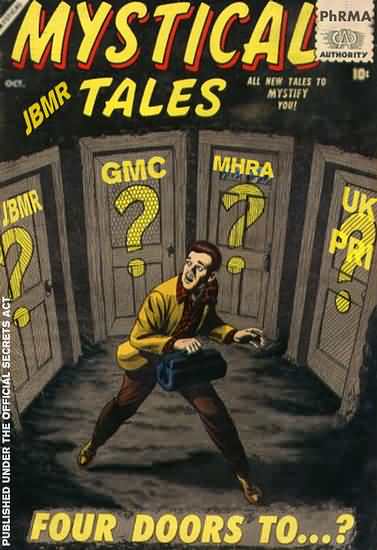
For anyone interested in integrity in science and medicine, one question looms large. "Where and how can an individual patient or professional ask questions about integrity and public safety?". In the answer to that question lies the most important indicator of good government and of safe medicine.

There are some who are only interested in the appearance of integrity.

Evidence from innumerable cases shows that question-askers are bounced from implausible pillar to post. In my case these pillars included the usual suspects - the General Medical Council (GMC), the discredited Medicines and Healthcare Products Regulatory Authority (MHRA, see here and here), a so called "scientific" Journal (JBMR, See here and here) and sadly also the brand new shiny but toothless UK Panel for Research "Integrity" (at least during our short but vacuous acquaintance). Question askers encounter interminable delay, obfuscation and outright deception. They see their concerns redrafted by others into entirely different ones which are more easily managed. They see their concerns bounced back to organizations who attempted to obscure them in the first place. Everything is shrouded in secrecy. There are legal threats and intimations of bodily harm that question askers may encounter. All this happens with a delay of several years during which time the questioner decides to give up, die or commit suicide.

The basis for these problems lies in the increasingly special relationship between the pharmaceutical industry, a network of powerful colleagues, the government and these very organisations which purport to deal with matters of "integrity" and "professionalism". When those who regulate, those who are regulated and those who scrutinize the regulators become one and the same, alarm bells should be ringing.

Speaking of teeth and of suicide, the story is told of the French academic who found himself facing those four doors. He decided to commit suicide. However he decided first to compose his own epitaph (Ref 1).

The first line was a very fine one-terminated with the word triomphe. To this, after a long search he could find no rhyme, but he could not bring himself to sacrifice his beloved line. Time passed, finding him still in search of his rhyme. He was assisted by a number of friends, but all was in vain. One day he succeeded. The rhyme so zealously sought has been discovered, and the completed epitaph is here as revealed by C.C. Bombaugh (Ref 1):-
Attendre que de soi la vétusté triomphe,
C'est absurde! Je vais au devant de la mort.
Mourir a plus d'attraits quand on est jeune encore:
A quoi bon devenir un vieillard monogomphe?
Monogomphe; a brilliant Hellenism signifying "who has but a single tooth".

The problem is that these monogomphe "integrity" bodies use their single gomphe to chomp away at achieving the very opposite of their stated purpose. They have continued to do this even after the inquiries into their malfunction such as Shipman inquiry, the
Bristol Heart Scandal inquiry, and the House of Commons Select Committee Report into the malfunction of the MHRA. In fact these very inquiries appear to have bolstered their antisocial and anti-scientific behaviour. Witness for example the repeated attempts by the GMC to bully a doctor who has raised concerns or the wholly inappropriate political use of the GMC to discredit Andrew Wakefield. Indeed, the GMC has been bullying one question-asker (Dr Rita Pal) repeatedly, using those very powers granted to it following the inquiries into the deaths caused by the rogue Dr Harold Shipman. The GMC certainly gives the impression that it regards repeated bullying and selective ignoring of problems as is its main role. What a chilling effect on anyone else wanting to ask difficult questions. But chilling appears to be the intent.

Sometimes the plan is to twist the nature of language itself. Any responses or correspondence can be redrafted into something which has the mere appearance of English. I have for example been trying to ascertain the meaning Procter and Gamble ascribe to the words "access", "data", "independent", "confidential" and "sufficient" without any great success. Linguistic trickery to obscure problems is a technique with which the MHRA and GMC will be fully aware.

To get a rhyme in English for the word month was quite a matter of interest with curious people years ago (Ref 1), and somebody made it out (or forced it) by making a quatrain, in which a tooth-challenged little girl is described as saying:-

I can get a rhyme for a month.
I can thay it now, I thed it wunth!
(Ref 1)

In the meantime, detailed analysis of the operation of malfunctioning systems is required. Even constructive ridicule may improve public safety. Deconstruction and comparison is also useful exercise. When people behave in one direction when encountering one problem, and in the opposite direction when encountering a very similar problem, questions have to be asked. A brief scientific study of the GMC and MHRA suggests that critical concerns about highly placed individuals and corporations are routinely obscured by a network of powerful colleagues, while punishment is reserved for (generally "overseas") doctors who have supposedly bumped and shouted at a drug representative. The silence within my profession as a whole is worrying, and does not point to the highest of standards.

The next Harold Shipman is on our doorstep.

It is called the MHRA (the FDA for those across the pond).

References

Ref 1. C.C. Bombaugh (1828-1906). Oddities and curiosities of words and literature. Dover Publications Inc. New York.

Earlier|Later|Main Page

Wednesday, March 14, 2007

P&G Pharmaceuticals: how to deal with a public relations disaster

ghostly writer arrivingPatients get damaged by misrepresented pharmaceutical research. “Ghost-writing” has been repeatedly criticized - but this diverts attention from the more important problem – “ghost science”, of which “ghost-writing” is only a small part. Ghosts work behind the scenes at every level of the pharmaceutical scientific process. Sometimes these ghosts make mistakes and get startled by the headlamps - as Procter and Gamble discovered this week.
The steps P&G have taken to suppress concerns about their research procedures involving the drug Actonel seem to have derived from a Monty Python script. For the backstory read press reports, collated postings on this blog, report in AAAS, or Slate.

Last year, Procter and Gamble released previously hidden raw data underlying one published paper, several meeting abstracts, and two draft publications (with myself as first author). Work by independent statisticians has confirmed that the data does not provide credible support for P&G's reporting of a convenient "plateau" for Actonel in any of the three ghosted publications.

A declaration of Mea Culpa would have served Procter and Gamble far better than the endless attempts to collude with other script writers (like the editors of the Journal of Bone and Mineral Research). Instead P&G have now stepped further into the mud:

  1. They refused to allow me to place the data they eventually provided (underlying three publications) into the public domain. This did not serve to enhance their credibility.
  2. They refused to allow me as author to submit raw data directly to a journal editor requesting such data.
  3. They declined to provide a copy of the consent form patients would have signed upon agreeing to participate in this research. Did patients consent to have the measurements I performed? Did participants realize that data derived from their risk would not be open to scrutiny by authors of the publications, or that it could be misrepresented?
  4. But wait .... whatever next .... the Python team would be impressed by P&G's new attempt to act behind the scenes to have a perfectly valid conflict of interest declaration removed from the first of several scientifically correct meeting abstracts submitted about this research.

Read what happened and laugh (or cry):

Step 1: The abstract below (authored by myself and an independent statistician) was submitted on 22 January for presentation at The International Bone and Mineral Society Meeting (to be held in Montreal). The statistical aspects have been redacted pending publication. The electronic submission was accompanied by a declaration of funding leading to the footer as shown - "Study funded by Procter & Gamble Pharmaceuticals".

Control/Tracking: 07-A-464-IBMS Current Date/Time: 1/22/2007 3:53:26PM
Relationship of fracture risk to change in bone resorption with risedronate in the HIP study - is there a plateau response?
Authors: A. Blumsohn(1), J. L. Hutton(2)
1 Sheffield Teaching Hospitals, Sheffield, UNITED KINGDOM,
2 Department of Statistics, University of Warwick, Coventry, UNITED KINGDOM.

Understanding the determinants of bisphosphonate induced change in fracture risk is a prerequisite to rational prescribing and therapeutic monitoring. A previous abstract (Blumsohn, Barton, Chines, Eastell. JBMR 2003;18 S2:S89), and draft publications failed to shed light on the true relationship between change in bone resorption (uNTX/Cr) and fracture risk in the HIP study. The study included 938 women (FN T score <-3, age 74 SD 3) who received Ca and either 5mg risedronate/day, 2.5mg or placebo for 3 years. Randomization and event codes were supplied to authors in 2006. Data did not provide evidence to support previous conclusions.
Previous reports on these data suggested risk of incident vertebral fracture (V#) was non-decreasing when NTX decreases beyond -30% (%?NTX < -30%), and the relationship was "non linear" with "little further improvement in fracture benefit below a decrease of 30 to 35%". It further suggested that another marker (%?PINP) was significantly predictive of V#.
We used several statistical models as well as visual inspection to evaluate a potential "plateau" effect at a putative threshold -30% or -40%.
--- --- -------- ---------- ------ ---- ----, ---- ---------- -- ---- --- ----, --- --- --------------- -- ---: ----- --- ---------- --- -------- --- ------- -- ---- --------- ------ ----- --- ----- --- ---------, --- ---- ------ --- --------- ---------- ----------- ---- ----------- --- ---- --- --- ------, ---- -- ------- --------- -- ---- -- --- ---------- ------- -----
------ ---------- ------ -- -------- -- - ------- ---- --- -------- ---------- ---- --- ----------- ---- ------ -------- -- -------- ---- ------ -- --- ------ --- -------- ---- --------- ------- ----- ---- -- --- ------ -- -------- ---- ----- - ---- --------- -- ----- --- ---- --- ----------- ----- ----- -- ---- ----- --------- -- ------- -- --- --------- ------- --- -- -------- -- --- --- ----- - -----
---------- ------ ------ -- -------- --- - ------- -- ------ ---------, --- ----------- -------- -- -- ------- ---- - - ------ --- ---- --- --- --- ----- --- ---- -- -- --------- ------------- ---- ------- --- ---------- ---------- ------ ------ ----------- ---------- --- -------- -- ----- -- --- ------- ------- ------ --- - --- --------- ---- -------, ------ ------- -- - ---- --------- --------, ------ -------- -- ----------- ------------ ------- ------ --- -- --- ----- -- ---------- -- ------- -- ---------- ------ ---- - -------

In conclusion, this study provides no evidence to support a plateau relationship between NTX change and fracture risk with threshold near -30% in patients taking risedronate.
Author Disclosure Block: Study funded by Procter & Gamble Pharmaceuticals.

Step 2: On the 6th of March a fascinating E-mail was sent from the meeting organizers to mysterious Dr C Purple at Procter and Gamble. Unfortunately for Dr Purple the E-mail was also copied to my own E-mail address which had accompanied the abstract submission, together with Dr Purple's earlier secret E-mail to the meeting organizers. Dr Purple had asked for my declaration of interests and funding to be removed from the abstract. The meeting organizers had complied with this request.

Subject: RE: Abstract Change
Date: Mon, 5 Mar 2007 17:33:59 -0500
From: "Paterson, Anne"
To: purple.cr@pg.com
CC: Aubrey Blumsohn


Dear Dr. Purple,

I have adjusted the disclosure so it does not include the below disclosure for P&G. There is currently no disclosure. If there is to be, please let me know and I’ll make the appropriate change.

Thank you for your patience and please do not hesitate to let me know if you have additional questions or concerns.

Kindly,
Anne

Anne Paterson
International Bone and Mineral Society (IBMS)
Washington, DC 20036

From: purple.cr@pg.com [mailto:purple.cr@pg.com]
Sent: Tuesday, February 27, 2007 10:47 AM
To: IBMS - Paterson, Anne
Subject: Abstract Change


Dear Anne:

Last Thursday we spoke about changing an abstract, here are the details;

Please check the abstract submitted by Blumsohn and Hutton (Title: Relationship of fracture risk to change in bone resorption with risedronate in the HIP study - is there a plateau response) for a statement in the disclosure block indicating that the study was funded by Procter & Gamble Pharmaceuticals. Would you please let me know if is this disclosure is still attached to the abstract. If it remains associated with the abstract, please tell me what is the process for having it removed from the abstract?

Thank you for your help with this.

Christopher Purple, Ph.D.
Medical & Technical Affairs
Procter & Gamble Pharmaceuticals
513.622.0516
purple.cr@pg.com


Step 3: Professor Hutton and I responded with some consternation. We were informed that the meeting organizers had been duped (misled) by Procter and Gamble.

From: Aubrey Blumsohn
Sent: Monday, March 05, 2007 5:59 PM
To: Paterson, Anne
Subject: RE: Abstract Change


Dear Ms Paterson

Kindly let me know the basis upon which you altered the abstract submitted by myself (removing the conflicts of interest/disclosure section). Please also state precisely who gave you permission to do so.

This is extremely strange. Dr Purple's rather unusual E-mail below your own appears to have derived from a commercial company.

I would appreciate your urgent response. I would also appreciate it if you would send be a copy of the IBMS conflicts of interest and disclosure policy as it applies to this meeting and to IBMS
activities in general.

The abstract as submitted is attached.

Yours Sincerely

Dr Aubrey Blumsohn
MBBCh, PhD, MSc, BSc(hons), MRCPath


Subject: RE: Abstract Change
Date: Mon, 5 Mar 2007 18:11:17 -0500
From: "IBMS - Paterson, Anne"
To: "Aubrey Blumsohn"


Dear Dr. Blumsohn,

I apologize for this misunderstanding as I was under the impression you knew about the conflict. I have reentered the disclosure in the abstract as indicated in your attached pdf.

Please let me know if you have any further questions. I will contact you if anything else comes up regarding this conflict.

Regards,
Anne

Anne Paterson
International Bone and Mineral Society (IBMS)
2025 M Street NW, Suite 800
Washington, DC 20036


Subject: RE: Abstract Change
Date: Tue, 6 Mar 2007 09:19:10 -0500
From: "IBMS - Paterson, Anne"
To: "Professor Jane Hutton"


Dear Dr. Hutton,

Thank you for your concern. It is not our policy and I take responsibility for the misunderstanding. I was misled and can assure you that as soon as I realized that the authors were not notified, I alerted the submitter and immediately returned it to its original form.

I am not sure how Dr. Purple viewed the abstract.

Please do let me know if you have any additional concerns.

Kind regards,
Anne

Anne Paterson
International Bone and Mineral Society (IBMS)


Well thank you Anne Paterson and the IBMS for behaving properly so far. Award of an oral presentation to to 07-A-464-IBMS may help restore a little of the lost credibility in skeletal pharmaceutical research.

And to Dr Purple of P&G: Please watch the Monty Python Parrot sketch below. Perhaps the PR staff at P&G should assist with research into soap and sanitary products like the Rely Tampon until you get some training from a proper pharmaceutical company - like Eli Lilly or Merck. Please invite me to give a seminar to your staff about the obligations of a doctor and how to deal with ethical problems in a more plausible way. I would be happy to do so any time.


You might also want to read some excellent blogs about pseudoevidence based medicine, a more effective public relations gambit, Conflicts of interest and other troubles with research. You are not alone.

Earlier|Later|Main Page

Tuesday, March 13, 2007

A journal editor does at least one right thing - well done Professor John A Eisman

fog at JBMRI posted previously about the attempt by the Editor of the Journal of Bone and Mineral Research (JBMR) to inhibit discussion about scientific misconduct and false declarations by authors of a published paper in JBMR (Richard Eastell et al. 2003 J.Bone.Miner.Res. 18:1051-6) as well as two draft publications and several meeting abstracts purportedly written by myself. That previous posting is reproduced below.

The editor, Professor John Eisman had agreed to present his case at the 3rd Annual Meeting of the International Society for Medical Publication Professionals (ISMPP, April 23 – 25, 2007, Philadelphia, PA). The meeting program is here. Thank you ISMPP for encouraging honest discussion about scientific procedure and publication ethics.

Update: However I now understand that Professor Eisman was "instructed" by someone not to attend. I have nothing to hide, and avoiding open honest discussion seems quite inappropriate Professor Eisman. Incredible.

Nevertheless Professor Eisman may be willing to read the evidence bundle, the independent statistical reports and the various corrected publications. He might even want to comment on the latest antics of Dr Purple at Procter and Gamble Pharmaceuticals and how that would be viewed by him as an honest editor. I will be detailing the various attempts of several parties to prevent the matter from being raised, and to allow those accused of misconduct (including a pharmaceutical company) to "independently" investigate themselves.

This is a meeting of medical writers (sometimes ghostwriters), perhaps not the most challenging of audiences. However I have always felt that over-emphasis on the problem of ghostwriting diverts attention from the more important problem of ghosted science. Medical writers do have a relevant role under proper circumstances, but under some circumstances they provide an easy conduit for scientific misconduct. The byline of the meeting is "Ensuring Integrity in Medical Publications: Conflicts, Credibility & Collaboration" and I will be reporting on the how the meeting addresses those goals.

"There is a demand today
for men who can make wrong appear right."
- Terence


I have a very old fashioned idea - that Medical Journal Editors should go about their business with as much objectivity and integrity as possible. They should act in the interests of the patients we serve. The Journal of Bone and Mineral Research (JBMR) is seeking a new editor to replace Professor John A. Eisman, MBBS, Ph.D. To apply, see here.

Editors wanting hints as to how to react when approached with concerns about research misconduct involving a major pharmaceutical sponsor and fellow friendly scientists, see the John A. Eisman approach. First try protracted delay. Then try meaningless gibberish, followed by excuses (or exasperation) when asked to reply properly. Then edit a letter of concern to remove all content, and offer to publish it giving a pharmaceutical company the right to respond. Express surprise when the offer is refused. Then decline to review any evidence at all, offering lame excuses. Decline to read statistical reports. Decline to read correspondence relating to denial of access to data. Decine to read anything relating to the concerns raised. Then suggest that those implicated will arrange for the concerns to be addressed. Good trick! It is always a good idea to address concerns that are different from those raised. When the matter reaches the press, write statements so at variance with your previous correspondence that it is hard not to laugh out loud. For collated correspondence and press statements see here. For press see here.

Will the JBMR eventually publish the truth about these three publications and how they came to be? Perhaps not. But then - who cares. Third rate conflicted medical journals that snuggle up to vested interests are steadily losing relevance.

Perhaps the new editor will join me in calling for Procter and Gamble to allow authors (including myself as first author of two of the three intended P&G publications) to make the raw data from the three publications publicly available. So far P&G have declined to allow that. I wonder why that might be?

Alternatively perhaps Professor John A. Eisman would care to perform a teensy tiny statistical analysis himself. He might even consider reading the statistical reports he was offered. Perhaps he would even care to review the evidence with me. Of course there is nothing whatever to hide Professor Eisman - or is there...


Earlier|Later|Main Page

Thursday, November 23, 2006

Editorial woes at the Journal of Bone and Mineral Research

I have a very old fashioned idea - that Medical Journal Editors should go about their business with as much objectivity and integrity as possible. They should act in the interests of the patients we serve. The Journal of Bone and Mineral Research (JBMR) is seeking a new editor to replace Professor John A. Eisman, MBBS, Ph.D. To apply, see here.

Editors wanting hints as to how to react when approached with concerns about research misconduct involving a major pharmaceutical sponsor and fellow friendly scientists, see the John A. Eisman approach. First try protracted delay. Then try meaningless gibberish, followed by excuses (or exasperation) when asked to reply properly. Then edit a letter of concern to remove all content, and offer to publish it giving a pharmaceutical company the right to respond. Express surprise when the offer is refused. Then decline to review any evidence at all, offering lame excuses. Decline to read statistical reports. Decline to read correspondence relating to denial of access to data. Decine to read anything relating to the concerns raised. Then suggest that those implicated will arrange for the concerns to be addressed. Good trick! It is always a good idea to address concerns that are different from those raised. When the matter reaches the press, write statements so at variance with your previous correspondence that it is hard not to laugh out loud. For collated correspondence and press statements see here. For press see here.

Will the JBMR eventually publish the truth about these three publications and how they came to be? Perhaps not. But then - who cares. Third rate conflicted medical journals that snuggle up to vested interests are steadily losing relevance.

Perhaps the new editor will join me in calling for Procter and Gamble to allow authors (including myself as first author of two of the three intended P&G publications) to make the raw data from the three publications publicly available. So far P&G have declined to allow that. I wonder why that might be?

Alternatively perhaps Professor John A. Eisman would care to perform a teensy tiny statistical analysis himself. He might even consider reading the statistical reports he was offered. Perhaps he would even care to review the evidence with me. Of course there is nothing whatever to hide Professor Eisman - or is there...


Cowardice asks: Is it safe?
Expediency asks: Is it politic?
But Conscience asks: Is it right?"
(William Punshon)

Earlier|Later|Main Page