Showing posts with label UK Integrity Panel. Show all posts

Saturday, August 15, 2009

Consultation

A hallmark of the UK NuLabour government is the sham public "consultation". Over recent months, Universities have been "consulted" on new procedures for self investigation (and effective cover-up) of research fraud (see consultation). The General Medical Council is "consulting" about their (already reasonable) guidance for doctors who fake research - while they fail to deal with actual doctors who have brought shame on the clinical research enterprise. The GMC is also "consulting" on how it could "improve its procedures for handling Fitness to Practice cases".

Much of what passes for "consultation" is theater designed to create an illusion that serious problems with these organisations are being addressed. I have yet to see actual examples of regulatory integrity lapses, cover-up and cock-up included within any consultation document.

Funniest of all is the current consultation on government regulation of "Practitioners of Acupuncture, Herbal Medicine, Traditional Chinese Medicine and Other Traditional Medicine Systems Practised in the UK". David Colquhoun is lucid on the problem of what we are regulating. He discusses in some detail examination papers and teaching material from degree courses on acupuncture and Chinese medicine at the University of Salford and the University of Westminster.

I am hardly a defender of the current state of medicine. Scientific medicine, medical leadership, and genuine evidence-based medicine are in a shambles right now. This is in part because of government interference, and because regulators have assisted in the "normalisation" of scientific fraud. It seems to me that there are a few things to address before "consulting" on the mechanics of regulation for these practitioners. Yet again, the clear message from government is that honest science and evidence are not on their agenda. Regulation and yet more guidance are not the solution to our problems - they are the problem.

I differ slightly from David in that I don't care that ill folk choose to get all sorts of advice. Nor do I care that such wares are sold, so long as they describe exactly what they do (see this company), and I don't foot the bill.

In any event, why regulate only these specific practitioners and techniques? Given my African origins I responded to the consultation with the helpful suggestion that we consider the regulatory normalisation of other therapeutic techniques such as scarification or FGM, drugs such as muti (human or otherwise), and diagnostic technologies such as bone throwing.

Earlier|Later|Main Page

Sunday, November 11, 2007

Memory Hole (8 November): Mostly about lawyers

Scientific Misconduct Blog Memory Hole: Events of November 8th

Definitions of the day

LAWFUL, adj. : Compatible with the will of a judge having jurisdiction.
LAWYER, n. : One skilled in circumvention of the law.
LITIGANT, n. : A person about to give up his skin for the hope of retaining his bones.
LITIGATION, n. : A machine which you go into as a pig and come out of as a sausage.
(The Devil's dictionary)

23 years ago today: Arthur Rudolph: US hides Nazi crimes

On 8 November 1984 it was reported that Arthur Rudolph imported from Nazi Germany to head the NASA Saturn Program (which led to the moon landing) was known to be an "Ardent Nazi" and a war criminal. He was operator of a slave camp. More importantly, the US knowingly provided cover for him. This is directly relevant to the more specific concerns on this blog - it concerns the role of government in a democracy.
"Papers Show Saturn Rocket Chief Was Called 'Ardent Nazi by U. S.": New York Times, 8 Nov 1984.

The law

14 years ago today: Inventing scientific findings is not fraud say lawyers

On 8 November 1993 the muddle of Scientific Misconduct "rules" reached the outer limits of farce
(Hilts, Philip J. "Science and Law Clash Over Fraud-Case Appeals," New York Times, 8 November 1993).

Procedures of science are designed to ensure the integrity of the scientific record, just as court procedures are designed to make sure that the legal game is played. This is an article about attempts to alter the procedures for deciding whether a scientist is operating within the rules of science. This was the midst of the Baltimore and Gallo "investigations". New rules were put in place by Bernadine Healy when director of the NIH to make lawyers the judge of appropriate science, radically altering the game in retrospect, and leading to these two cases being "lost" (at least legally).

"In the first case before the hearing board under the new rules, Rameshwar Sharma, a scientist at the Cleveland Clinic Foundation, was charged with making false statements in an application to the National Institutes of Health. He wrote that he had done a series of experiments and described the results, when in fact he had not done the work."

By any definition that would constitute research misconduct and a major offense against science, the public, and patients. This is not a game, and it is exactly how patients die.

In his defense, he said that he no intent to deceive but that his statements were 'anticipator writing' because he expected to do the work later. The hearing said this was not misconduct because the Office of Research Integrity could not prove the deliberately false statements were intended to be false. The need to prove intent is part of the new definition. Falsifying results does not constitute intent.

This is lawyers and the "big boys" of science saying that saying that science and honesty don't matter. The muddle began here.

Source: Hilts, Philip J. "Science and Law Clash Over Fraud-Case Appeals" New York Times, 8 Nov 1993

Crocodile

10 years ago today: UK "initiatives" to tackle scientific misconduct

The Journal Science published a bit of reality-free gobbledegook about a November 8th 1997 meeting concerning UK initiatives to "tackle scientific misconduct and fraudulent publication in a more systematic way". There is a disconnect between what folk say and what they fear to do.

Williams, Nigel. "Editors Seek Ways to Cope With Fraud" Science 278 (14 November 1997), p. 1221 [Full report].

Some quotes from the article:
  • A new committee, set up by the editors of nine prominent medical journals called last week for governments to tackle scientific misconduct and fraudulent publication in a more systematic way.
  • Cases are still exposed mostly by chance, and we worry about the scale of the problem
  • "Normal peer review can sometimes identify problems, but sorting through raw data to investigate them can be a miserable business".
  • These incidents were described without revealing names because of worries about libel laws [describing scientific deviations is libel]
  • The meeting backed calls by one of the legal experts on the committee, Ian Kennedy of University College London, for the development of a protocol for editors to help protect genuine whistle blowers.
  • COPE's efforts are being matched by other initiatives in Europe.
  • And at the most recent meeting of the European heads of research councils in Dublin last month, the problem of scientific misconduct was at the top of the agenda.
  • The council heads are looking in particular at Danish efforts that have culminated in a new national committee on scientific dishonesty. Unlike the U.S. Office of Research Integrity, which can investigate misconduct claims only when they involve government funds, the Danish committee can work across the scientific spectrum.
  • Editors can only go so far," says Kennedy. "Eventually you need an independent body to investigate claims fairly.
So what happened ten years later?:

See:
http://scientific-misconduct.blogspot.com/2007/10/memory-hole-15-october-uk-research.html
UK research misconduct Hit-Squad announced (UK-PRI)

Self quotation: You should treat any offer of support from UK-PRI in the same way you would treat the offer of fellatio from a crocodile.

The law

8 years ago today: German Professor fakes 80 clinical studies - not a crime

On 8 November 1999 German investigators report that dozens of bogus scientific papers were published by a cancer research professor over 15 years.

The Professor was Friedhelm Herrmann, a leading cancer research specialist. The report states that "at least 80 of his published papers were faked", and "they developed an aversion to using genuine data."

The last sentence of the news report states: "Faking scientific research, however, is not a criminal offence under German law".

Source: German scientist 'faked cancer research', The Guardian, Nov 8, 1999

4 years ago today: Medical journal editors colluding with fraud

On 8 November 2003 there were some choice quotes from a BMJ article: Have editors got their priorities right? (BMJ 327:1113; 8 Nov 2003):

"Journal editors are much more frightened of being sued for libel by academics or drug companies than they are of publishing fraudulent research" Peter Wilmshurst claimed last week.

He said that every time that he submitted an article highlighting research fraud, every word was scrutinised by an army of libel lawyers and the article was frequently rejected.

"I have submitted many scientific articles for publication and many had implications for survival of patients, but no journal has ever asked me to prove that I got the results claimed. This might suggest that medical journal editors are more concerned with the reputations of academics and their institutions than the lives of patients.

"The simple truth is that editors are most concerned with money. Journals are never sued for publishing false results no matter how many patients died. In scientific research they can have the best of both worlds. They are absolved from blame if a study is wrong and gain an improved impact rating if the research is an important advance..."

"I would like to see whether the policies at journals changed if some were sued by patients harmed by implementation of treatments based on their publications."

"I believe that there should be random checks of raw data of work in progress and of submitted work. We know that the use of performance enhancing drugs is common in competitive sports because of enforced drug checks without warning at sporting events and between events. If we did not have these checks we might mistakenly conclude that doping was not common in sport."

"Failure to produce the raw data should be considered the equivalent of failing the inspection and should result in a ban on future research for a specified period and a review of previous research published.

"The code of silence that pervades the medical profession and the research establishment: There is still considerable reluctance to shop another doctor, no matter how dishonest".

2 years ago today: SSRI advertisements not exactly science-based

On 8 November 2005 PLoS medicine published as article titled: "Serotonin and Depression: A Disconnect between the Advertisements and the Scientific Literature" (Lacasse JR, Leo J 2005 PLoS Med 2(12): e392).

Apparently direct to consumer advertisements for drugs are not exactly truthful. What a surprise. Next episode - the disconnect between the scientific literature and the underlying raw data. Hat tip HCR.

Earlier|Later|Main Page

Monday, October 15, 2007

Memory Hole (15 October): UK research misconduct Hit-Squad announced

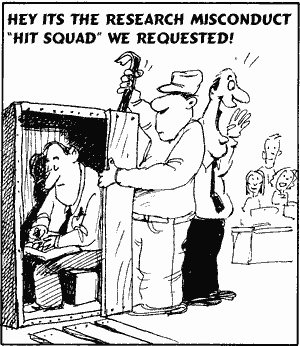
UK-PRI Hit Squad

6 years ago today: Research Misconduct - UK Clamp down promised

On 15 October 2001 it was reported that a UK "clamp down" on research fraud was pending, and a new body (a "hit squad") would emerge.

This is a joke.

The BBC news report of 15 October 2001 read:
  • Research fraud faces clamp down
  • UK doctors are calling for a national body which can send in "hit squads" where researchers are suspected of fiddling their results.
  • Fraudulent research misleads doctors and the public.
  • Professor Alberti, Royal College of Physicians said: There has been a tendency in the past for people to hush things up.
  • However, there is no set way of tackling institutions thought to be the source of fraudulent research.
  • Leading doctors stressed the urgency of the situation.
  • "At the moment the system is shambolic".
  • 'Must have teeth'
  • A national panel merely issuing advice would be not be much use - the new body should have the teeth to inspect research institutions, spot the offending researchers and deal with them.
  • "We need a rapid response".
  • One researcher, Dr Anjan Kumar Banerjee, falsified research into the gut disorder Crohn's disease. He substituted his own urine for that of 12 research subjects - his fraudulent research was published in the leading journal Gut. Dr Banerjee was suspended from the medical register for 12 (!) months by the GMC.

I repeat below part of an article I wrote for the Journal Radstats about the body that eventually emerged (the UK Panel for Research Integrity). There is far more to say, but we will leave this problem here for the moment. A previous post about UK-PRI is here

The UK panel for research integrity - In whose interest?

To the naïve, it might make sense that a national "Research Integrity Panel" should be established. University science is conducted in the public interest, and existing integrity bodies such as the MHRA and the General Medical Council have become increasingly implausible. Such a panel might ensure that attempts to distort the scientific record are properly investigated, exposed and corrected, and that institutions adhere to their own rules in terms of research integrity.

Most other developed countries have bodies which (at least to some extent) profess to do exactly that. Plans for a "UK Panel for Health and Biomedical Research Integrity" - (UK-PRI) have been in gestation for a decade or more. The "fathers" of that panel, Professor Sir Ian Kennedy and Professor Michael Farthing understood very well why such a panel was needed. Both are individuals of great integrity and wisdom. They understand the nature of the problem, the implausibility of internal university investigation, the attempts at obfuscation, and the very difficulties experienced by those who have attempt to state the truth in the face of considerable power. They have both written about these problems extensively.

In 1998 Professor Sir Ian Kennedy wrote (Cope Report 1998, ref 35):

"There has increasingly been the stated perception that the public interest means not staying quiet in the face of wrongdoing.....The witness fears that if s/he risks speaking out s/he will lose his/her job, promotion, or prospects of ever working again in the field. And it does not seem to matter to whom the witness chooses to speak--whether it is to the researcher whose work is in question, or to the line manager, or to the head of the institution. Abundant anecdotal evidence suggests that this fear is not misplaced". .... "it is suggested that they report their concerns to the "responsible authority." But herein lies a major problem. Currently, there is no institution which can fill the role of the "responsible authority"..... "Clearly, any whistleblowers protocol will be stillborn unless an appropriate "responsible (investigative) authority" is created at the same time. In the USA, this role at the Federal level is fulfilled by the Office of Research Integrity. The Danish Committee on Scientific Dishonesty was created precisely to serve as the agency to which complaints of research misconduct could be referred. …It investigates allegations of misconduct at arms' length from the editor, the researcher, and the organisation in which the researcher works. A similar body is urgently needed in the UK. Its creation would give both the whistleblower and the editor an independent arbiter to which they could turn. As a public body, its primary remit would be to act in the public interest."

That was an excellent summary of the problem and the required solution. As the new body continued gestating, these principles were forgotten. After a further five years of gestation, it was finally announced (36) in March 2005 that the birth would take place in October 2005. October came and went. In April 2006 UK PRI emerged. The headlines screamed "Panel to expose fraudulent medical research", "Watchdog eyes scientific fraud", "New panel calls on researchers to blow whistle and stamp out complacency over cheating" (37).

But what was born was not quite what was expected. UK-PRI is hosted by Universities UK, the body that promotes the interests of UK Universities. The body immediately faced criticism. Peter Wilmshurst, a consultant cardiologist who has exposed a number of research fraud cases, said "Your stakeholders have a stake in keeping research fraud under cover" (36) and "My concern is that this is set up under the auspices of UUK. If you look at the record of the universities, they have consistently concealed research fraud and protected the crooks." (37) The body has reportedly received some funding from the pharmaceutical industry - a critical mistake.

I am disappointed that we have moved so far from Sir Ian's vision and his clear understanding of where the problems lie. In March 2005 the University of Sheffield declined to allow UK-PRI to get involved with the problem in Sheffield, stating that UK-PRI was not an investigatory body, but that the MHRA (the UK drug regulator) would investigate. This was despite the fact that the MHRA had already stated they have no remit to investigate scientific misconduct in research involving licensed drugs. This is the way problems and those raising them get bounced from implausible pillar to implausible post.

It is not clear whether UK-PRI will be yet another such pillar or post but initial indications are that it will. UK-PRI now states that its major role is to "develop a programme of training" and "guidelines" and to "develop a robust national procedure". The body has no investigatory powers nor teeth of any description. What we now have is potentially worse than nothing at all. UK-PRI may assist to provide an impression that "all is well" and that those wishing to raise concerns really have somewhere to turn. That will cause others to offer even less support than they already do, and will surely cause further harm. I wondered whether they spoke to even a single person who had tried to raise concerns during their long gestation? There are already many perfectly good "procedures" and "Codes of Good Conduct" and other such cozy documents. These documents may not be perfect, but that is not where the problem lies. What we need is courage and some guts.

Having met with UK-PRI, I must report with some sadness that those raising concerns should not yet be encouraged that it is any easier to do so since April 2006.

References

35. Kennedy I. Whistleblowers. The COPE report, 1998.
36. White C. UK agency to combat research misconduct. British Medical Journal, 2005; 330: 616.
37. News reports on new integrity panel (Guardian April 12th 2006, THES April 14th 2006)
Earlier|Later|Main Page

Wednesday, June 06, 2007

Safe medicine, whistleblowing and the Monogomphe

where to turn?

For anyone interested in integrity in science and medicine, one question looms large. "Where and how can an individual patient or professional ask questions about integrity and public safety?". In the answer to that question lies the most important indicator of good government and of safe medicine.

There are some who are only interested in the appearance of integrity.

Evidence from innumerable cases shows that question-askers are bounced from implausible pillar to post. In my case these pillars included the usual suspects - the General Medical Council (GMC), the discredited Medicines and Healthcare Products Regulatory Authority (MHRA, see here and here), a so called "scientific" Journal (JBMR, See here and here) and sadly also the brand new shiny but toothless UK Panel for Research "Integrity" (at least during our short but vacuous acquaintance). Question askers encounter interminable delay, obfuscation and outright deception. They see their concerns redrafted by others into entirely different ones which are more easily managed. They see their concerns bounced back to organizations who attempted to obscure them in the first place. Everything is shrouded in secrecy. There are legal threats and intimations of bodily harm that question askers may encounter. All this happens with a delay of several years during which time the questioner decides to give up, die or commit suicide.

The basis for these problems lies in the increasingly special relationship between the pharmaceutical industry, a network of powerful colleagues, the government and these very organisations which purport to deal with matters of "integrity" and "professionalism". When those who regulate, those who are regulated and those who scrutinize the regulators become one and the same, alarm bells should be ringing.

Speaking of teeth and of suicide, the story is told of the French academic who found himself facing those four doors. He decided to commit suicide. However he decided first to compose his own epitaph (Ref 1).

The first line was a very fine one-terminated with the word triomphe. To this, after a long search he could find no rhyme, but he could not bring himself to sacrifice his beloved line. Time passed, finding him still in search of his rhyme. He was assisted by a number of friends, but all was in vain. One day he succeeded. The rhyme so zealously sought has been discovered, and the completed epitaph is here as revealed by C.C. Bombaugh (Ref 1):-
Attendre que de soi la vétusté triomphe,
C'est absurde! Je vais au devant de la mort.
Mourir a plus d'attraits quand on est jeune encore:
A quoi bon devenir un vieillard monogomphe?
Monogomphe; a brilliant Hellenism signifying "who has but a single tooth".

The problem is that these monogomphe "integrity" bodies use their single gomphe to chomp away at achieving the very opposite of their stated purpose. They have continued to do this even after the inquiries into their malfunction such as Shipman inquiry, the
Bristol Heart Scandal inquiry, and the House of Commons Select Committee Report into the malfunction of the MHRA. In fact these very inquiries appear to have bolstered their antisocial and anti-scientific behaviour. Witness for example the repeated attempts by the GMC to bully a doctor who has raised concerns or the wholly inappropriate political use of the GMC to discredit Andrew Wakefield. Indeed, the GMC has been bullying one question-asker (Dr Rita Pal) repeatedly, using those very powers granted to it following the inquiries into the deaths caused by the rogue Dr Harold Shipman. The GMC certainly gives the impression that it regards repeated bullying and selective ignoring of problems as is its main role. What a chilling effect on anyone else wanting to ask difficult questions. But chilling appears to be the intent.

Sometimes the plan is to twist the nature of language itself. Any responses or correspondence can be redrafted into something which has the mere appearance of English. I have for example been trying to ascertain the meaning Procter and Gamble ascribe to the words "access", "data", "independent", "confidential" and "sufficient" without any great success. Linguistic trickery to obscure problems is a technique with which the MHRA and GMC will be fully aware.

To get a rhyme in English for the word month was quite a matter of interest with curious people years ago (Ref 1), and somebody made it out (or forced it) by making a quatrain, in which a tooth-challenged little girl is described as saying:-

I can get a rhyme for a month.
I can thay it now, I thed it wunth!
(Ref 1)

In the meantime, detailed analysis of the operation of malfunctioning systems is required. Even constructive ridicule may improve public safety. Deconstruction and comparison is also useful exercise. When people behave in one direction when encountering one problem, and in the opposite direction when encountering a very similar problem, questions have to be asked. A brief scientific study of the GMC and MHRA suggests that critical concerns about highly placed individuals and corporations are routinely obscured by a network of powerful colleagues, while punishment is reserved for (generally "overseas") doctors who have supposedly bumped and shouted at a drug representative. The silence within my profession as a whole is worrying, and does not point to the highest of standards.

The next Harold Shipman is on our doorstep.

It is called the MHRA (the FDA for those across the pond).

References

Ref 1. C.C. Bombaugh (1828-1906). Oddities and curiosities of words and literature. Dover Publications Inc. New York.

Earlier|Later|Main Page

Tuesday, May 15, 2007

The birth and death of the UK Panel for Research Integrity - Part A

I laughed out loud when I read the today's Guardian article about the "new" UK research integrity panel (UK-PRI).

'Whistleblowing in the Wind?'
by Jessica Shepherd [Link].

Potential customers beware.
You should treat any offer of support from UK-PRI in the same way you would treat the offer of fellatio from a crocodile.


There is a lot more to say on this topic (so stay tuned).

At least the journalist involved had the good sense to realise what she was dealing with.

Whistleblowing in the wind?
A new hotline for those who suspect malpractice in medical research has not been universally welcomed.
Jessica Shepherd reports [Link]
Tuesday May 15, 2007 The Guardian


The UK Research Integrity Office and its hotline has no investigatory powers - but they can give advice. Photograph: Linda Nylind

In just nine months, Malcolm Pearce went from being considered a highly accomplished gynaecologist-researcher to a fraudster who potentially harmed patients. He had published two papers in the British Journal of Obstetrics and Gynaecology on work that never took place. Had it not been for a whistleblower, he might never have been found out and struck off the medical register.

The fact that his case was dealt with speedily, protecting the rights of both the accused and the whistleblower, was unusual, according to Dr Stephen Lock, a former editor of the British Medical Journal, writing in the publication at the time of the case, in 1995. "In most other medical institutions in Britain, nothing would have happened; the affair would have been brushed under the carpet, and the whistleblower would probably have been hounded out of his or her job," he said.

That was more than 10 years ago and hopefully things have changed. But Britain is still lagging behind its neighbours when it comes to preventing research misconduct. The Scandinavian countries, Germany, France and the US have had organisations to investigate fraud or monitor investigations for more than 10 years. Ours - the UK Research Integrity Office - was set up only last year.

"We have been relatively late with this," admits Professor Michael Farthing, who is vice-chair of a panel that looks into research integrity in health and biomedical sciences, of which the UK Research Integrity Office is a part.

But, as if to catch up, the UK is now attempting what is thought to be a world-first: a hotline for those who suspect research misconduct. The hotline, which went live on Friday, for the moment covers only medical research - the most common form of research misconduct - but there are plans to expand into all disciplines. It is aimed at anyone who suspects malpractice, from a minor tinkering of data to plagiarism, fabrication and falsification.

Dr Andy Stainthorpe, who runs the UK Research Integrity Office, who will man the helpline between 8am and 8pm every weekday, says he is expecting anything between 10 and 100 calls a month. "It could be a university administrator who calls, or the person whose responsibility it is to handle allegations of misconduct, like the pro vice-chancellor for research," he says.

What can callers expect? "Investigations into research misconduct rest solely with employers - so, a university or an NHS trust in this case," says Stainthorpe. "The helpline exists to give impartial and independent advice to callers on how to handle allegations of research misconduct.

"If someone phones up, I will discuss the issues with them and could also pass the matter on to a panel of experts in the UK who have tackled those issues before. We can give callers confidence by letting them know whether what they are observing might be misconduct or not. Cases are rare and quite often callers won't have come across one before. It is useful to seek guidance from someone who has handled something like it previously."

Stainthorpe says he has had experience of "several" cases of research misconduct in his role at the Research Integrity Office and in places where he has previously worked. "There is no reason why a caller should not just go to their pro vice-chancellor for research if that is the person who deals with research misconduct in their institution," he says.

And that is why the research community has not altogether welcomed the hotline - or the creation of the Research Integrity Office. Sir Iain Chalmers, editor of the James Lind Library in Oxford, which documents the evolution of fair tests of medical treatments, says: "There's not much point in making allegations of research misconduct to the helpline. The organisation behind it has no powers of investigation. It is actually very unfair to the people who make the allegations because it could be that their allegations are brushed aside ultimately.

"It is also unfair to those who are alleged to have practised misconduct. As long as the office and the helpline have no investigatory powers, justice will not be done."

Dr Hugh Davies, the ethics adviser to the National Patient Safety Agency, describes the helpline as "problematic". He says: "It's one way to deal with research misconduct, but it could encourage unfounded accusations of research misconduct, and how is it going to deal with that?"

To which Stainthorpe replies: "There is the potential that we will waste a bit of our time, but it is better that we are here for those who need us. This is a three-year experiment. The helpline will be reviewed in six months. We don't know what the size of the issue is yet, and we need to get more hard evidence of incidents in order to know more about the scale of the problem."

And Farthing concedes: "This is not the solution to research misconduct at all - it opens another opportunity for people to raise their concerns."

Another opportunity is needed. A study published in Nature in 2005 claimed that a third of US scientists had engaged in serious research misconduct in the past three years. Of the 3,200 scientists who took part, less than 1% said they had falsified data, but more than 12% admitted to tolerating a misuse of data by their colleagues.

"It would be very difficult to say we in the UK are any different," says Farthing. "I have to say that my inclination is that there is a rise in research misconduct. There are huge pressures on people to perform. There is huge competition among academics. They need to get their next grant."

Despite concerns that cases of research misconduct are growing, Chalmers says there is evidence to show universities, academic journals and the government do not take allegations of malpractice seriously enough. This, he says, is in direct contrast to the pharmaceutical industry, which has set up a system of "forensic examination" into allegations of misconduct.

"Universities are in a difficult position. They are not the most appropriate organisations to judge themselves. They want to keep their reputation unblemished. If it is a senior member of staff who is being alleged to have practised research misconduct, how do they deal with that? It is a great embarrassment."

Embarrassment is the least of it. The cost of medical research misconduct can just as easily be human lives.


Earlier|Later|Main Page

Wednesday, May 09, 2007

The case of Professor Peter Warnke and the alleged coverup at Liverpool University

My attention has just been drawn to this ongoing important court hearing in the UK discussed in the Observer article below. Apparently yet another case of an institution not being totally open when dealing with potential offenses against patients. We have the usual secret investigations, as well as poor treatment of whistleblowers and those who come to the defense of whistleblowers.
As Roy Poses comments on this case "It seems that many types of health care organizations in many countries lack a mechanism to give whistle-blowers a fair hearing, investigate their complaints, and protect them from the wrath of those they accuse, and from institutional leadership which fears those who would rock the boat, even if it is in an effort to alter course away from the iceberg."

I wonder whether the new UK Panel for Research Integrity (UK-PRI) was involved? They hit the headlines some time back as the new wonder-team who were supposed to provide that mechanism. UK-PRI of course now maintain that Universities should "independently" investigate themselves. This is despite abundant evidence from innumerable cases that this does not work. In fact it pretty much never works, so one wonders why anyone would advocate this approach. If one instituted a regimen of patient care that was shown never to work that would hardly be sensible would it. So why would apparently intelligent individuals create systems that employ mechanisms that are known not to work? It's called evidence based support (or EBS). A bit like evidence based medicine (EBM) really.

Also of note is the role of the General Medical Council (GMC) in the report. I would very much like to know whether the GMC held any proper open Fitness to Practice Enquiry, or whether they simply brushed it all under the carpet for their friends as part of an anonymous and secret screening process as they are inclined to do. Perhaps a little like the progress of a rather simple complaint about Professor Richard Eastell (Previous Research Dean at Sheffield Medical School) involving a minor aspect of the Procter and Gamble research scenario in Sheffield. This complaint was placed with the GMC in 2005, and involved a declaration to a journal (similar concerns were raised about Andrew Wakefield - a matter which the GMC has pursued with vigour).

Irrespective of what Warnke actually did, I find the news report in the observer depressing.
Medical school accused of cover-up after claim that surgeon retained samples without consent
Antony Barnett Sunday February 25, 2007
The Observer [Link]

Allegations that patients at a Liverpool hospital had parts of their brains removed for medical research during neurosurgery without consenting to the procedure, can be revealed today.

The University of Liverpool is accused of covering up the procedures, alleged to have resulted in at least 12 patients having brain parts removed. Its medical school, which was embroiled in the Alder Hey organ retention scandal, is facing claims that it tried to silence a senior hospital whistleblower who raised the alarm about alleged misconduct by a leading brain surgeon.

Until 2005, the university employed Professor Peter Warnke, who was chair of neurosurgery and operated at the Walton Centre hospital. In 2002, allegations surfaced that Warnke had been taking tissue from the brains of living and dead patients at the Walton Centre without obtaining consent.

Warnke is alleged to have taken samples of brain tissue during surgery, freezing them in liquid nitrogen, marking them with a black dot and sending them to Genpat 77, a private biotechnology company in Germany. The samples were used to test a new treatment for brain diseases involving an antibody called TIRC 7. Warnke was a joint owner of the patent taken out on TIRC 7, along with the founder of Genpat 77. Warnke has always vigorously contested claims of wrongdoing. The Observer has established that, at around the same period, Warnke attempted to obtain tonsils that had been removed from patients at the Aintree Hospital in Liverpool for use in associated research. Elizabeth Preston, the hospital's medical director, said: 'I can confirm that Professor Warnke did ask for tonsils, but a nurse questioned whether he had ethical consent. He was refused and as far as I am aware he never had access to any tissues from Aintree.'

Both the nurse and a surgical colleague of Warnke's raised questions about his conduct with Dr Marco Rossi, who then chaired the regional ethics committee set up to improve research standards after the Alder Hey scandal, where hundreds of children's organs were retained without parents' consent. Rossi, who was a consultant neuropathologist at the Walton Centre, claims that when he began investigating the allegations against Warnke he suffered threats from senior staff at the university's medical school. He claims that the level of intimidation made him ill and he was unable to continue his work.

Rossi is suing the Walton Centre, the University of Liverpool and the strategic regional health authority for breach of contract. He argues that as a senior employee and whistleblower they should have protected him, and claims that senior medical school staff were more concerned in covering up a potential scandal. He alleges that he was subjected to a campaign of bullying and harassment in an attempt to get him to withdraw his accusations. In court, the university has argued that Rossi's allegations about Warnke were irrelevant and should not be heard.

Last week, a judge rejected this and ordered the university to
hand over its dossier on the affair, including an internal investigation into Warnke's conduct. The court has heard that Rossi alleges that dozens of ethical consent forms used by Warnke for his research were either incomplete or inaccurate.

Although Rossi left in 2002, no action was taken against Warnke until April 2005, hours after Rossi launched his legal action. Warnke was suspended and later resigned. In November 2006 he was appointed chief of neurosurgery at the Beth Israel hospital in Boston, part of Harvard Medical School. Warnke had previously served on the Post-Redfern Committee, which was set up at the University of Liverpool to investigate the Alder Hey scandal.

The university had employed the Dutch pathologist, Professor Dick Van Velzen, who was found guilty of serious professional misconduct for retaining children's organs from 1988 to 1994.

The British law firm Weightmans, which is acting for Warnke, issued a statement to The Observer rejecting Rossi's claims. It said the allegations against Warnke were 'brought by a disgruntled former employee and a colleague of our client'. It added that the allegations were the subject of an independent investigation by the General Medical Council in 2005, which, in January 2006 wrote to Warnke stating they would take no further action [comment: now that's a surprise].

A spokeswoman for Liverpool University said: 'In the context of the current proceedings it would be inappropriate for the university to comment.'

Mel Pickup, chief executive of the Walton Centre, said: 'We would like to reassure former patients of the Walton Centre that at no time have there been any concerns about patient safety or appropriate patient care provided by the individuals connected with this case.'

What is it with us doctors?

The more recent report by the BBC [Link] was even more depressing. It appears that Liverpool University conducted some sort of "internal investigation". They apparently refused to reveal that investigation to Rossi the whistleblower but have now been forced to do so by a judge. It all sounds a bit like a criminal arranging the details of his own "independent" trial, declaring himself innocent, and then refusing to show the victim the basis for such a declaration, and what bits of the evidence had been shown to the judge.

Earlier|Later|Main Page

Any complaints? The case of Gideon Koren and the anonymous letters

I have managed to get hold of some interesting letters.

They are a series of abusive letters written between 1998 and 1999 and sent anonymously by Professor Gideon Koren to dozens of members of staff at the University of Toronto. They were written at the height of the attempt by the University of Toronto to obstruct the raising of concerns about a drug trial by Nancy Olivieri.

Here is one example:


Here is another:


Gideon Koren was at the time (and still is) a very senior academic at the University of Toronto with important responsibilities over clinical research. For months Koren repeatedly lied, denying writing the letters, until he was identified as author by DNA evidence. The University conducted no investigation until forced to do so, calling it an "internal matter" and left Koren's frightened colleagues to accumulate evidence and pay for DNA studies themselves. Koren ultimately received a stiff reprimand and a slap on the wrist.

Although a minor facet of the Olivieri scandal the case of Gideon Koren is yet another sad example of the behavior of Universities when facing problems involving matters of individual reputation and money. In any sane universe, this sort of behavior by a clinical academic in charge of research probity in a major University would be a career ender.

There are at least three profound consequences of this saga for the University of Toronto and for all academics.

  1. First concerned academics and clinicians are unlikely to raise issues of integrity. It may seem that there is almost no point in doing so.

  2. Second, incidents of this sort contribute to the lack of trust our patients have in the "science" we try to sell to them. Koren is involved in an area of science of great importance to children. The science involves understanding the harm we as doctors can cause to babies in utero. An example of Koren's "science" involves the study of harmful effects of antidepressants during pregnancy. The question is why Koren should be believed when making pronouncements about science, and why he should be allowed to conduct such studies in the first place.

    In 2006 a scandal erupted in the pages of the Wallstreet Journal over a JAMA publication investigating antidepressant withdrawal during pregnancy. The paper failed to disclose that the researchers had 60 financial relationships to pharmaceutical companies, and most authors were paid as consultants by the makers of antidepressants (Wall Street Journal July 11 2006). Koren was cited in the WSJ as follows:

    To further make that point, a videotaped interview with Gideon Koren, the director of the Motherisk Program at the University of Toronto, was played. Dr. Koren said the data identifying a risk of cardiac malformation were "very low quality" and that regulatory agencies were "just throwing us statements, mostly for medical-legal reasons." Dr. Koren is currently conducting a study funded by drug maker Wyeth looking at the development of children exposed to the company's Effexor, a non-SSRI antidepressant. That relationship was not disclosed.

    And therein lies the problem.

  3. Third it relates to the principles that should guide "integrity" bodies that claim to govern and advise about "research integrity". Given the multitude of examples of obfuscatory institutional behavior it would seem that a guiding principle must be to assume that institutional "investigations", particularly involving clinical drug studies, are designed to obfuscate and condone rather than to illuminate. Indeed there are no examples I can find of proper institutional investigations where individual reputations and money are at stake. That is not to malign the University of Toronto or indeed any other University, but we simply have to find a better way of doing things. Our patients deserve far better.

The rather marvelous approach of the new Research Integrity Panel in the UK will be discussed in the next post.

Earlier|Later|Main Page

Monday, October 09, 2006

Watchdogs and Fig Leaves

Many government, professional and private organizations claim to support ethical conduct in research.

Some of these organizations pontificate and write guidelines, but remain completely silent and unsupportive when those guidelines are breached.

Others are used as a smokescreen allowing "virtuous protestations from those whose success is based upon systemic failures" (1).

They can also be used to create a false impression that "all is well", that "there are safeguards" out there, and that "whistleblowers are supported" - when no plausible safeguards exist.

Sometimes these organizations are completely subverted by those with different aims, and used as a Fig-Leaf to hide systemic failures.

A report in The Times describes just such a Fig-Leaf (Drug trials and errors : An expert watchdog is disbanding in protest. The Times. 7 Oct 2006 Link).

"an expert watchdog has announced that it is to disband, claiming it has been used as a fig leaf for the Government’s failure to provide volunteers with independent advice or support. The watchdog CERES (consumers for ethics in research) launched itself as “the voice of the guinea-pig” in 1989. For the past three years this group of academics and health service experts has lobbied for funding to run helplines for drug-test volunteers. But it is to disband on December 31, claiming that the Government’s clinical ethics committee has been advising drug-trial researchers that simply showing volunteers a leaflet from CERES will satisfy the EU requirement. CERES says this has been done “without our permission or recognition"

Here is how CERES was represented in the Consent form for the ill-fated TGN1412 trial. I hadn't read this consent form before, and I am shocked by it's complacent and misleading content.

It remains to be seen whether the new UK Panel for Research Integrity will turn out to be any less of a Fig Leaf for research misconduct.

References
Girard,M. (2005) Reformulating the principles of Hippocrates. Medical Veritas 2:682.

Earlier|Later|Main Page