Showing posts with label olivieri. Show all posts

Sunday, December 09, 2007

Memory Hole (7 December): A case study in ethical medical leadership

Scientific Misconduct Blog Memory Hole: Events of December 7th

9 years ago today: A critical commentary on the role of leadership in medicine

On 7 December 1998 Professor Manuel Buchwald wrote a letter which has become a case study in medical ethics.

In that year Professor Brenda Gallie held the position as leader of the Research Division of Cancer and Blood at the Hospital for Sick Children at the University of Toronto. Her line manager was Professor Manuel Buchwald (OC, PhD FRSC, and Lombard Insurance Chair of Pediatric Research, Hospital for Sick Kids Chief of Research). Buchwald is one of the co-discoverers of the Cystic Fibrosis gene. He is listed in the Canadian Who's Who.

Manuel BuchwaldIn May 1998 Gallie learned that Dr. Nancy Olivieri, a member of her Division had failed to persuade Buchwald or the hospital administration to assist honestly with a critical ethical crisis involving clinical research funded by the Canadian Pharmaceutical Company Apotex.

Gallie wrote to Buchwald and the hospital President suggesting that the matter required urgent action. They responded by telling her that she "did not know the whole story", and should not become involved. It later became known that Apotex were involved in granting tens of millions of dollars to the University, and that the University were about to attempt to whitewash the embarrassing affair. The funding from Apotex was promised to increase to $55million, and university leaders were encouraged to act according to the wishes of Apotex. As part of a widespread campaign of bullying, the leadership of University of Toronto began to attack a series of academics who had attempted to stand up for honesty in science. On the 7th of December 1998 Buchwald wrote the below letter to Gallie. It is self explanatory. It includes a wonderful series of comments on integrity in medical leadership. Moral duty, our duty to patients and our duty to colleagues are, according to Buchwald, inconsistent with being a leader. Moral integrity is apparently incompatible with the overriding duty of a leader to the institution.

Snippet of letter by Manuel Buchwald
For the complete letter see here - Manuel Buchwald to Brenda Gallie, 7 December 1998

This letter is derived from the morality of Auschwitz. It would seem to me to disqualify someone from being a respected scientist involved in human research. The University of Toronto did nothing to discipline Buchwald. Gallie was appalled, and resigned her leadership position. She moved her research program to the Ontario Cancer Institute.

Great intellect implies neither humanity nor ethical insight. It's all in the ventromedial prefrontal cortex several inches behind the brow. Buchwald, as a younger scientist had held himself as an advocate for human rights.

Earlier|Later|Main Page

Friday, October 26, 2007

Memory Hole (26 October): Olivieri report released

Nancy Olivieri

6 years ago today: Report into the case of Nancy Olivieri

On 26 October 2001 the Committee of Inquiry into the dispute involving Dr. Nancy Olivieri, the Hospital for Sick Children, the University of Toronto, and Apotex Inc. issued their landmark report (compulsory reading for all those who pretend to be concerned about academic fraud).

"The Hospital and the University should have defended vigorously the right of clinical researchers to disclose risks to research subjects and patients. They had a responsibility to protect the public interest and academic freedom from inappropriate actions by Apotex, but they did not do so".

The committee's report contains 31 recommendations, including:
  • Contracts involving industrial sponsorship of clinical research should never prevent researchers from informing patients or the scientific community of any risks.
  • All universities and affiliated teaching hospitals should have in place policies and practices that are effective in protecting academic freedom, as well as principles of research and clinical ethics.
  • Health Canada should review the current regulation of health research and make appropriate changes to protect the public interest and the rights of patients who volunteer to be subjects of research.
  • The University and the Hospital should provide redress to Dr. Olivieri for the unfair treatment she has received.

The public interest is not served by allowing academic institutions to investigate and exonerate themselves with impunity.

A further article by Karen Birmingham (2000. Nature Medicine 6, 609-610) summarized the 9 page Report of a panel investigating Gideon Koren signed by the University of Toronto President, Robert Prichard.

"Being an accomplished medical researcher and teacher is sufficient to excuse behavior that includes destroying institutional equipment, harassing colleagues and lying to them and to superiors - at least at the University of Toronto and at the Hospital for Sick Children in Toronto."

Reading:
  1. The Olivieri Report (2001)
  2. See The Olivieri Case: Context and Reflections (Ecclectica, Dec 2005)
  3. Defending Medicine: Clinical Faculty and Academic Freedom (2004)
  4. A Schafer, Biomedical conflicts of interest: a defence of the sequestration thesis—learning from the cases of Nancy Olivieri and David Healy, J Med Ethics 2004; 30: 8-24. doi:10.1136/jme.2003.005702
  5. Scullduggery : "L'affaire Olivieri" by Donald Forsdyke

Earlier|Later|Main Page

Wednesday, August 08, 2007

Ethics test - conflicts of interest at Toronto University

It isn't hard to understand the pressures on a University President (or Vice Chancellor) to do the wrong thing. Let's take the case of Nancy Olivieri at the University of Toronto. The University of Toronto didn't do the right thing for her. They didn't do the right thing for our patients who depend on integrity of the scientific process.
This test has only one question. By giving an honest answer, you will discover where you stand morally. The test features a completely non-fictional situation in which you will have to make a decision. No one else will know, so you won't be fooling anyone but yourself if you give an untruthful answer. Remember that your answer needs to be honest, yet spontaneous.

Please read slowly and thoughtfully, giving due consideration to each line.

Here's the situation:

You are Robert Prichard, the President of a University. The University of Toronto to be specific. There is chaos all around you caused by the attempt by Dr Olivieri to publish what she has found in a drug trial involving a big commercial company. Apotex to be specific. One academic, Gideon Koren is sending anonymous threatening correspondence to several other academics. You are caught in the middle of all of this.

You receive a letter. You suddenly realize who it is from.

It's Dr Bernard C Sherman PhD P. Eng (CEO of Apotex Inc)!


It begins:

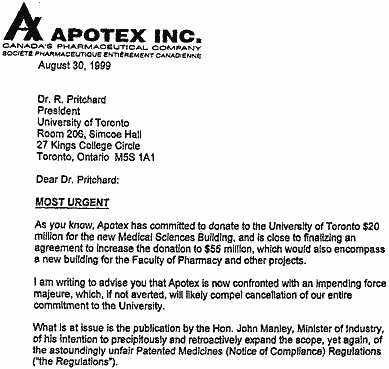
"As you know, Apotex has committed to donate to the University of Toronto $20 million for the new Medical Sciences Building, and Is close to finalizing an agreement to increase the donation to $55 million, which would also encompass a new building for the Faculty of Pharmacy and other projects. I am writing to advise you that Apotex is now confronted with an Impending force majeure, which, if not averted, will likely compel cancellation of our entire commitment to the University."

It ends with something that sounds like a command...

"We urge you to immediately contact the Prime Minister"


See full letter here. You receive it on 30 August 1999.

So here's the dilemma, and please give an honest answer. What would you do?
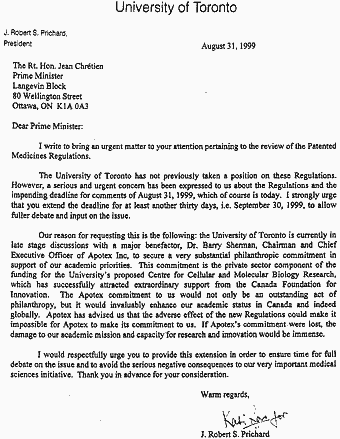
  1. write to the Prime Minister the next day (31 August 1999) urging him to urgently reconsider the new drug patent protection regulations or
  2. wait few days before urging the Prime Minister to do what is necessary.


Answers below the fold --

Letter to the Prime Minister

(Full letter PDF format)

Earlier|Later|Main Page

Wednesday, May 09, 2007

Any complaints? The case of Gideon Koren and the anonymous letters

I have managed to get hold of some interesting letters.

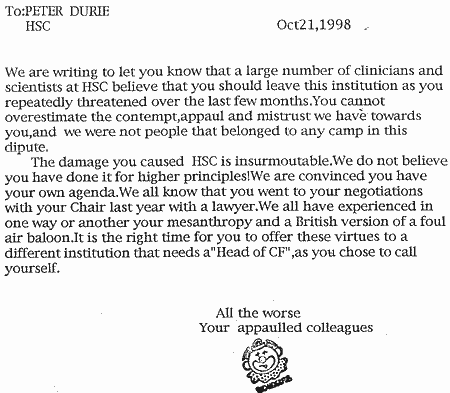
They are a series of abusive letters written between 1998 and 1999 and sent anonymously by Professor Gideon Koren to dozens of members of staff at the University of Toronto. They were written at the height of the attempt by the University of Toronto to obstruct the raising of concerns about a drug trial by Nancy Olivieri.

Here is one example:


Here is another:


Gideon Koren was at the time (and still is) a very senior academic at the University of Toronto with important responsibilities over clinical research. For months Koren repeatedly lied, denying writing the letters, until he was identified as author by DNA evidence. The University conducted no investigation until forced to do so, calling it an "internal matter" and left Koren's frightened colleagues to accumulate evidence and pay for DNA studies themselves. Koren ultimately received a stiff reprimand and a slap on the wrist.

Although a minor facet of the Olivieri scandal the case of Gideon Koren is yet another sad example of the behavior of Universities when facing problems involving matters of individual reputation and money. In any sane universe, this sort of behavior by a clinical academic in charge of research probity in a major University would be a career ender.

There are at least three profound consequences of this saga for the University of Toronto and for all academics.

  1. First concerned academics and clinicians are unlikely to raise issues of integrity. It may seem that there is almost no point in doing so.

  2. Second, incidents of this sort contribute to the lack of trust our patients have in the "science" we try to sell to them. Koren is involved in an area of science of great importance to children. The science involves understanding the harm we as doctors can cause to babies in utero. An example of Koren's "science" involves the study of harmful effects of antidepressants during pregnancy. The question is why Koren should be believed when making pronouncements about science, and why he should be allowed to conduct such studies in the first place.

    In 2006 a scandal erupted in the pages of the Wallstreet Journal over a JAMA publication investigating antidepressant withdrawal during pregnancy. The paper failed to disclose that the researchers had 60 financial relationships to pharmaceutical companies, and most authors were paid as consultants by the makers of antidepressants (Wall Street Journal July 11 2006). Koren was cited in the WSJ as follows:

    To further make that point, a videotaped interview with Gideon Koren, the director of the Motherisk Program at the University of Toronto, was played. Dr. Koren said the data identifying a risk of cardiac malformation were "very low quality" and that regulatory agencies were "just throwing us statements, mostly for medical-legal reasons." Dr. Koren is currently conducting a study funded by drug maker Wyeth looking at the development of children exposed to the company's Effexor, a non-SSRI antidepressant. That relationship was not disclosed.

    And therein lies the problem.

  3. Third it relates to the principles that should guide "integrity" bodies that claim to govern and advise about "research integrity". Given the multitude of examples of obfuscatory institutional behavior it would seem that a guiding principle must be to assume that institutional "investigations", particularly involving clinical drug studies, are designed to obfuscate and condone rather than to illuminate. Indeed there are no examples I can find of proper institutional investigations where individual reputations and money are at stake. That is not to malign the University of Toronto or indeed any other University, but we simply have to find a better way of doing things. Our patients deserve far better.

The rather marvelous approach of the new Research Integrity Panel in the UK will be discussed in the next post.

Earlier|Later|Main Page

Sunday, March 11, 2007

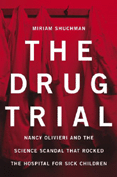
The Olivieri case: The Drug Trial debunked

obscuring the truthProgress in medicine relies on honest science. The bullying of scientists who have attempted to raise issues of integrity in medicine is a stain on our profession. So is the silence of colleagues.

Whistleblowers swim in shark-infested waters. They quickly learn about the iniquities of a system which protects the wrongdoers instead of patients. There is overt collusion between universities, professional regulatory bodies, drug licensing authorities and medical journals to obscure problems of science and scientific procedure. Often this is done to protect pharmaceutical patrons.

These stories expose the paranoid lengths our profession will go to keep scientific misconduct out of sight. Manipulation of the truth, whitewash, protectionism and lack of accountability are the standard response. We have ended up with pharmaceutical "science" that is in part a house of cards glued in place by vested interests.

The case of Nancy Olivieri at the University of Toronto continues to raise many worrying issues. The bullying of Olivieri was intense. Amongst the most awful things to happen to Olivieri was publication of a book which concentrated on her supposed personal attributes while ignoring the ethical principles she raised. Unfortunately the author of this book (Miriam Shuchman) failed to declare her conflicts of interest. Shuchman has now been exposed as mis-citing her anonymous sources, several of whom have complained. The University of Toronto have not distanced themselves, nor has it protected Olivieri from these attacks - there has been silence.

Sometimes the small sub-stories are most enlightening. The University of Toronto failed to take proper action against a malicious and very senior colleague who wrote anonymous threatening correspondence to Olivieri and several others. This individual, Professor Gideon Koren, repeadly denied doing so, until entrapped by DNA evidence. He remains an active researcher producing research "findings" which have relevance to patients. It is not clear whether our profession should accept such findings without question. The layer of Teflon coating some senior medical "thought leaders" is very thick.

I have previously written about this book [Link]. Now Arthur Schafer, a Canadian philosopher has written a scathing indictment of Shuchman's book and of her ethics (Bioethics , Vol. 21 (2) 2007, pp 111-115). The full review is here here. Extracts are below.

Review of the Drug Trial - by Arthur Schafer - Extracts
Full text here

The use of anonymous quotations, and the mis-citing of sources

The heavily biased manner in which Shuchman assembles her material seriously undermines The Drug Trial's credibility. Credibility is an especially important issue when evaluating the claims made in this book, because most of the hostile quotations are attributed to doctors and patients who are not identified. One of the few clearly identified patients, "Howard", has now gone on record as saying that his words, as quoted in the book, were twisted beyond recognition. He insists that, so far from being critical of Olivieri's patient care or ethics, he considers Dr. Olivieri to be a highly ethical doctor who is utterly dedicated to her patients.

A brief excerpt from Howard's letter of protest to Shuchman, which has now been made public, raises deep ethical concerns about the integrity of Shuchman's journalism: "Dear Miriam: You've used a smoke-and-mirrors approach to spinning my statements to inaccurately portray Nancy by misquoting me, attributing quotes to me that I didn't make, omitting portions of my comments that would alter the effect and taking these comments out of context."

My confidence in Shuchman's journalistic reliability, already shaken by numerous factual errors and skewed descriptions of key events was further eroded when I came across a passage in which she "quotes" from a commentary I published in The Globe and Mail. I wrote none of the words she attributes to me.

The problem with Gideon Koren

Many of Shuchman's other allegations of ethical misconduct, directed against Olivieri, rely on the testimony of Olivieri's leading foe at Sick Kids, Dr. Gideon Koren. Koren, then a senior scientist and scientific administrator at the Hospital, has been found guilty of and severely disciplined for both professional and research misconduct, first by the hospital and the university, and later by the Ontario medical licensing body. The hospital and the university found that his actions, including persistent "lying" in connection with his efforts to discredit Dr. Olivieri, "constitute gross misconduct and provide sufficient grounds for dismissal."

The CAUT Report found that Dr. Koren "attempted to discredit Dr. Olivieri by dishonest means". In the words of the Discipline Committee of the College of Physicians and Surgeons of Ontario, Dr. Koren was guilty of "conduct unbecoming a physician". "His actions were childish, vindictive and dishonest", authoring "vicious diatribes" contained in anonymous "poison pen letters" against Dr. Olivieri. Koren was stripped by the University of his Endowed Chair, required to arrange that his ethically suspect research be deleted from the scientific record, publicly reprimanded by the licensing body, and required to pay substantial fines by the hospital, the university and the licensing body.

Shuchman has great admiration for Koren and devotes almost a full chapter of her book to trivializing his misconduct and praising his stellar virtues and research accomplishments. Unfortunately, she omits to inform her readers of the full extent of Dr. Koren's publicly reported misconduct.

Institutional obfuscation

Olivieri's hospital, The Hospital for Sick Children, and her university, the University of Toronto, have also taken a public drubbing for failing to provide her with effective support as she struggled with Apotex. Actually, not only was Olivieri denied effective support, she was fired from her position as the director of the Hospital's hemoglobinopathy programme, and both she and those colleagues brave enough to support her experienced harassment of many kinds. In the words of the CAUT Report: "Neither HSC nor the University …took effective action to defend principles of research ethics, clinical ethics and academic freedom." When it was discovered that the university was negotiating with Apotex for a huge financial donation, well, some people drew their own conclusions, and these were not flattering to the university

The veritable cornucopia of discredit which Shuchman heaps on Nancy Olivieri is, I'm sorry to say, standard punishment for those who have the temerity to challenge powerful vested interests. In the popular imagination David bravely slays Goliath. Alas, in the real world, the whistle-blower's issue of principle is easily re-described as an act of private disloyalty and, worse, as evidence of professional incompetence and psychological disturbance.

For every Erin Brockovitch, rewarded with fame and fortune (when Julia Roberts was cast by Hollywood to portray her brave struggle), there are a dozen other whistle-blowers consigned by employers and colleagues to professional oblivion. Typically, those who challenge authority find that their professional competence, personal lifestyle and mental stability are all brought into question. Most whistle-blowers are also labeled malcontents and publicity seekers, as Shuchman stigmatizes Olivieri. They are duly punished with demotion, suspension, and/or dismissal. The case of Dr. Aubrey Blumsohn, recently suspended from his job by Sheffield University after he blew the whistle on one of that University's major research funders, Proctor and Gamble, fits the same pattern. Few whistleblowers escape this fate.

Demonstrably false charges

To fill out her story, Shuchman compiles a lengthy charge sheet against Olivieri. The most serious accusation is that Olivieri negligently delayed the implementation (at Sick Kids Hospital) of proper guidelines for the treatment of sickle cell patients. Shuchman claims that this delay led directly to the death of a young patient, Sanchia Bulgin. Shuchman is unmoved by the fact that Olivieri was not one of the physicians treating this patient, and that the responsible physicians were found (by two official inquiries) to have violated established guidelines which had been in place for years. It's a bizarre accusation.

Reading The Drug Trial I was repeatedly struck by how often Shuchman's account of events is contradicted by the findings of a series of independent inquiries - all public documents, all easily obtainable. Almost all of the anti-Olivieri "revelations" presented in Shuchman's book are warmed-over versions of allegations already disproven by one or more of these impartial inquiries, and the others are undocumented hearsay. In short, Shuchman's way with well-established facts would have brought a smile to the face of Procrustes.


Related Links
Gideon Koren - misconduct [Link]

Earlier|Later|Main Page

Monday, July 10, 2006

'The Drug Trial' by Miriam Shuchman - an exercise in logical fallacy

Intimidation of researchers and corporate distortion of scientific debate has become part and parcel of pharmaceutical "science". The consequences for patients and for public trust in science have been calamitous. Much thought is required to resolve the crisis. This disappointing book is not part of that debate.

It begins with a story. A researcher, Nancy Olivieri, obtained funding from Apotex to research a drug. She asserted her right (and obligation) as a researcher to publicise findings which she believed to be correct. Apotex and the University of Toronto responded by sacking, threatening and gagging. Properly independent inquiries were held into the way in which Olivieri was treated, each one exonerating her. And she was reinstated.

Shuchman relies heavily on a spurious form of argument that attempts to give the impression that Olivieri was somehow responsible for the academic freedom debacle.

Through adept use of the "straw man" fallacy Shuchman ignores the actual ethical problem, and substitutes a distorted and misrepresented version of a different problem. It is an evasion tactic, but on whose behalf? Certainly not on behalf of patients who rely on proper debate in science.

Secondly Shuchman relies on ad hominem attack. Selective and anonymous insulting of Olivieri is not ad hominem - it is simply insult. To make matters worse it has been suggested that much of the gossip Schuchman reports is false. To reject the principles raised by Olivieri based on such personal attack is ad hominem, and no argument at all. One wonders what forces might have motivated Schuchman?

The fallacies are discussed eloquently in the review by Professor David Healy

"Again and again the events are seen through a prism of sympathy for those who have been portrayed elsewhere as the villains ... Take Gideon Koren .......In the midst of this saga, Koren sent a string of anonymous hate mails to Olivieri’s colleagues. ..Koren was disciplined for misconduct in sending the anonymous letters, and in then repeatedly denying responsibility until he was identified as author by DNA evidence. 'His actions were childish, vindictive and dishonest.’ I’ll leave it to the reader to guess how Miriam Shuchman might portray this episode in a manner that generates sympathy for Dr Koren."

"Starting right from the subtitle, The Drug Trial dodges the key issues by claiming that this is a scientific rather than an ethical scandal. If Olivieri got the science wrong, she ipso facto got the ethics wrong ........If it turns out that Apotex’s drug has some benefits for the heart in some patients with thalassemia, as the book suggests, this would no more invalidate the call that Nancy Olivieri made than recent findings that thalidomide is an excellent treatment for leprosy now invalidate the efforts of Siegfried Lenz to raise concerns about its teratogenic effects.... The key issue is whether in the face of ambiguous clinical trial data, a clinician treating patients should err on the side of the patient or on the side of the corporation that hopes to make money out of future patients. Shuchman glides over this..."


In the British Medical Journal Martyn rates the book 1 star and writes:

It is disappointing that Shuchman's book hardly touches on these issues. Instead, it retells the story from a worm's eye view, dwelling on the personalities of the people involved, what they said about each other, who was sleeping with whom, and the tricks they got up to to blacken each other's reputations.

Earlier|Later|Main Page