Showing posts with label Medical leadership. Show all posts

Saturday, May 23, 2009

Is Medicine in the same boat as the Catholic Church?

This post has nothing directly to do with scientific fraud, science or medicine.

It is about recent reports of corruption and terrible evils that have taken place within the confines of the leadership of the Catholic Church.

A few days ago a long-delayed investigation into Ireland’s Roman Catholic-run institutions was released. It chronicled how priests and nuns molested, abused and tortured thousands of boys and girls for decades. More importantly it documented how those in authority, government officials, and government inspectors failed to stop the beatings, rapes and abuse. The report concludes that church officials shielded their orders' pedophiles from arrest, amid a culture of self-serving secrecy. They turned a blind eye.

In the United Kingdom, we have medical "regulatory" bodies (such as the MHRA and the General Medical Council). We have individuals promoted to positions of professional leadership. These bodies and individuals are supposed to act as guardians of scientific and clinical integrity in medicine. They are supposed to protect the public against quackery, and to uphold the scientific ideals of our profession. Like the corrupt bodies within the Church, these institutions don't always fulfill their stated mission. Too often they act act as protectors of those who are guilty of scientific fraud, of abusing patients and of corruption. Particular individuals within those bodies act to conceal crimes and deception. Rules of conduct are meticulously created and revised, but disobeyed with impunity. The supposed mission of these organisations and the reputation of our profession is brought into disrepute through these actions.

These organisations hide their sins behind a barrrier of secrecy. Names and transparency are important however. The Christian Brothers successfully sued the commission in 2004 to keep the identities of all of its members unnamed in the report resulting in massive backfire and complete loss of any residual reputation. In medicine, bodies such as the General Medical Council demonstrate the same staggering incompetence when they try to get involved in tricky little exercises to protect their friends. Those, like the hilarious exercise to try to hide the scientific adventures of their friend Professor Richard Eastell and his "collaborations" with Procter and Gamble Pharmaceuticals tend to result in a similar outcome for the profession of medicine.

Read the full report of the Commission to Inquire Into Child Abuse report here, or a summary (Associated Press).

The corruption was articulated even more strongly in Milwaukee this week. It is said that retired Archbishop Rembert G. Weakland states that he "did not comprehend" the potential harm to victims in Milwaukee, nor did he understand that what the priests had done constituted a crime (see here and here)

Said Weakland:
"We all considered sexual abuse of minors as a moral evil, but had no understanding of its criminal nature."

I "accepted naively the common view that it was not necessary to worry about the effects on the youngsters: either they would not remember or they would ‘grow out of it’."
Weakland stands accused of assisting in cover-up of the abuse. A 2003 report on the sexual abuse of minors by clergy in the Roman Catholic Archdiocese of Milwaukee revealed that allegations of sexual assaults on minors had been made against 58 ordained men, who were under the direct supervision of the Archbishop of Milwaukee. By early 2009, the Archdiocese of Milwaukee had spent approximately $26.5 million in attorney fees and settlements to victims. Weakland retired in 2002 after it became known that he paid $450,000 to a man who had accused him of date rape.

Why are these men and women not in prison?

See also:
  1. Cargo Cult Science : Large Groups of Humans
  2. Video Documentary : Deliver us from Evil
  3. The Freethinker: ‘We did not know that child abuse was a crime,’ says retired Catholic archbishop
  4. Report of the Commission to Inquire Into Child Abuse in Ireland

Earlier|Later|Main Page

Sunday, December 09, 2007

Memory Hole (7 December): A case study in ethical medical leadership

Scientific Misconduct Blog Memory Hole: Events of December 7th

9 years ago today: A critical commentary on the role of leadership in medicine

On 7 December 1998 Professor Manuel Buchwald wrote a letter which has become a case study in medical ethics.

In that year Professor Brenda Gallie held the position as leader of the Research Division of Cancer and Blood at the Hospital for Sick Children at the University of Toronto. Her line manager was Professor Manuel Buchwald (OC, PhD FRSC, and Lombard Insurance Chair of Pediatric Research, Hospital for Sick Kids Chief of Research). Buchwald is one of the co-discoverers of the Cystic Fibrosis gene. He is listed in the Canadian Who's Who.

Manuel BuchwaldIn May 1998 Gallie learned that Dr. Nancy Olivieri, a member of her Division had failed to persuade Buchwald or the hospital administration to assist honestly with a critical ethical crisis involving clinical research funded by the Canadian Pharmaceutical Company Apotex.

Gallie wrote to Buchwald and the hospital President suggesting that the matter required urgent action. They responded by telling her that she "did not know the whole story", and should not become involved. It later became known that Apotex were involved in granting tens of millions of dollars to the University, and that the University were about to attempt to whitewash the embarrassing affair. The funding from Apotex was promised to increase to $55million, and university leaders were encouraged to act according to the wishes of Apotex. As part of a widespread campaign of bullying, the leadership of University of Toronto began to attack a series of academics who had attempted to stand up for honesty in science. On the 7th of December 1998 Buchwald wrote the below letter to Gallie. It is self explanatory. It includes a wonderful series of comments on integrity in medical leadership. Moral duty, our duty to patients and our duty to colleagues are, according to Buchwald, inconsistent with being a leader. Moral integrity is apparently incompatible with the overriding duty of a leader to the institution.

Snippet of letter by Manuel Buchwald
For the complete letter see here - Manuel Buchwald to Brenda Gallie, 7 December 1998

This letter is derived from the morality of Auschwitz. It would seem to me to disqualify someone from being a respected scientist involved in human research. The University of Toronto did nothing to discipline Buchwald. Gallie was appalled, and resigned her leadership position. She moved her research program to the Ontario Cancer Institute.

Great intellect implies neither humanity nor ethical insight. It's all in the ventromedial prefrontal cortex several inches behind the brow. Buchwald, as a younger scientist had held himself as an advocate for human rights.

Earlier|Later|Main Page

Tuesday, October 30, 2007

Memory Hole (30 October): Junk science

Scientific Misconduct Blog Memory Hole: Events of October 30th


8 years ago today: Science versus quackery in SSRI drug trials

On 30 October 1999 an important, worrying and predictive article by Sarah Boseley appeared in the Guardian. This is about open, honest and properly represented science versus quackery. The problems are obvious.

An abbreviated version of the Guardian article is reproduced below:
Bad scienceThey said it was safe, The Guardian Oct 30 1999

Since the launch of Prozac there has been a spate of disturbing accounts of violence and suicide committed by people prescribed the drug. Victims and families of killers have sued Eli Lilly but no cases had reached a verdict because Lilly settled out of court.

However in 1999 for the first time, Lilly came up against a family in the US who would not settle. The Forsyths wanted a hearing. Internal documents belonging to Lilly were produced in court, and these "showed that Lilly knew as long as 20 years ago that Prozac can produce in some people a strange, agitated state of mind that can trigger in them an unstoppable urge to commit suicide or murder".

Lilly's own internal documents show it was identified as early as 1978. On August 2 of that year, when only three trials were under way, minutes of a meeting of the Fluoxetine (Prozac) Project Team run thus: "There have been a fairly large number of reports of adverse reactions... Another depressed patient developed psychosis... Akathisia and restlessness were reported in some patients." A similar meeting 10 days earlier had noted that "some patients have converted from severe depression to agitation within a few days; in one case the agitation was marked and the patient had to be taken off [the] drug."

The minutes further state that "in future studies the use of benzodiazepines to control the agitation will be permitted". So, from that point on, Lilly's trial subjects would be put on tranquillisers to get them over the akathisia experienced by some in the early days on the drug. Yet once Prozac was on the market, there was no warning to doctors that such action might be necessary.

Those who developed akathisia or who had any suicidal tendencies were excluded from the trial data on the basis that they would otherwise obscure the results of the drug's success in treating depression. Yet the German licensing authority, the Bundes Gesundheit Amt (BGA), on scrutinising the results, expressed concerns about the drug's safety. On May 25, 1984, according to Lilly's internal documents, a letter from the BGA stated: "During the treatment with the preparation [Prozac], 16 suicide attempts were made, two of these with success. As patients with a risk of suicide were excluded from the studies, it is probable that this high proportion can be attributed to an action of the preparation [Prozac]."

During the licensing process in the US, however, Lilly did not tell the Food and Drugs Administration (FDA) of the German concerns. Some of Lilly's own scientists had reservations about this.

One of them, John Heiligenstein, wrote in an internal memo on September 14, 1990: "We feel caution should be exercised in a statement that 'suicidality and hostile acts in patients taking Prozac reflect the patient's disorder and not a causal relationship to Prozac'.

A memo from Thompson ran: "I hope Patrick [probably a Lilly employee, but not identified fully in the memo] realises that Lilly can go down the tubes if we lose Prozac, and just one event in the UK can cost us that."

A memo from the German office to Lilly's US headquarters in that November indicates that Lilly was keen to root out the word "suicide" altogether from its database record of side-effects experienced by patients on the drug: Claude Bouchy and Hans Weber in Germany were alarmed by suggestions from their US superiors that, when GPs reported a suicide attempt on Prozac to them, they should record it as "overdose" (even though it is not possible to kill yourself by overdosing on Prozac), and that a GP's report of "suicidal ideation" should be recorded as "depression" - "Hans has medical problems with these directions and I have great concerns about it," runs a memo from Bouchy to Thompson. "I do not think I could explain to the BGA, to a judge, to a reporter or even to my family why we would do this, especially on the sensitive issue of suicide and suicide ideation."

Something had to be done. Lilly finally agreed to undertake the study suggested by the FDA, and look at the suicide rate among UK patients on Prozac, but it didn't. Instead, the company put together a "meta-analysis". Lilly's own scientists, led by Charles Beasley, did the work.

Beasley's study was published in the British Medical Journal in 1991. It had "the appearance of scientific rigour", says Dr Healy, but it is clear, he says, in the light of the documents that emerged in the Forsyth case, that the so-called meta-analysis had included only 3,065 patients out of around 27,000 involved in the trials and that it had also included data that the FDA had rejected during licensing. Among those excluded from Lilly's study were the 5% of patients who had shown akathisia-like symptoms during the clinical trials and had dropped out, and also the 13 or 15 suicides. Nor was there any mention of the fact that a considerable number of patients had been put on benzodiazepines to suppress the very problem that Lilly was claiming did not occur.
Is this science?? Has the Beasley paper been retracted or corrected? We cannot claim to prescribe under the banner of science if we fail to deal with this.

Sources: They said it was safe, The Guardian Oct 30 1999
Related patient blogs: Furious Seasons, Soulful Sepulcher

Medical Leadership

2 years ago today: UK Drug regulator undeclared links with Syngenta

On 30 October 2005 Britain’s drugs safety watchdog (the MHRA) was "forced to declare an interest in one of the world’s largest pesticide companies, following an investigation by the Sunday Herald". Sir Alasdair Breckenridge, the chairman of the MHRA "changed his mind only after responding to a series of allegations about potential conflicts of interest". He formally declared his involvement with Swiss agrochemical giant, Syngenta. The revelation has prompted fierce criticism.

"This was also not the first time that Breckenridge had been caught up in controversy about an alleged conflict of interest". There have been calls "for Breckenridge’s resignation over alleged failings in regulating anti-depressant drugs". "From 1992 to 1997, Breckenridge was a scientific adviser to SmithKline Beecham (now GlaxoSmith-Kline), which manufactured one of the drugs, Seroxat". Three other members of the MHRA’s committee on the safety of medicines – professors Chipman, Park and Griffiths – declared interests in Syngenta in 2004. Ian Kimber, head of research at Sygenta’s central toxicology laboratory in Cheshire, is a member of the MHRA’s committee on the safety of devices.

So much for that stated "independence".

Source: Drugs watchdog linked to pesticide company - Sunday Herald 30 Oct 2005

2 years ago today: The purpose of a University

On 30 October 2005 the Times newspaper and BBC revealed that a lecturer at Southampton Solent University in the UK secretly filmed meetings with senior academics at which she was put under pressure to pass students whom she believed should have failed. “As a new lecturer I was under huge pressure to pass the students. The college was financially driven. It was a pure bums-on-seats policy. It wasn’t about education at all.”

A colleague stated on film: “Essentially, in the end you have to fit with the system. It’s as simple as that.

Source: Lecturer reveals university pressure to pass poor students Times Online Oct 30 2005

Earlier|Later|Main Page

Sunday, October 21, 2007

Memory Hole (21 October): Vioxx and a quacking duck

The scientific process

8 years ago today: A story of ducks and a single death in a Vioxx clinical trial

On 21 October 1999 a 73-year-old woman died. That death and our response to it tells volumes about the health of our profession.

In medicine we sell our wares under the banner of science. The technique of science (the "scientific method") consists of a number of steps. For a double blind randomized clinical drug trial those steps might be:
  1. State a meaningful hypothesis
  2. Design a study and statistical methods to test it
  3. Do the study in a double blind randomized way
  4. Unblind the study AFTER deciding what happened to each patient and locking the database
  5. Study authors analyze the results
  6. Share the results with everyone
That is the usual way of science. This method is not used by the practitioners of any system of quackery.

So that takes us to the Merck Advantage trial of Vioxx, and a single 73-year-old female participant in that trial who died on this day - Oct. 21, 1999. She died a few minutes after calling her son to tell him she felt short of breath.

The Advantage trial was a very short (12-week) clinical trial in 5,500 patients. If you want to avoid showing up long term side effects, you keep your clinical trials short and scientifically irrelevant (that's about the meaningful hypothesis part).

Now eight people taking Vioxx suffered heart attacks or sudden cardiac death in the Advantage trial, compared with just one taking naproxen, according to data released by the F.D.A. in 2005. The difference was statistically significant, but Merck never showed the data that way.

In the published study, Dr. Lisse (University of Arizona) reported that five patients taking Vioxx had suffered heart attacks during the trial, compared with one taking naproxen, a difference that did not reach statistical significance. But the paper never mentioned the other cardiac deaths of patients taking Vioxx, including the 73-year-old woman.

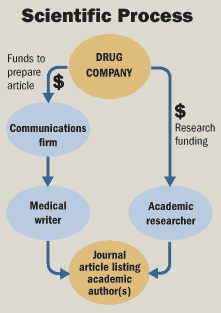
Dr. Lisse said that while he was listed as the paper's first author, Merck actually wrote the report (that's the authoring bit). "Merck designed the trial, paid for the trial, ran the trial," Dr. Lisse said. "Merck came to me after the study was completed and said, 'We want your help to work on the paper.' The initial paper was written at Merck, and then it was sent to me for editing."

Now, the other thing in usual science is not to allow company technocrats with a vested interest to decide themselves what happened to individual 73 year old women after the study is unblinded.

Neither patients nor their doctors were aware whether patients were receiving Vioxx or naproxen. Results from the trials were also supposed to be blinded when they were examined, so that Merck researchers could not bias the results. After examining the case, Dr. Eliav Barr, a Merck employee judged that the woman had probably died of a heart attack."

"Common things being common, the clinical scenario is likely to be MI (heart attack)" Dr. Barr wrote in an E-mail message in November 2000 to Dr. Reicin, the Merck clinical research executive.

Dr. Reicin quickly shot back: "I think this should be called an unknown cause of death." A few hours later, she wrote, "I would prefer unknown cause of death so we don't raise concerns."

Interesting science"A fatal event not being treated as objectively as possible surprises me," said Dr. Myerburg, a prominent cardiologist. "It looks like they're playing around with this death."

In November 2001, an F.D.A. reviewer who had examined all the company's data concluded in a report to other agency officials that Merck had misclassified the death. But the F.D.A. never told anyone either.

Dr. Lisse, the study "author" said he had never heard of the case of the woman who died, until told of it by a reporter.

So can we really believe anything at all, and how to distinguish this from the worst type of quackery? As the old saying goes, ...If it looks like a duck, and it quacks like a duck...it's a bloody duck.

What is even more amazing is that the leadership of medicine says nothing -- nothing at all. Medical students learn none of this in any of their pseudo-ethics training.

Sources:
  1. Correspondence in the Annals of Internal Medicine on the problem: Deeply disturbing evidence of medicine run amok
  2. New York Times, April 24, 2005: "Evidence in Vioxx Suits Shows Intervention by Merck Officials"
Earlier|Later|Main Page