Saturday, March 08, 2008

BMJ Advertising Watch : 08 March 2008 (giving obfuscators a voice)

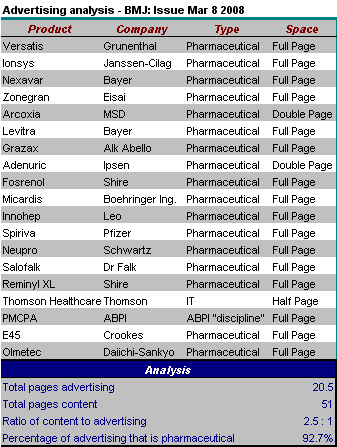
This is the British Medical Journal Advertising analysis for this week.


The 1.5 pages of advertising material that was not devoted to pharmaceuticals comprised:
  • An advertisement for an information technology company (half a page)
  • A report from the Association of British Pharmaceutical Industry (ABPI) listing their token wrist slapping of companies deemed to have breached the ABPI code of practice. The ABPI is of course the lobby group for Pharmaceutical companies in the UK.
These ABPI reports are always puzzling. They seem to choose a few slightly important examples of system malfunction -- while selectively ignoring all serious scientific misconduct or fraud that have led to significant human misery. I might be cynical, but perhaps the intent is to convey an impression that some self-policing is taking place.

This time we are told that ProStrakan promoted a medicine "in a way that was inconsistent with its summary of product characteristics" and UCB Pharma "failed to maintain a high standard". How about dealing with some of the real problems of misrepresented science ABPI, or perhaps that doesn't matter much to your members.

So, ABPI, I suggest that you start with GSK and the problems raised in the report by Harvard Psychiatrist Professor Joseph Glenmullen. Perhaps the ABPI and its members regard the following as good scientific practice:
a) selective publication of positive data,
b) counting of events during the washout phase of clinical trials as if they were events on placebo
c) "recoding" of study events to misrepresent what they are.
Some scientists would regard these actions as serious scientific misconduct, but perhaps the ABPI would not agree. If so, I would be curious to know their reasons.
ABPI, you could even slap a few wrists over the misrepresented data and untruths told to journals and doctors about Procter and Gamble studies in Sheffield. Please do feel free to discuss if you care.

There were a few other depressing features in the BMJ this week. At least the BMJ continue to employ some excellent journalists (Jeanne Lenzer and Shannon Brownlee) who do tell it as it is. One wonders how long this will continue.

Rules: As usual this is for the UK version of the BMJ. The classified advertisement section is excluded, as are advertisements for the BMA, products of the BMJ/BMA/BNF or the government.

Click here for collated BMJ Advertising analyses.

Earlier|Later|Main Page

Friday, March 07, 2008

A Day of Shame for Science in the United Kingdom

This is the report of the so called "criminal" investigation of GlaxoSmithKline (GSK) by the UK Medicines and Healthcare Regulatory Authority (MHRA). It concerns fakery and misrepresentations of science involving the drug Seroxat/Paxil. Given the close links between the MHRA and GSK this can hardly be regarded as an independent or relevant investigation.

Nevertheless, the MHRA could hardly avoid acknowledging many of the scientific manipulations that took place within their report. Many others are not discussed. These include the apparent "recoding" of clinical records in randomized trials, and the counting of events in the washout phase of trials as events on placebo. There seems very little doubt as to what happened, and the fakery is not denied.

Many children and adults are likely to have died as a result of this fakery.

The upshot of this report is that scientific misconduct is acceptable in the United Kingdom. It is acceptable for doctors and patients to be misled.

The problem is that the MHRA is only concerned about information supplied to themselves by GSK. They are not concerned about the veracity and numeric accuracy of the information supplied by themselves to the public and to doctors. They regard the provision of false or incomplete information to themselves as legal so long as that information does not directly concern licensing. They ignore the fact that doctors and patients make decisions based on information in the scientific literature, and that this literature may be faked. They ignore the fact that they themselves rely on the "peer reviewed" scientific literature to make decisions. Despite this, the MHRA have previously declared that they have no remit to be concerned about the integrity of the scientific literature involving drugs, except where it is related to a licensing procedure. They maintain that the scientific literature is "exploratory" and that fraud in this literature is therefore not relevant.

It took the MHRA four years of "investigating" to reaffirm that fakery involving drugs no longer matters.

It is time for the honest members of the medical profession to say that they disagree.
This is a day of shame for science in this country, for our profession, and for the supine leadership of our profession.

No amount of legal tweaking over issues of data-supply to regulators is going to solve this problem. There are no right answers to the wrong questions.

The government might start by reassessing their failure to respond properly to the issues raised by the Commons select committee report of 2004/5. They might start by examining their refusal to address any of the critical issues raised by that report. They might make a clear statement that honest science matters. They might make it clear that in this country we expect the usual rules of science to be obeyed, and that raw and complete data should be made available both to regulators, authors of scientific publications and to concerned scientists. They might admit that the regulator has failed to scrutinize or retain actual raw data in the past, and has simply accepted the summary claims of industry with blind faith. They might think a little about the conclusions of the select committee concerning the honesty, integrity and independence of the MHRA. They might stop their cozy meetings with industry CEO's.

It was also most unusual that Gordon Brown should have invited the CEO of a company undergoing criminal investigation over the deaths of vulnerable patients to join his International Business Advisory Council.

No, I tell you. No, sir. Corruption charges! Corruption? Corruption is government intrusion into market efficiencies in the form of regulations......We have laws against it precisely so we can get away with it. Corruption is our protection. Corruption keeps us safe and warm. Corruption is why you and I are prancing around in here instead of fighting over scraps of meat out in the streets. Corruption is why we win.
(From the Movie Syriana)

Earlier|Later|Main Page

Wednesday, March 05, 2008

The Osler Corner - On the role of a university


A great University has a dual function: To teach and to think.
William Osler (1849-1919)
Aequanimitas and other addresses p120


Click here for collated posts from the Osler Corner

Earlier|Later|Main Page

Tuesday, March 04, 2008

The Osler Corner - on "education" by industry

A quote from 1909:
I would protest against the usurpation on the part of these men [purveyors of pharmaceuticals] of our function as teachers....... What right have Z. & Co. to send on a card directions for the treatment of anemia and dyspepsia, about which they know as much as newborn babe, and , if they stick to their legitimate business, about the same opportunity of getting information!
For years the profession has been exploited in this way until the evil has become unbearable.
William Osler 1909 (Can Lancet 1909;42:899-912)
Click here for collated posts from the Osler Corner

Earlier|Later|Main Page

Threats and Hipsavers in osteoporosis - rescuing science from lawyers

A Harvard researcher who published a study in JAMA that showed that a particular hip protector doesn't reduce the risk of fractures in the elderly is being sued by a company (Hipsaver). Hipsaver makes a different hip protector.

The story is covered in the Harvard Crimson and on the Wall Street Journal Health Blog (Hip-Protector Maker Sues Harvard Doc Over JAMA Study)

The JAMA study, published last year, involved more than 1,000 people at 37 different nursing homes. Participants wore a hip protector on one side of the body. Over 20 months of follow-up, the study found that there was no difference in fracture rate between the protected and unprotected sides. The upshot of the JAMA paper was that:
"In summary, this large multicenter clinical trial failed to demonstrate a protective effect of a hip protector on hip fracture incidence in nursing home residents despite high adherence, confirming the growing body of evidence that hip protectors are not effective in nursing home populations."

"These results add to the increasing body of evidence that hip protectors, as currently designed, are not effective for preventing hip fracture among nursing home residents"
So why is the author being sued? Well, the makers of the Hipsaver device state that
"The researcher’s JAMA-published conclusions have wrongfully damaged the entire field of hip protection, including the HipSaver brand".
"It would have been more appropriate and scientifically accurate for Dr. Kiel to limit his conclusions to the specific hip protector that he studied"
"It is totally irresponsible for public health opinion leaders with tax-funded grants to study and publish the results of a dud hip protector and then trash the entire field of hip protection."
According to the Harvard Crimson: "Representatives for HipSaver accuse Kiel of deliberately using one particular type of hip protector that is inferior to many of the protectors on the market and concluding that all hip protectors were not effective."

There is indeed increasing evidence from other sources that hip protectors are not as useful as initially hoped (See Cochrane Review : BMJ 2006;332:571-574 - "Pooling of data from three individually randomized trials of 5135 community dwelling participants showed no reduction in hip fracture incidence with provision of hip protectors.")

Robert L. Hernandez, who is representing HipSaver, described Kiel’s article as "disparaging" and "grandiose".

Disparaging?
Grandiose?

The bottom line however is that there is no good evidence that the Hipsaver device works any better to prevent fractures. Hipsaver imply (without any evidence) that their device would prevent more fractures than the chosen device. So what do Hipsavers cite as their "evidence". On their website, they cite their best evidence for efficacy - a 13 month long uncontrolled study of 38 individuals who wore a hip protector.

38

And guess what: "Number of hip fractures in HipSaver wearer group was: 0"

Now that is some evidence. Firstly, the expected hip fracture rate in elderly individuals at risk is (ballpark) 2% per annum. So the expected number of fractures in these 38 individuals would have been around ......... 1 fracture...... maybe.

Furthermore, we can calculate the upper confidence limit of a reported zero fracture rate at N=38 (See here for calculation). All we can say on the basis of Hipsaver's experiment is that the 95% upper confidence limit of the event rate in these "Hipsaver protected" individuals is around 7.5% per year. In other words the information content of HipSaver's experiment is almost zilch.

To make matters even more depressing, the JAMA paper received publicity last year when it was reported that three of the authors received money from makers of bone-strengthening drugs and failed to disclose that potential conflict to JAMA.

The field of osteoporosis - my field - is sadly a minefield of bad science. It is dominated by a powerful clique of characters who live in a parallel universe in which the normal rules of science are ignored. By their silence, these individuals have lent tacit support to all sorts of inappropriate things, including legal bullying. Dr Kiel is not part of that clique, but I didn't notice any enquires from the Harvard bone fraternity when I tried to stand up for honest science. Well you know guys, every time you remain silent, you are casting a vote for the kind of science you want.

Or, as Helen Keller said:
Science may have found a cure for most evils; but it has found no remedy for the worst of them all - the apathy of human beings.
(Helen Keller, My Religion)
Earlier|Later|Main Page

Saturday, March 01, 2008

BMJ Advertising Watch : 01 March 2008 (another day another lie - perhaps)

This is the British Medical Journal Advertising analysis for this week.


Having retired the misrepresented Dr Jarvik, the back cover Lipitor advertisement (Pfizer) features a fireman. Is he really a fireman? See Pharma Giles and Health Care Renewal on the "mis-impressions and distractions" of the Jarvik campaign. Now who is this un-named fireman, does he exist, and did he really say "What's terrifying for them is everyday for me"? As a doctor of average intelligence I am obviously deeply impressed by a fireman telling me about lipidology. We shall see:
Medical Information
Pfizer Limited
Walton Oaks
Dorking Road
Tadworth, Surrey
KT20 7NS

1 March 2008

Dear Sir

I note the photograph of a fireman on the back cover of the BMJ this week (issue 1 March 2008).

I would appreciate it if you would let me know the name of this fireman, since certain statements are attributed to him. I would like to know whether this fireman exists, whether he is an accredited fireman, and whether he really made the statements attributed to him. If he is not a fireman, please let me know which parts of this advertisement are truthful and science-based.

Best wishes

Dr Aubrey Blumsohn
In the meantime, the BMJ continues to advertise itself to advertisers thusly:
"We protect our reputation by careful balance of editorial and advertising, which means your messages will always stand out".
The BMJ seemed short of advertising material this month. There was however an advertisement for books! Sadly the troubling testosterone advertisement was back.

Rules: As usual this is for the UK version of the BMJ. The classified advertisement section is excluded, as are advertisements for the BMA, products of the BMJ/BMA/BNF or the government.

Click here for collated BMJ Advertising analyses.

Earlier|Later|Main Page

I am Shiva, God of Death

Just finished watching a good movie (Michael Clayton - 2007)

Lawyers have been instrumental in facilitating the great corporate scientific crimes that have soiled the landscape of medicine. Michael Clayton (George Clooney) is a legal fixer. He slips through various phases of complicity, guilt, and understanding of corporate lies and murder.
"I realized Michael, that I had emerged not from the doors of Kenner, Bach, and Odeen, not through the portals of our vast and powerful law firm, but from the asshole of an organism who's sole function is to excrete the... the... the poison, the ammo, the defoliant necessary for other, larger, more powerful organisms to destroy the miracle of humanity. And that I had been coated in this patina of shit for the best part of my life. The stench of it and the sting of it would in all likelihood take the rest of my life to undue. And you know what I did? I took a deep cleansing breath and I put that notion aside. I tabled it. I said to myself as clear as this may be, as potent a feeling as this is, as true a thing as I believe I witnessed today, it must wait. It must stand the test of time, and Michael, the time is now."

"I am Shiva, God of Death"
Worth watching.

Earlier|Later|Main Page