Saturday, March 22, 2008

BMJ Advertising Watch : 22 March 2008 (The fabric of civilization)

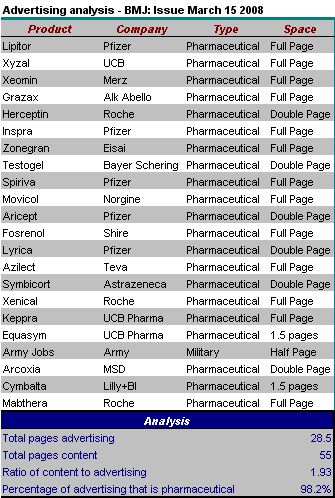
This is the British Medical Journal Advertising analysis for this week.


Rules: As usual this is for the UK version of the BMJ. The classified advertisement section is excluded, as are advertisements for the BMA, products of the BMJ/BMA/BNF or the government.

The Devils Dictionary Defiled defines Truth in Advertising thus:
Truth in Advertising - n. a fiction whose realization is impossible. Advertising's end is selling, and should truth enter the practice it would mean the end of selling. The end of selling is the end of civilization.
Stephen R. Brubaker, 2006
Truth in advertising would drain the advertising field of all creative talent and energy. All the talent would have to be absorbed by the fields of politics, journalism, and law. In several of these fields, good fiction writers would be welcome, as they would be able to raise the standards of the craft measurably. But once all fantasy has been removed from the process of product disclosure, there will be an expectation that product flaws be disclosed as well. When consumers discover the full extent by which goods and services are likely to fall short of their once fantasized ideal of function, durability, economy, and satisfaction, all commerce will cease. The white-hot economy will freeze solid, fracture, and shatter like glass. It would prove the undoing of civilization. Fabrication is the fabric of civilization.
- American Enterprise Trade Commission
Click here for collated BMJ Advertising analyses.

Earlier|Later|Main Page

Monday, March 17, 2008

Scientific integrity: Another resignation from the British Psychological Society

Another psychologist, Cole Davis, has recently resigned from the British Psychological Society (BPS) over their ignoring of scientific integrity. His resignation letter submitted today for publication in the BPS Journal (The Psychologist) is below - but not yet published.

British Psychological Society in trouble
17 March 2008
To the British Psychological Society

Further to my resignation last year, the last straw being your encouragement of the appellation 'Chartered Scientist', available to people who do not necessarily embrace scientific methods:

I no longer accept the British Psychological Society's claim to be acting in the public interest, and support the recently declared stance of another ex-member. Although I personally do not need to use the term in order to make a living, I shall call myself a psychologist and will give any support to a body which can regulate psychology in a responsible manner.

Over the years it has become apparent that the BPS is not such an organisation.

Cole Davis
Psychologist
formerly "Chartered Occupational Psychologist"

Davis previously wrote to the Psychologist in 2007 detailing BPS failure to uphold scientific integrity.

The BPS - value for money in the public service?
Published in The Psychologist, February 2007


Sir

The BPS regularly refers to its duty to the public when defending itself against i) accusations of failure to support its members, ii) ostentatious advertising of members under a cloud and iii) being over-expensive.

I no longer subscribe to such a defence. Three times, spread over some years, I have sought either support or guidance on ethical matters. On none of these occasions was I offered any.

In the last instance, when I told officials that I was being repeatedly and overtly pressurised to falsify research findings for a public project, I was told that 'we don't give legal advice' and that I should consult the Code of Ethics. Apart from the fact that there is little in the Code of Ethics about corruption, other than an urging of the practitioner to behave professionally, I don't see why some guidance was not forthcoming. I was in touch with members of the BPS with responsibility for regulations and ethics; if all that is necessary is already on the web site, then I think there is a certain amount of redundancy in the organisation.

In short, I don't think members' subscriptions are benefiting the public and I think reorganisation, rethinking and refunds are in order.

Yours Sincerely

Cole Davis
Chartered Occupational Psychologist, London NW2


See also the resignation of Lisa Blakemore Brown. What of the regulatory body for doctors in the UK (The General Medical Council)? Do they have much real regard for honesty and for the integrity of science upon which our patients rely?

Earlier|Later|Main Page

BMJ Advertising Watch : 15 March 2008 (and summary of an important paper)

Before discussing the BMJ Advertising watch for this week, I thought I would summarize an excellent 2006 article in PLoS medicine about advertising in medical journals[1].
  • The amount of money involved is large. In 2003 drug companies spent US$448 million on advertising in medical journals [1]. The American Medical Association (AMA) receives at least US$40 million annually from advertising[2].
  • It is effective at increasing sales. Analysts calculate that the return on investment is about $5.00 for each $1.00 advertising spend [3].
  • Advertising in general medical journals is almost exclusively for pharmaceuticals, and not other medical products, or consumer products of interest to doctors (computers, holidays and so on). Many journals have statements which exclude general consumer advertising [1]. For example the JAMA states "products or services eligible for advertising shall be germane to, effective in, and useful in the practice of medicine". It is proposed that accepting advertising for consumer goods would help minimize the conflict of interest inherent in pharmaceutical advertising, and would free editors from threats[1] made by advertisers which leads them to participate in editorial scientific fraud. Another option is to eschew journal advertising altogether (as has PLoS Medicine).
  • "Military recruitment advertisements" were noted in JAMA as an important exception to pharmaceutical advertising[1]. During a single anomalous year (1997) JAMA ran advertisements for Land Rover vehicles, Steinway pianos, Wellcraft boats, pork, and Quaker oatmeal [1].
  • The exclusivity of pharmaceutical advertisements is not due to affordability. After adjusting for circulation rates, advertising rates in medical journals are far less expensive than rates in consumer magazines (such as Vogue) [1].
  • Various inappropriate "mottos" of journals are discussed [1]. The Journal of Clinical Endocrinology and metabolism states: "we use our know-how to help you reach the industry's thought leaders and maximize your return". The NEJM states "Place your ad in the New England Journal of Medicine and make our relationship with the medical community yours". The BMJ states "We protect our reputation by careful balance of editorial and advertising, which means your messages will always stand out".
  • Advertisements are not "educational". The American College of Physicians (publisher of Annals) colluded with this excuse by arguing in court that profits on pharmaceutical advertising should not be taxed because advertisements were educational. Justice Marshall judged "we are bound to conclude that the advertising in Annals does not contribute importantly to the Journal's educational purposes"[4]. The notion of advertisements as "educational" is easily rebutted. Although there are more than 10,000 drugs on the market, 50% of the advertising expenditure is on only 50 of these. Competing drugs regularly cohabit in the same journal. Reviews of pharmaceutical advertisements conclude that 44% would lead to improper prescribing [5], about 60% of cited research was company sponsored, and 30% of advertisements with medical claims contain no scientific references. 19% cited "data on file" that is not open to scrutiny [6], impossible to obtain [7][8] and therefore potentially false.
  • Apart from influencing doctors, advertising (or the threat of its withdrawal) is used to manipulate editorial decisions [1]. Several examples are given. In 1992, a study in Annals criticized the accuracy of advertisements in journals [5]. Large pharmaceutical companies subsequently withdrew advertising in that journal [7]. In 2004, an editor at Dialysis and Transplantation told an author that although the author's article had passed both editorial and peer review, the marketing department rejected it. The journal later reversed its decision, but the author refused to resubmit." [1].
References
  1. Fugh-Berman, Adriane; Karen Alladin, Jarva Chow (2006-06-01). "Advertising in Medical Journals: Should Current Practices Change?". PLoS Medicine 3 (6): e130. Retrieved on 2008-03-16.
  2. American Medical Association [AMA - 2004 Annual report]. AMA (2005). Retrieved on 2008-03-16.
  3. Neslin, Scott (2008-03-16). ROI Analysis of Pharmaceutical Promotion (RAPP) - An Independent Study. Retrieved on 2008-03-16.
  4. American College of Physicians v. US. 3 Cl.Ct 531 (1983)
  5. Wilkes, M S; B H Doblin, M F Shapiro (1992-06-01). "Pharmaceutical advertisements in leading medical journals: experts' assessments". Annals of internal medicine 116 (11): 912-9. PMID 1580449.
  6. Cooper, Richelle J; David L Schriger (2005-02-15). "The availability of references and the sponsorship of original research cited in pharmaceutical advertisements". CMAJ : Canadian Medical Association journal=journal de l'Association medicale canadienne 172 (4): 487-91. PMID 15710940.
  7. Mindell, J; T Kemp (1997-12-13). "Evidence based advertising? Only two fifths of advertisements cited published, peer reviewed references". BMJ (Clinical research ed.) 315 (7122): 1622. PMID 9437300.
  8. Hafeez, A; Z Mirza (1999-08-28). "Responses from pharmaceutical companies to doctors' requests for more drug information in Pakistan: postal survey". BMJ (Clinical research ed.) 319 (7209): 547. PMID 10463894.

This is the British Medical Journal Advertising analysis for this week.


New records have been set for the amount of advertising, and the ratio of advertising to content. The single half page that was not devoted to pharmaceutical advertising was for the army. Unfortunately both the problematical (evidence free) advertisement for testosterone, as well as the Pfizer fireman (? a fake fireman) were back.

Rules: As usual this is for the UK version of the BMJ. The classified advertisement section is excluded, as are advertisements for the BMA, products of the BMJ/BMA/BNF or the government.

Click here for collated BMJ Advertising analyses.

Earlier|Later|Main Page

Friday, March 14, 2008

The Osler Corner - On polypharmacy

Osler was one of the greatest physicians of all time. Here are some of his thoughts on polypharmacy from around a century ago.
For generations the people of the United States have indulged in an orgy of drugging. Between polypharmacy in the profession and quack medicines, the American Body has become saturated ad nauseum.
Sir William Osler (1849-1919), British Medical Journal (1910) 1470-2
The young physician starts life with twenty drugs for each disease, and the old physician ends life with one drug for twenty diseases.
Sir William Osler (1849-1919)
The battle against polypharmacy, or the use of a large number of drugs (the action of which we know little, yet put into bodies of which we know less), has not been fought to a finish.
Sir William Osler (1849-1919), in Aequanimitas p255
In 2008 polypharmacy may occur because treatment guidelines are imposed on doctors for multiple specific diseases. Even when guidelines are science-free or commercially biased, the legal and practical risks of disobeying them may override logic. Clinical trials (and guidelines) rarely take account of polypharmacy, and generally exclude patients taking other medicines.

Click here for collated posts from the Osler Corner

Earlier|Later|Main Page

Tuesday, March 11, 2008

Zetia - something brewing on Cafe Pharma

[Zetia]Cafe Pharma, the anonymous bulletin board for Pharmaceutical Sales Representatives, is always amusing and insightful. The mud flows freely. From these anonymous comments today on the Schering Plough board [Link, Link], one wonders what innovations are brewing with Zetia and a "49 day plan". Some great science I suspect.

Yesterday, 06:33 PM Zetia 49 Strategy
Wondered what everyone thinks about this Zetia 49 plan??

I hate having extra $$ that I have to spend on Drs that I can barely see. I have a hard time spending all my lunch/dinner $$ now. Can't get docs out to dinner anyway - especially the ones they've targeted for me...... This instruction that we are to have a lunch or dinner EVERY DAY - come on!! Like all the Drs offices aren't booked already for the year - or have stopped doing lunches/dinners altogether! ....

Throwing money at a problem is not the way to fix things - it will only make matters worse. Have the company come clean about the study, give us some good (or even not so good) evidenced based medicine - and let us earn back the business the right way.

Yesterday, 07:55 PM Zetia 49 Strategy
Hey how about replacing the Vytorin combination of Zetia and Simva with Zetia and Cheerios.... You could call it something creative like Cheatios. Come on, I know you SP shitheads can make something out of all of this. Run a trial call Son of Enhance and use a Priest as the "Head Investigator and enroll only 8 year old little boys. Then hold the results for 10 years until they reach legal age and then reveal the truth. Send this one up to your marketing team.....

Yesterday, 10:25 PM 49 day plan ... hahahahahahahahaha RIGHT !!!??
this is a joke....??? right.

Yesterday, 10:32 PM Re: 49 day plan ... hahahahahahahahaha RIGHT !!!??
My 49 day plan consists of seeing how many of the next 49 days I cannot work. Hell I'll probably extend the plan if it works out for me.

Today, 01:50 AM Re: 49 day plan ... hahahahahahahahaha RIGHT !!!??
at least you'll be kept busy until 1Q 08 numbers go public .....

Today, 06:08 AM Zetia 49 Strategy
Does any one think that having all this extra money thrown at us looks and feels like we are "buying" back the business - not "earning" back the business?
Once again, SP is seeing just how far it can go without crossing the line...
Hey Fred, Carrie - the line HAS been crossed! Integrity counts!...

Today, 06:08 AM Zetia 49 Strategy
Here is why it will not work: ...We have lost the trust of doctors. It is not the message, but until there is DATA showing that Zetia reduces CV events and mortality, doctors will say that we are just spewing the same old shit, and get even more pissed....

Earlier|Later|Main Page

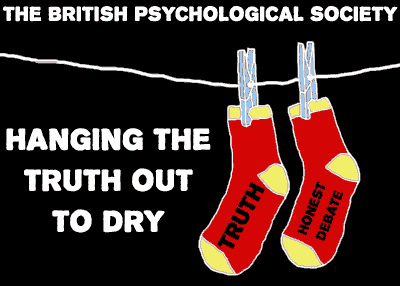
The Shame of the British Psychological Society - Last chapter in the Lisa Blakemore Brown saga

A year ago I devoted several postings to the disgraceful and ludicrous abuse of a clinical psychologist, Lisa Blakemore Brown (LBB), by the British Psychological Society (see collated postings including this one). The abuse lasted 10 years, and was apparently motivated by factors other than evidence, logic or concern for patients. It has in my view brought this society into serious disrepute.

The treatment of LBB started as an obvious travesty when a commercially funded patient "support" group and the BPS itself appear to have colluded to create a triggering complaint. What followed was a protracted farce. The BPS seems to have realized that its actions would not be hidden, and the farce was terminated this week. It has left LBB financially destitute, with a destroyed career and ill health.


and a few days later


The abuse of health professionals by professional leadership is a key threat facing the safety of medical practice. Such abuse often takes place simply because these individuals have expressed a view, or because they have raised concerns. Abuse by professional regulatory bodies is particularly troubling.

The BPS has some important questions to answer, and it is not "closed" as they suggest. There are questions about the integrity, motives and honesty of BPS procedures. There are questions about the factors motivating the entirely spurious complaints, and who arranged for their invention. There are serious concerns about the way in which the BPS attempted to abuse one of its members through the misuse of psychology itself, and the way in which the medical profession assisted.

By contrast, professional regulators have remained silent in the face of gross abuses of science, obvious lies, fraud and the deaths of patients -- where these problems involve commercial companies or a network of powerfully connected colleagues. The BPS remains completely silent on the widespread fraud which is increasingly apparent within the pharmaceutical psychiatric literature. The regulatory body governing medicine in the UK (the General Medical Council) has also remained silent, and has refused to entertain a complaint of professional misconduct from patients and families involving the medical leadership of GlaxoSmithKline.

The silence is deafening.

Equally worrying is the fact that this abuse stirred scarcely a breath of protest amongst other members of the BPS. Few psychologists troubled themselves to ask the simplest of questions. Such silence is surely a badge of shame for any caring profession.

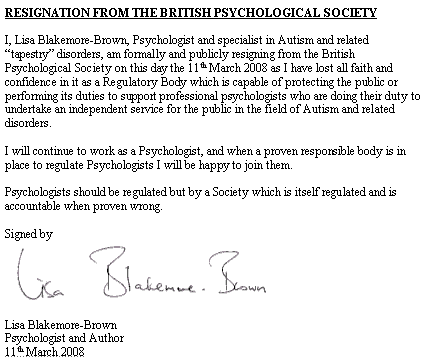
Lisa Blakemore Brown has now resigned from the BPS.


Earlier|Later|Main Page

Sunday, March 09, 2008

The 2008 Pharma "Competitive Intelligence" Conference

Now this should be an interesting meeting.

The 2008 Pharma Competitive Intelligence (CI) Conference on Sept. 15-17 in New Jersey.

"This is one of the best and largest gathering of pharma Competitive Intelligence professionals".

Who is speaking?
Here is a sampling of the many pharma speakers:
  • Monika Giese, Head Global Competitive Intelligence, Novartis Pharma AG
  • Jerry Hoffman, Manager-Global Competitive Intelligence Strategy, Eli Lilly & Co.
  • Daniel Pascheles, Vice President, Global Competitive Intelligence, Merck
  • Renee Pierson, Global Intelligence Leader, Johnson & Johnson Pharmaceutical Services
  • Chandra Ramanathan, Director, Global Business and Competitive Intelligence, Bristol-Myers Squibb
  • Craig McHenry, Senior Director, Competitor Insights, Wyeth
What is competitive intelligence?
We don't really want to explain, but probably stuff that interferes with honest science and honest people. Perhaps spying and some bullying. Perhaps things like:Is this ethical?
See The Ethics of Competitive Intelligence

If we are competing, why are we all there?
Depends who we are competing with

So who is the competition?
Proponents of the doctrine that black is black.

Please explain?
"There was a society of men among us,
bred from their youth in the art of proving,
by word multiplied for the purpose,
that white is black and black is white
according to how they are paid".
Jonathan Swift


Earlier|Later|Main Page