Monday, January 28, 2008

NMT Medical closes migraine trial in U.S. - a case to watch

This news-snippet rings a few alarm bells. I have posted about some apparently dodgy dealings in a clinical trial involving Boston-based NMT Medical, the MIST I trial, and UK clinical investigators.

The previous saga involved a medical device, and the conduct and conclusions of the Migraine Intervention with STARflex Technology (MIST) I trial. MIST I had two co-principal investigators:
  1. Dr Peter Wilmshurst, a respected cardiologist and
  2. So-called headache specialist Dr Andrew Dowson. Although Dowson described himself as a neurologist, he is not. More importantly, Dowson has restrictions on his medical practice following previous research misconduct.
Wilmshurst states that NMT has repeatedly "blocked his attempts (as principal investigator) to view the complete MIST I data set, has lied about whether echocardiograms from the MIST patients have been independently reviewed, and has massaged the data to portray its PFO device in the best possible light". He was sidelined from the study, his concerns were ignored, and Dowson presented the findings which have now been questioned. For details see here.

Several ethical, procedural and scientific issues arose in MIST I which went beyond the issue of migraine to other aspects of the device. One can only hope that NMT are not going be so foolish as to attempt to threaten Dr Wilmshurst for quite properly discussing scientific procedures involving patients. The of MIST I is ongoing, and it seems that NMT may have resorted to legal threats - always a credible scientific tactic. This case is worth keeping on the radar.

Now we read that NMT is shutting down the MIST II trial. This may be appropriate as MIST I showed no efficacy for migraine. However questions have to be asked when trials are shut down. If the continuation of MIST II was in any way dependent on the outcome of MIST I, then the ethics of starting MIST II have to be questioned. If the termination was truly related to difficulty with recruitment then this raises other issues.

NMT Medical closes migraine trial in U.S. Mass High Tech, 23 Jan 2008
NMT Medical Inc. reports plans to shut down its migraine technology trial, MIST II, to instead focus on using its technology to prevent the onset of stroke.

According to officials at Boston-based NMT, the move should save the company approximately $14 million over the next two to three years, as it redistributes funds originally budgeted for MIST II (Migraine Intervention with STARFlex Technology). NMT has stopped enrolling patients in MIST II, which was being conducted at 20 centers in the United States.

NMT president and CEO John E. Ahern said that strict enrollment requirements from the U.S. Food and Drug Administration has made MIST II an expensive endeavor "with little likelihood of being completed in a reasonable time frame."
Earlier|Later|Main Page

The politics of pharmaceutical bloggers: Part 2

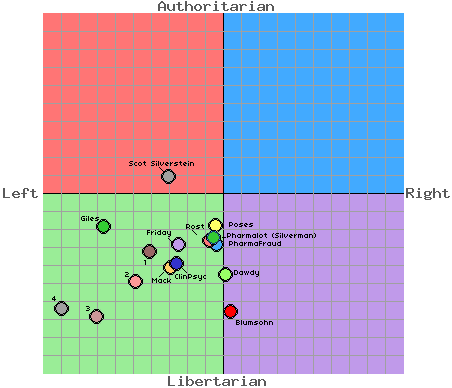
In a previous post I challenged pharmaceutical bloggers to undertake a political test. Here are the results so far. They key is below the chart. For details see here. Take the test here. Clicking individual "dots" should open the respective blogs in a new window. For comparison, below the plots are scores for political figures and UK political parties according to the authors of the test.

Blogs so far are
Healthcare Renewal (Roy Poses and others) - the serious master of them all
Pharmagossip (Jack Friday) - the less serious master of them all
Pharmalot - and the man behind it - Ed Silverman of The Star-Ledger of New Jersey. Superlative journalism and a key source.
Brandweek NRX and Dr Peter Rost, previous Vice President of Pfizer
Pharma Giles - Good Fun
Pharma Fraud - Doesn't Like J&J particularly
Furious Seasons - Excellent look at seriously bad science in psychiatry
Scientific Misconduct Blog - This blog
Clinical Psychology and Psychiatry: A great blog discussing the malfunction of medical science with an emphasis on psychiatry
Pharma BlogoSphere and much more from John Mack (Editor & Publisher of Pharma Marketing News/Pharma Marketing Blog)
Dr Scot Silverstein, an author at Healthcare Renewal

1, 2 and 3 are three excellent and hard hitting (and deeply depressing) UK-based patient blogs devoted specifically to exposing misconduct and misrepresentation in clinical trials of Seroxat (Paxil) and various aspects of the integrity of GlaxoSmithKline.

1 = Bob Fiddaman Blog
2 = Seroxat Secrets
3 = It's quite an experience: Matt Holford (a compliance lawyer)

4 is Honest Medicine. Julia Schopick created Honest Medicine in honor of her late husband, Tim Fisher, as a way to "work with others to make significant changes to the way people think about, and interact with, our flawed medical system."

Some historical figures


UK Parties


Earlier|Later|Main Page

Saturday, January 26, 2008

BMJ Advertising Watch : 26 January 2008

This is the British Medical Journal Advertising analysis for this week.

I'll also continue to comment on any appearance of any discussion in the BMJ about questionable Ezetimibe research.

Rules: As usual this is for the UK version of the BMJ. The classified advertisement section is excluded, as are pages advertising the BMA or products of the BMJ/BMA/BNF.

Comment: This week the BMJ exceeded all records with 24.5 pages of advertising (giving 1 page of advertising for each 2.4 pages of content). Again 98% of the advertising was for pharmaceuticals. The other 2% was a single half page advertisement for Ramsay Healthcare (for more about Ramsay and their cozy arrangements with the Labour Government see here).

Discussion about the Ezetimibe scandal: Finally, the BMJ published a short news piece by the excellent Jeanne Lenzer on the shonky research underlying the approval of Ezetimibe (Ezetriol, Vytorin, Zetia). There remains no discussion in the BMJ about the precise way in which the scientific community were deceived, the delayed reporting, the attempts to circumvent investigators and to alter endpoints, the interesting sale of Schering shares ($25 million) by an executive, or any discussion of the principles of good science. However a belated and half-hearted congratulations. In contrast to the last issue, there were no advertisements for Ezetimibe.

Merck and Schering-Plough state:
"All of us at Merck and Schering-Plough proudly stand by the established efficacy and safety profiles of Zetia and Vytorin."
Define efficacy. Given the evidence of your behavior, why should we believe you?

Our profession remains mute.

Click here for collated BMJ Advertising analyses.

Earlier|Later|Main Page

Thursday, January 24, 2008

Pharmaceutical bloggers - Take the political test

The debate about the functioning of the pharmaceutical industry is enmeshed in a wider political debate. There seems to be reluctance to confront the ideological issues head on. This allows the continued burbling of those who create ideological opponents by declaring themselves on the side of "the free market" and against "intrusive regulation" while failing to define the meaning of the words they use. It is why we read twaddle like this from Billy Tauzin of PhRMA or the illogical rants of Robert Goldberg and Peter Pitts on DrugWonks. These individuals (in my view) represent the very antithesis of the free market they espouse.

There is an interesting "Political Compass" that has been working its way through a few political blogs. Take the test here. My score is below. I challenge my friends on the blogroll to report their scores. I suspect we all lie in a similar range - hardly foes of the free market or of industry in general.

As already pointed out, there are some significant flaws in the questionnaire, but it's a useful start. Some propositions are worded in such a way that people with radically different views on the issue would be forced to answer in a similar way.

Here is one example of a proposition one is asked to score:

Question A: "Governments should penalise businesses that mislead the public"

That is an incomplete proposition, and one which begs several qualifying clauses. One could ask a different question:

Question B: "Governments have the right to protect businesses that mislead the public by enacting legislation and through regulatory procedures which
a) disallow scrutiny
b) allow hiding of evidence
c) prohibit litigation by individual consumers through regulatory pre-emption rules"


I suspect these answers would distinguish Billy Tauzin or Robert Goldberg from the ideological straw-men they set up as adversaries. The distinction is between honesty and dishonesty, and open transparent science versus secrecy.

Earlier|Later|Main Page

Wednesday, January 23, 2008

Jeanne Lenzer on the "clinical trial register"

Last year the US Congress required drug companies to post announcements of clinical studies in a public database.

The "Clinical Trial Register" as currently constructed is most unlikely to solve the problem. In fact it may provide an appearance of a solution, diverting attention from the real problem. There are several obvious reasons for this, some of which are given by the excellent medical reporter Jeanne Lenzer in her NPR interview of 18 January 2008 (Transcript here).

On the "federal fine for pharma companies who misreport or don't report"

LENZER: Ten thousand dollars, it’s meaningless. Even though some of those fines can accumulate after a certain period of time, they get a 30-day warning period, and at $10,000 a day that’s nothing next to the millions of dollars per day that they pull in. And if the past serves as any kind of information, then what we know is, is that they will ignore these.

Death as a trade secret: On the fact that we already had a Clinical Trial Register - it was called the FDA. Those charged with maintaining that register have colluded to hide inconvenient findings.

LENZER: Yes. There was a research scientist who really had a stricken conscience and called me and said that Congress is looking at whether antidepressants cause suicidality or not. And it’s natural to wonder is it really the drug or is it the underlying depression?

And what this research scientist, who remains anonymous, said to me was because they knew there was a question about suicidality with their pills. What they did in this study was they took healthy test subjects, screened them all to not be depressed and then tested them with this drug that they hoped they would be able to use for urinary incontinence.

And what they found was there was about a doubling of the suicidality among these patients. So that sure seemed like important information to patients who were taking that same drug for depression.

INTERVIEWER: But because the drug was not put on the market as an anti-incontinence product, the rules did not require Lilly to disclose the suicide of an otherwise healthy 19-year-old college student in the midst of a trial in its own laboratory.

LENZER: Exactly. And when I filed a Freedom of Information Act request with the FDA for all of the serious adverse events and deaths of patients taking this drug, and when I got that database back, it did not include her death. And it didn't include the deaths of at least four other patients. They weren't even patients. These were healthy volunteers who were taking the drug as part of a clinical trial.

And I asked the FDA why they hadn't released these deaths, and they said, because they are a trade secret. And they were a trade secret because the drug didn't make it onto the market for that particular use, for incontinence. But it was being used by many patients for depression.

The most important comment of all : On raw data

INTERVIEWER: It seems to me that, you know, there’s a very good solution for this at hand, and that would be a change in the law that would allow the FDA to demand and post on the Internet not only the existence of all clinical trials but the results, and then let it be sorted out by the medical community. But that’s not possible now, is it?

LENZER: You’re right, because right now, under trade secrecy rules, which is what affected the girl that we discussed earlier who committed suicide, her death was considered a trade secret. We need to change things so that anyone’s clinical outcome on a trial should never be a trade secret, and that should be available for scrutiny - and I'd also add not just the results of these trials but the actual underlying raw data. They need to be available to other scientists for scrutiny.

For other comments see Clinical Psychology and Psychiatry : Clinical Trial Registry of WHAT?

Earlier|Later|Main Page

Saturday, January 19, 2008

BMJ Advertising Watch : 19 January 2008

This is the British Medical Journal Advertising analysis for this week.

I'll also comment on any appearance of any discussion in the BMJ about questionable Ezetimibe research.

Rules: As usual this is for the BMJ as delivered to subscribers in the UK. The classified advertisement section is excluded, as are pages advertising the BMA or products of the BMJ/BMA/BNF.
BMJ Advertising analysis 19 Jan 2008
Comment: This week only 98% of the advertising was for pharmaceuticals (there was a single half page advertisement for a Private Healthcare company). As before, there was no advertising space devoted to other products doctors might be inclined to purchase (stethoscopes, expensive cars, services, holidays, books, cosmetics), or non-pharmaceutical healthcare products. The ratio of advertising space to content was about the same as last week (1 page of advertising for each 2.6 pages of content).

There were two rather good articles about osteoporosis in this issue. I'll discuss these over the next few weeks.

Discussion about the Ezetimibe scandal: Still none at all. There was however a full page advertisement for Ezetimibe (Ezetriol, Vytorin, Zetia). The advertisement states "Better Together", "For patients not controlled by initial statin alone". The advertisement doesn't mention that the only evidence available so far suggests that the drug has no clinical benefit at all. It also doesn't mention what happened to the data.

Click here for collated BMJ Advertising analyses.

Postscript: Matthew Holford posted an interesting commentary on this BMJ Ad-watch. He revealed correspondence with the BMJ asking about their reported rejection of a scientific paper criticising GlaxoSmithKline. This rejection was apparently on the basis of the legal costs of review rather than on factual content. He asked how much an advertisement costs in comparison with legal "peer review" of a manuscript (perish the thought). He received no reply. I'll say more about this next week.

Earlier|Later|Main Page

Tuesday, January 15, 2008

Ezetimibe Zetia Vytorin - Headless Chicken Award

The Ezetimibe data are out (all those thousands of un-analyzed images that formed the excuse for non release of the results were obviously analyzed at the speed of light). From the WSJ "The long-delayed and much-speculated-about data from Merck and Schering-Plough’s Enhance study comparing whether a combination of Zetia and Zocor works better than Zocor alone were finally released today."

It's a bummer. Time for the first Headless Chicken award of 2008.


Earlier|Later|Main Page