Showing posts with label Academic bullying. Show all posts

Sunday, February 07, 2010

A petition - academic bullying

I'm taking a break while sorting out a few other things. However this seems a worthwhile petition to 10 Downing Street.

The case referred to in the petition appears to be that of Dr. Howard Fredrics, formerly of Kingston University. The case of Howard Fredrics is an important one - most especially so to writers who seek to call the leadership of academic institutions to account for their actions.
We the undersigned petition the Prime Minister to instigate an open enquiry into allegations of workplace bullying / harassment in institutions of higher education and concerns about the way the judicial system has dealt with complaints about such bullying and with those who protest (publicly or otherwise) about wrongdoing by their employers; the enquiry to be conducted with a view to addressing issues of concern that it may uncover.

Workplace bullying is a widespread problem wrecking health and careers and costing billions to the taxpayer. This problem is particularly serious in higher education. A recent survey by the Universities Colleges Union showed that as few as 45.1% of the participants were fortunate enough to never experience bullying.

Existing legislation addresses some aspects of workplace bullying, but does not deal with this problem comprehensively. There is also a perception that the judicial system does not always enforce the existing legislation fairly. Dissatisfaction with the way bullying is dealt with has led some to go public.

In response to the handling of a recent case by the courts, many academics and others expressed their indignation about the bullying that prevails in institutions of higher education, as well as the failure of the judicial system to deal with these problems satisfactorily. Similar concerns have been voiced before.

In addition to the obvious non-pecuniary benefits, addressing the problem of workplace bullying will bring about substantial pecuniary benefits in the form of improvements in the economy and cost savings to the taxpayer.

Sign the petition:

http://petitions.number10.gov.uk/Justice-Bullying/#detail


Earlier|Later|Main Page

Saturday, July 05, 2008

Rhetta Moran, David Healy - and the language of academic bullying

My friend Rhetta Moran was fired from Salford University (a "greater" Manchester University) in 2005 under very unusual circumstances.

There are fascinating linguistic aspects of sham university procedures and integrity scandals. Rhetta's research was said to be "no longer compatible with the school".

A key problem facing academia in the UK is the lack of any plausible institution that speaks up for integrity and the values of a university. As Rhetta states, "One would have thought that the idea of "compatible" or "incompatible" research would be something that should interest an academic union".

This brief summary of Rhetta's story serves as a prelude to my next post about a joint letter we wrote to Sally Hunt about the dismal integrity failures of the Association of University Teachers (AUT). Hunt is currently General Secretary of the University and College Union (UCU), and the last General Secretary of the AUT the merger with NATFHE to form the UCU.

The idea of "incompatible" research formed a key part of the scandalous firing of Professor David Healy at the University of Toronto. Following a lecture during which Healy expressed concerns about the integrity of pharmaceutical research, Dr. David Goldbloom fired him, stating that : "We believe that it is not a good fit between you and the role as leader of an academic program in mood and anxiety disorders at the Centre and in relation to the University. This view was solidified by your recent appearance at the Centre in the context of an academic lecture. While you are held in high regard as a scholar of the history of modem psychiatry, we do not feel your approach is compatible with the goals for development of the academic and clinical resource that we have."

In contrast to supine academic unions in the UK, some other academic unions (most notably the Canadian Association of University Teachers) have acted vigorously to defend many academics confronted by important assaults on integrity.

I will let Rhetta introduce herself:

Dr Rhetta Moran, 1 July 2008

I was dismissed by the University of Salford under unusual circumstances in 2005 following a previously successful academic career. During the previous year, I had been the lead investigator in a publicly funded project (Salford RAPAR SRB5) which was designed to collate accurate information about housing, health, employment, economic, personal safety and education problems involving people seeking asylum. The project was funded through the Office of the Deputy Prime Minister. Clearly this was a contentious project.

No factually plausible reasons for my dismissal as an academic under such circumstances have ever been provided. Employers appear to exercise the right to dismiss staff on the most thinly constructed grounds, or even no grounds at all, such as unspecified research "incompatibility". The university returned all grant funds including a newly obtained one (£192,316) from the European Social Fund.

I have learned that legal structures designed to deal with employment disputes have almost no relevance to academic integrity. Neither, unfortunately, did the Association of University Teachers (AUT).

We now know that the PCT Chief Executive, Mike Burrows, wrote to my "boss" Professor Michael Harloe and told him I was being removed from leadership of the research in April 2004. This was very shortly after a newspaper article appeared in the Observer. In this article (March 28, 2004) the Observer described how young asylum-seeking women were having to go underground in Salford. Drawing on work and contacts provided by myself, it cited me as follows:
People have been dumped in Salford, but without resources,' says Dr Rhetta Moran, a senior research fellow at the Revans Institute with overall responsibility for the Salford RAPAR project. 'There was no additional support for local practitioners. There is not one immigration solicitor in the whole city. And it leads to bitterness because this is a place where locals have been making their own demands on the council for years.
Other staff employed on the project were threatened with immediate suspension for gross misconduct if they had anything to do with me. It appears that there was an attempt to induce staff to accuse me of bullying, but they declined to do so. The following month I received a letter of dismissal signed by John Dobson, who advised that my research was no longer "compatible" with the school. Dobson as it happens is also the current President of Salford University UCU.

This lack of "compatibility" was never explained.

One would have thought that the idea of "compatible" or "incompatible" research would be something that should interest an academic union. The AUT attempted to induce to me to go along with a sham process as well as a gag agreement while ignoring every principle involved. Their silence has been deafening.


The university then stated that the reason for my dismissal was because I was "redundant" - a truly marvellous tautology.

I was finally sacked in January 2005, the day before the Deputy Prime Minister announced the opening of the Central Salford Urban Regeneration Company, in which my former boss Vice Chancellor, Michael Harloe has major involvement.

It is not clear whether any "incompatibility" might be down to fear of research or academic discussion that a City Council or conflicted academic leadership would find uncomfortable. It would be good to know.
Earlier|Later|Main Page

Saturday, April 05, 2008

Gardasil scandal: University of Queensland exits the civilized scientific community

Just after my last post on the role of a University I read this piece in today's British Medical Journal about an appalling episode at the University of Queensland that goes right to the heart of what a University is. The University of Queensland has broken its contract with the scientific community. This is an absolute disgrace.

I am reminded of the letters to me stating that I needed University "authorisation" to discuss issues of scientific procedure. I recall the warning of "public dissociation" and that "public interest disclosure legislation" somehow applied to discussion of scientific methodology involving Procter and Gamble.

From the University secretary and registrar at Queensland (Douglas Porter) this most absurd of comments:

Douglas Porter, wrote to Dr Gunn, asking him to provide a written apology to CSL stating that the "comments were made by you in your personal capacity and were not endorsed or authorised by the university." - "The University of Queensland’s vice chancellor declined to comment and referred the BMJ to Mr Porter, who said that Dr Gunn "had no authority to speak on behalf of the university" and should not have mentioned his university position. "It’s an absolute storm in a teacup."

What are you Mr Porter - The University of Kentucky Fried Chicken, or a real University? Shame, shame and more shame.

BMJ 2008;336:741 (5 April) [Link]
Academic freedom is at risk in dispute over Gardasil, lecturers say
Melissa Sweet, Sydney


Senior academics are outraged that the University of Queensland has asked an academic to apologise to a drug company for his public comments on a vaccine against human papillomavirus that was developed jointly by the university and the company.

Academics at the university and elsewhere say that the request is a threat to academic freedom and warn that it raises worrying concerns about universities’ independence and ability to negotiate conflicts of interest.

The request came after the company, CSL, wrote to the university’s vice chancellor complaining about comments on the radio made by Andrew Gunn, a senior lecturer in general practice.

The programme dealt with the general issue of pharmaceutical marketing and briefly mentioned Gardasil, whose development has reaped millions of dollars for the university as well as public and political kudos.

CSL’s director of public affairs, Rachel David, wrote: "I feel Dr Gunn’s comments are inappropriate and inconsistent with the long-standing relationship CSL has with the University of Queensland and given the involvement of the university in the development of Gardasil."

On 14 March the university’s secretary and registrar, Douglas Porter, wrote to Dr Gunn, asking him to provide a written apology to CSL stating that the "comments were made by you in your personal capacity and were not endorsed or authorised by the university." Mr Porter also asked to be sent a copy of Dr Gunn’s letter to CSL.

Dr Gunn said he was disappointed by the university’s response and that the company’s complaint seemed to be aimed at stopping him from speaking out again. "Even if you’re fairly resistant to pressure, it’s got to make you think twice about saying potentially critical things about their products," he said.

Wayne Hall, of the university’s School of Population Health, described CSL’s response as "heavy handed" and said that the university’s response was "disrespectful of the rights of academics to speak out on matters of public interest."

The university’s executive dean of health sciences, Peter Brooks, also expressed concerns about the handling of the complaint and said that universities generally needed to do a better job of resolving conflicts of interest.

"If you’ve got very large amounts of money changing hands, then it’s very difficult, I think, not to let that influence you to some extent," he said. "It’s a dilemma that universities have.

"Quite frankly, I have said that I think that if anybody at UQ [University of Queensland] makes a statement about Gardasil, including the inventors, if it’s going to be a public statement then probably under conflict of interest [guidelines] they should acknowledge that the university receives significant funding from CSL each year."

Paul Glasziou, director of the Centre for Evidence-Based Medicine at the University of Oxford and a former University of Queensland academic, said that the freedom of academics to speak without interference from their employers or government was crucial in an open society and that it was reasonable for Dr Gunn to have used his academic title.

Chris Del Mar, dean of health sciences and medicine at Bond University, Robina, Queensland, and an honorary professor at the University of Queensland, said that universities should support academics in saying what they think. "Discourse and argument are the stock in trade of academics," he said. "To gag [argument] is anti-academic."

Simon Chapman, of the University of Sydney’s School of Public Health, said that the registrar’s letter should appal all researchers and academics.

"The registrar and vice chancellor would do well to read their own website on how academics should present themselves in public. The University of Queensland’s policy states: ‘It is accepted practice that where a member of staff is writing on something which is clearly within the range of professional expertise, it is appropriate for the member of staff’s university position to be given.’"

Professor Chapman said that the registrar’s suggestion that a university would have official views on drug company promotions or a specific vaccine is "both preposterous and inimical to academic freedom."

David Henry, adjunct professor at the School of Medicine and Public Health at the University of Newcastle, New South Wales, said that the university’s response was even more inappropriate than CSL’s.

He said, "It is fairly predictable that a company will react to what they see as a commercial threat, but it is very worrying that a university would require an academic to get clearance before giving an interview."

"It shows that poor funding of Australian universities has led to desperation in their attempts to raise funds from other sources, including commercial companies. In doing this they are abandoning part of their mission, which is to generate and communicate new knowledge in a fearless and impartial way."

Carolyn Allport, president of the National Tertiary Education Union, added: "If freedom of inquiry is to be respected as a core responsibility of universities, then it is important that both universities and academics and researchers retain their rights to engage in critical commentary, in the public interest."

The University of Queensland’s vice chancellor declined to comment and referred the BMJ to Mr Porter, who said that Dr Gunn "had no authority to speak on behalf of the university" and should not have mentioned his university position.

"You’re just beating this up," he told the BMJ. "It’s an absolute storm in a teacup."

Dr David of CSL said that she had asked the university to clarify whether Dr Gunn was speaking on behalf of the university, because "if the university does not have access to correct information about our products, it is clearly a more important issue than if the interview simply reflected the opinions of an individual."

She said, "Neither I nor anyone else at CSL has the power or the inclination to ‘gag academic freedom’ or any form of freedom of speech, and I am not aware of any arrangement with the university or any other academic institution in Australia that would even allow for this possibility."

A spokesman for UniQuest, the university’s commercial arm, said that the exact value of Gardasil’s returns to the university was confidential but that it amounted to some millions of dollars annually.

A transcript of Dr Gunn’s comments is available at www.abc.net.au/rn/perspective/stories/2007/2108059.htm


Although not relevant here - remind me - what is the evidence that Gardasil actually works?

Earlier|Later|Main Page

Tuesday, April 01, 2008

It's Groundhog Day for bullying by GlaxoSmithKline over Seroxat

It seems that attorneys representing GlaxoSmithKline (GSK) in the UK have sent a letter threatening a patient (Bob Fiddaman). Fiddaman writes the "Seroxat (Paxil) Sufferers blog". As a result of the letter, Fiddaman felt intimidated to remove a video he created and posted to his website in February.

Here is a link to the Fiddaman Video which is now hosted on U-Tube.


As doctors we sell our services and the products of industry under the banner of science. The leadership of our profession has long colluded with industry to silence those who draw attention to dishonest science. Although much criticism of medicine is ill-founded, many critics strike at the core of what we do. Their questions are about science. Many of those critics are our patients. They question the quality, transparency and honesty of our science, and they do so with good reason. We ignore these patients and these questions at our peril. That such patients should be threatened is a disgrace.

GSK stand accused of conducting some fairly disreputable science. The particular questions Fiddaman has been asking in his blog relate to a particular medical employee of GSK, Dr Alastair Benbow. The attorneys apparently complained to Fiddaman that Benbow was feeling harassed as a result of the video. They also took umbrage that Fiddaman has implied that Benbow was a liar.

It seems to me that Dr Benbow does indeed have some serious answering to do. He has to explain whether public comments he made were truthful (or otherwise) at the time he made them. If not truthful, he has to explain whether he lied, was duped by his employer, or whether he failed to examine the facts before making crucial public statements. He has to respond both as a scientist and as a medical doctor. And he has to respond in public.

It is not sufficient for a public scientific figure to claim harassment when asked to justify crucial public scientific statements that he made. There is a bit of age-old advice called the Second Rule of Holes: "When you find yourself in a hole, the first thing to do is to stop digging." In other words, don't let your ghostwriters draft your obituary.

Some of the questions Benbow has to answer are in the Glenmullen report. There are many other questions. Read Fiddamans blog, or other excellent blogs about the failure of science involving SSRI's written by questioning patients or patient representatives (Seroxat Secrets, Furious Seasons, AHRP, Matt Holford). Those very same questions are being asked by psychiatrists and psychologists (Clin Psych, Carlat).

Earlier|Later|Main Page

Sunday, March 09, 2008

The 2008 Pharma "Competitive Intelligence" Conference

Now this should be an interesting meeting.

The 2008 Pharma Competitive Intelligence (CI) Conference on Sept. 15-17 in New Jersey.

"This is one of the best and largest gathering of pharma Competitive Intelligence professionals".

Who is speaking?
Here is a sampling of the many pharma speakers:
  • Monika Giese, Head Global Competitive Intelligence, Novartis Pharma AG
  • Jerry Hoffman, Manager-Global Competitive Intelligence Strategy, Eli Lilly & Co.
  • Daniel Pascheles, Vice President, Global Competitive Intelligence, Merck
  • Renee Pierson, Global Intelligence Leader, Johnson & Johnson Pharmaceutical Services
  • Chandra Ramanathan, Director, Global Business and Competitive Intelligence, Bristol-Myers Squibb
  • Craig McHenry, Senior Director, Competitor Insights, Wyeth
What is competitive intelligence?
We don't really want to explain, but probably stuff that interferes with honest science and honest people. Perhaps spying and some bullying. Perhaps things like:Is this ethical?
See The Ethics of Competitive Intelligence

If we are competing, why are we all there?
Depends who we are competing with

So who is the competition?
Proponents of the doctrine that black is black.

Please explain?
"There was a society of men among us,
bred from their youth in the art of proving,
by word multiplied for the purpose,
that white is black and black is white
according to how they are paid".
Jonathan Swift


Earlier|Later|Main Page

Friday, February 08, 2008

The ongoing story of Wyeth, the FDA and Dr. Hampshire

This is an ongoing story that should not be forgotten

From the GAP blog:

Last Wednesday, Senator Charles Grassley sent a letter to the HHS Secretary and FDA Commissioner detailing how Wyeth Pharmaceuticals engaged in a smear campaign aimed at discrediting an FDA safety officer (and GAP client) assigned to review one of Wyeth's animal care products. After Wyeth met with FDA officials and presented false and misleading information, the FDA wrongfully removed GAP client Dr. Victoria Hampshire from her position as the drug's reviewer.

Dr. Hampshire previously found that Wyeth's ProHeart 6, a canine heartworm drug, was responsible for contributing to the deaths of hundreds of dogs. After following correct procedures in mid-2005, the drug was removed from the marketplace due to obvious safety concerns.

Grassley's letter details how Wyeth (by its own actions and those of a subsidiary) and the FDA performed several questionable and unethical actions in retaliating against Dr. Hampshire in attempts to get ProHeart 6 back on the market. These include:
  • Wyeth's threats to bring down high-level Bush administration pressure on the FDA if they refused to release confidential information.
  • Wyeth's hiring of a public relations firm to research Dr. Hampshire's personal property and tax records. This same firm hired consultants to lie and mislead Dr. Hampshire into believing they were veterinarians in a feeble and failed attempt to entrap her into establishing a direct monetary relationship with a Wyeth competitor.
  • Wyeth's hiring of a private investigator to 'dig up dirt' on Dr. Hampshire.
  • FDA's opening of a criminal investigation into Dr. Hampshire's background, unbeknownst to her. This background saw a Wyeth subsidiary official repeatedly contacting FDA investigators in an attempt to guide their probe.
  • FDA's referral of the criminal case, based on Wyeth's misleading "evidence," to the United States Attorney's Office of Maryland. That office declined to prosecute.
This is a disgrace. It is not the way science is supposed to work. It is not the way scientists doing an honest job are supposed to be treated. Shame and more shame on Wyeth, and shame on those who have colluded, covered up, and "declined to prosecute" the criminals in this case.

The Senator earlier sent a letter to Wyeth, demanding to know whether they paid private investigators to spy on the FDA official. A character called Clint Newsum, Wyeth's counsel, was heavily involved in all this. The same Clint Newsum has been paying off pet owners whose dogs have died after taking Proheart. On this website you can see the letters Clint Newsum has sent to bereaved pet owners, offering them "shut up" money on condition they stop speaking out about ProHeart causing their pet's deaths (and absolving Wyeth of any blame).

Some Wyeth products are:
  • Advil
  • Advil PM
  • Alavert
  • Caltrate
  • Centrum
  • ChapStick
  • Dimetapp
  • Dristan
  • Preparation H
  • Robitussin
  • Premarin
  • Effexor
  • Ativan
  • Protonix
  • Enbrel
  • Torisel
  • Tygacil
  • Zosyn
See links to earlier reports on this disgraceful story

Wyeth Mission Statement:
At Wyeth, our mission is to bring to the world pharmaceutical and health care products that improve lives and deliver outstanding value to our customers and shareholders.

Earlier|Later|Main Page

Friday, February 01, 2008

A few notes on the abuse of occupational health procedures

"Whom the Gods wish to destroy, they first make mad"
-Euripides

Over the past few years I have listened to many cheerless stories of individuals who have exposed unacceptable practices within universities and hospitals. The institutional response is almost formulaic.

A frequent part of the common experience is the abuse of occupational health procedures. Following an incident this week involving a colleague, I have summarised some aspects of UK occupational health law below.

Most of these individuals started with the belief that their institutions would assume responsibility for upholding their own rules of conduct. They assumed that responses would be honest, colleagues and professional bodies would behave honorably, and that someone would take responsibility for the safety of the product (whether that product is a drug, honest science, open academic discourse or care of individual patients).

In reality, most are projected into an Alice in Wonderland world of sham procedures, collusion, lies and bullying. Many become ill (see the case of Dr Z), and some die. Distress signals are used by poor managers to invent "health concerns" and to avoid rational discussion about genuine problems. That hospitals and medical schools abuse their staff through health mechanisms is indicative of deep immorality within these institutions. The process usually starts as an apparent expression of genuine concern about the health of the employee.

Sadly, psychopathic administrators and medical leaders are rarely subjected to psychiatric or medical evaluation.

Employees should almost never agree to an employer's "offer" of health evaluation under these circumstances. When such evaluation takes place, it should only be for the benefit of the employee. Any assertion by the employer that they must have any right of access to health information is illegal and constitutes serious bullying.

Aspects of the relevant law is summarised from these sources: a) Occupational Health Law, 4th Edition, Diana M Kloss ISBN 0632-064978, b) Medical Ethics Today: Its Practice and Philosophy, Veronica English, Gillian Romano-Critchley. 2002 2nd Ed. BMJ Books, ISBN 0727917447
  1. The physical occupational health (OH) records technically belong to the employer, but the employer has no right of control or access to the information therein.
  2. OH doctors should have an agreement their employer with regard to confidentiality of records. If the doctor leaves the company, records remain the property of the employer, but should be passed to a new doctor or nurse with the same obligations. If an employee moves to another employment, OH records can only be transferred to the new employer with consent.
  3. Employers cannot enforce terms in contracts of employment stating that employees must provide copies of medical records.
  4. OH doctors have a duty of confidence which is the same as that for any other doctor. For example, if an OH physician were to reveal to the human resources department (without permission) that an employee has a drink problem the doctor could be sued for damages. Secretarial staff who have access to confidential information share these obligations.
  5. According to the General Medical Council there are restricted circumstances under which information could be conveyed by a doctor:
    • The patient explicitly consents.
    • Some circumstances where the doctor shares information with other health professionals caring for that patient
    • Parliament requires disclosure (notifiable diseases, RIDDOR reporting of injuries at work, and more worryingly "terrorism legislation")
    • Disclosure may be made to a statutory regulatory body for investigation into a health professional's fitness to practice (it is worrying that the GMC would see fit to incorporate such a provision without detailed qualification)
    • Disclosure is in the public interest, e.g. to the police about a serious crime
  6. If consent is provided, it can later be withdrawn. Consent should be in writing for the protection of the doctor or nurse. Consent should clarify exactly what records may be passed over - not simply "all records". The OH doctor can refuse to accept partial consent if that would be misleading through omission. An OH doctor should not communicate with the patient's own doctor without consent.
  7. Guidance from the Nursing and Midwifery Council (2002) is more coherent with greater emphasis on the purpose for which information was supplied: "To trust another person with private and personal information about yourself is a significant matter. If a person to whom that information is given is a nurse, midwife or health visitor, the patient or client has a right to believe that this information, given in confidence, will only be used for the purposes for which it was given and will not be released to others without their permission".
  8. Mere attendance at the OH department does not imply consent.
  9. Even if an employer is facing legal action by an employee, OH records should not be disclosed to the employer without consent or a court order.
  10. An occupational health doctor may find that an individual is somehow unfit for a job or that the employee is in danger. This does not justify a breach of confidence. If the danger is to others there may be a case for breach of confidence, but even then this requires very careful deliberation.
  11. Per the Faculty of Occupational Medicine's Guidance on ethics: "Occasionally the occupational physician ....may find that an individual is unfit for a job where the safety of other workers or the public is concerned. He should then take great care to explain fully why he thinks the disclosure of unfitness is necessary.... Where this is not obtained the occupational physician is faced with an ethical dilemma..... Ultimately, the safety of other workers and the general public must prevail..."
  12. Occupational health doctors should not become involved in advising employers on the validity or otherwise of sickness absence of an employee. They can however (in consultation with the employee) advise management on potential changes required to the conditions of employment. The doctor may also advise the employer about future employability but without providing clinical details of sickness to the employer.
  13. Some occupational health records may be of direct relevance to the employer (for example where the employer has a legal requirement to monitor toxic substances). Those records should be maintained separately from other records. Conveying of such records also requires consent.

Earlier|Later|Main Page

Wednesday, October 24, 2007

Memory Hole (24 October): Everyone is fooled

Scientific Misconduct Blog Memory Hole: Events of October the 24th


Houdini patent

81 years ago today: Houdini's last performance

On 24 October 1926 Harry Houdini the famous escapologist gave his last performance
(at the Garrick Theatre in Detroit).

His escapes relied on trickery and misdirection.

Not unlike the nimble evasions and circumlocutions, and the Houdini-like scientific escapes discussed here.
It is about those scientific fraudsters and fakers who slip through the loopholes. Everyone is fooled.

He was also a genius.

The picture is a detail from his 1 March 1921 patent application for a diving suit.

#1370316 signed "H Houdini, Inventor".

Serious science and engineering underlying the tomfoolery.


78 years ago today: Stock market crash

24 October 1929 was the "Black Thursday" crash on the New York Stock Exchange. I am interested in the functioning and malfunctioning of government and "regulators" (including drug "regulators") in a supposed free market - hence this entry.

60 years ago today: Walt Disney and the "communists"

On 24 October 1949 Walt Disney testified to the House Un-American Activities Committee naming Disney employees he believed to be communists. Ditto above.

scientific authorship

5 years ago today: Imperial College London and the mystery publication

On 24 October 2002 a mysterious paper appeared in the New England Journal of Medicine about hypertrophic cardiomyopathy (W. Shamin et al. NEJM. 347, 1326 1333, 2002)

There were eight authors. The signatures of all eight appeared on the original submission and the three revised versions. Over the weeks following publication it emerged that several of these signatures were forgeries. Indeed most "authors" had never seen the manuscript, nor the original data.

Six "authors" had affiliations with Imperial College. Two authors, Waqar Shamin and Mohammed Yousufuddin appear to have chosen six other authors at random to lend prestige to their paper. One author stated "The first thing I knew of it was when Yousufuddin rang me two days before its publication to congratulate me, and to ask me about the method involved in case journalists questioned him".

Having said that, authors in the NEJM and elsewhere are often not authors at all.

This is a good quote about the importance of authorship:

"the integrity of a body of literature is our society’s ultimate temporal forum for negotiating life and death, suffering and wellness... the medical well-being of the society it serves is dependent on the question of who stands behind the word."
-Fr. Mark Gruber, 1999 (cited in ref)

Source for main story: "Paper Retracted as Co-Author Admits Forgery," Nature 421: 77.

3 years ago today: Bullying of doctors in the USA for raising patient welfare concerns

On 24 October 2004 the Association of American Physicians and Surgeons passed a resolution to investigate what they describe as "bad faith" peer review (basically use of hospital "peer review" proceedings to bully doctors who advocate too loudly or too persistently for better patient care).

One year earlier in October 2003, the same newspaper, the Pittsburg Post Gazette published an excellent series of articles over four days dealing with the abuse of doctors who had voiced concerns over patient welfare in the United states. Some of the articles in this "Cost of Courage" series are below:

Part 1: How the tables turn on doctors
Part 2: When right can be wrong
Doctors who spoke out: part A
Doctors who spoke out: part B
Doctors who spoke out: part C
Doctors who spoke out: part D
Extra: Rules of fair play don't always apply
Extra: Centre County hospital critics soon unwanted
Extra: Doctors pay for reporting suspicions

Source main story: Medical groups look into 'bad faith' peer reviews, Pittsburg Post Gazette, Oct 24, 2004

2 years ago today: Cylert discontinuation

On 24 October 2005 the FDA announced that "the overall risk of liver toxicity" from Cylert (Pemoline, an ADHD drug) "outweighs the benefits of this drug". It was linked with 21 cases of liver failure, of which 13 resulted in liver transplantation or death (incidence 10 to 25 times greater than the general population). Abbott Laboratories had already discontinued production.
Source: FDA Alert: Cylert

Earlier|Later|Main Page

Saturday, October 20, 2007

Memory Hole (20 October): The Protectors

Scientific Misconduct Blog Memory Hole: Events of October the 20th

Quotes of the day

This and no other is the root from which a tyrant springs; when he first appears he is a protector.
Plato circa 400 B.C.

A good deal of tyranny goes by the name of protection.
Louise Erdrich

60 years ago today: Academic Freedom is un-American

On 20 October 1947 the House Un-American Activities Committee opened hearings into supposed communist influence in the motion picture industry.

22 years ago today: Secret C.I.A funding at Harvard

On 20 October 1985 it was reported that Nadav Safran, a Harvard Professor of Near Eastern Studies had been receiving confidential research funding from the Central Intelligence Agency ("Harvard Widens Inquiry in C.I.A. Aid to Professor," New York Times 20 Oct 1985). Part of the agreement was that he should submit his manuscripts to the CIA for prior approval. Several scholars had earlier withdrawn from a conference on Islamic fundamentalism at Harvard after learning that the CIA was one of its sponsors. Safran was later forced by his colleagues to resign his Harvard position. See some discussion in the Harvard Crimson of 1986.

6 years ago today: UK Government accused of coverup over sheep research

On 20 October 2001 the UK Labour Government was accused of trying to hide details of the disastrous scientific investigation into BSE in sheep.

2 years ago today: Pargluva and regulatory failure

On 20 October 2005 an important article was published JAMA (Brophy JM. Selling safety - lessons from muraglitazar. JAMA 2005; 294) indicating various techniques used to provide a deceptive impression of the drug Pargluva (muraglitazar) to a puppet FDA panel. For the methods used to mislead see the summary at Health Care Renewal.

The FDA panel reviewing Muraglitazar had known of concerns, but had conflicts of interest. They backed the drug regardless of the absence of any evidence of meaningful efficacy (NYT). The summary of the FDA meeting (available on the internet archive here) indicates concerns about increased heart failure and cardiac death with Pargluva (short term cardiac death rate 0.3% with Pagluva 0% with Actos, CCF 0.75% for Pargluva vs 0% for Actos). Five clinical trials had been notified to the FDA (the "clinical trial register") but were not available in published form.

The parallel scientific report in JAMA concluded "muraglitazar should not be used or approved to treat patients with diabetes until an appropriate dedicated trial to assess cardiovascular outcomes is performed." - which is exactly the conclusion an honest FDA panel should have reached.

On 18 March 2006 Bristol-Myers Squibb discontinued the development of muraglitazar.

2 years ago today: Nature study on distortion of clinical guidelines

On 20 October 2005 the journal Nature reported on their investigation of "independent" clinical guidelines ("Cash interests taint drug advice" Vol 437/ 20 October 2005). The results of the survey showed that "drug companies are distorting decisions about how their products are being prescribed". Surprise.

"Nature found that more than one-third of authors declared financial links to relevant drug companies, with around 70% of panels being affected. In one case, every member of the panel had been paid by the company responsible for the drug that was ultimately recommended." Nature studied over 200 guidelines deposited with the US National Guideline Clearinghouse. Only 90 contained details about conflicts of interest. Of those, just 31 were free of industry influence.

In one example uncovered by Nature, guidelines for the treatment of anaemia in HIV positive patients were written by a working group selected by Paul Volberding at UCSF. Volberding convened the group at the request of Ortho Biotech. Ortho Biotech funded the meetings and all six members were paid by the company for lecturing or consultancy. The group's guidelines (P.Volberding et al. Clin. Infect. Dis. 38, 1454-1463; 2004) recommend use of epoetin alpha, a drug marketed by Ortho Biotech.

Patients die as a result of schlock science - does anyone care?

2 years ago today: David Healy, the BMJ and Academic Stalking

On 20 October 2005 Professor David Healy gave a landmark talk at Columbia University. Amongst other things he detailed the role of lawyers at the British Medical Journal in the peer review process: "our best journals refuse to take articles on the basis of sheer terror about what pharmaceutical companies might do to them rather than on the basis of any concerns about the scientific merits". The lecture was scheduled as a debate between Healy and James Coyne (University of Pennsylvania), but Coyne pulled out. Coyne had an interesting role in the stifling of academic debate (see Academic Stalking) as did academics at Oxford University. Sickening reading.
Earlier|Later|Main Page

Monday, October 08, 2007

Memory Hole (8 October): Illusions of due diligence

The Scientific Misconduct Blog Memory Hole: Events of October the 8th

This quotation from the movie Syriana is appropriate to many of these events:
"We're looking for the illusion of due diligence, Mr. Pope. Two criminal acts successfully prosecuted -- it gives us that illusion."

60 years ago today: Attempt to hide secret human radiation experiments

On 8 October 1947, J.C.Franklin, operations manager of Oak Ridge, wrote to the general manager of the US Atomic Energy Commission: "There are a large number of papers which do not violate security but do cause considerable concern to the Atomic Energy Commission insurance branch, and may well compromise the public prestige and best interests of the commission". He added that such documents "are definitely prejudicial to the best interests of the Government" and ordered that "any such documents be edited or kept secret".

He was writing about the need to keep secret many research experiments involving radiation in humans. These had been carried out without consent or public knowledge.

Source: "Inquiry Links Test Secrecy To A Cover-up," New York Times, 15 December 1994

8 years ago today: Further adventures of Professor Martin Keller

On 8 October 1999 it was reported that Professor Martin Keller of Brown University had received "hundreds of thousands of dollars from drug companies" while he was receiving federal funds to test new drugs, and then provided favorable reports on those drugs without notifying the payments. Keller was paid more than half a million dollars in consulting fees in 1998, most of it from pharmaceutical companies whose drugs he touted.

Scientists seeking US funds are required to disclose to their research institutions any "significant financial interests" that could be affected by the proposed study. Then it's up to the institutions to assess the financial interests. If the institutions find a conflict, they must report it to the US funding agency and protect the research from bias. According to the newspaper report, Brown University appeared unconcerned about the regulations or the conflict of interest. The American Psychiatric Association announced that they were "investigating". For Keller's later involvement in shonky research see here or here or read about his depressing involvement in GSK's study 329 here.
Source: Boston Globe 8 October 1999, page B01

8 years ago today: London professor struck off for bullying and dishonesty

On 8 October 1999 A British professor of respiratory medicine with an international reputation in asthma research was struck off the medical register for bullying and threatening a junior colleague to cheat in a drug trial. See report of the case in the BMJ here and here.

Former Professor Robert Davies had threatened and abused a young doctor and tried to persuade him to break the trial code in order to fiddle the results. Davies threatened that Ramsay's career would be "finished" if he told anyone about the request to break the code blinding the study of the SmithKline Beecham drug Prankulast.
  • The case involved tape recording of Professor Davies by Dr Ramsay. It is likely that without that recording the incident would have ended the career of Dr Ramsay instead of his senior "old-tie" boss. Davies told another colleague that he did not "know a microscope from a fucking hole in the ground". On the tape, Professor Davies is heard saying: "If I hear you speak to anybody you’re finished, OK." Davies said he had been "flabbergasted" to learn Ramsay had taped their conversations. He said when he had told Ramsay he would be finished if he spoke out, it was "in no way a threat to his career".
  • The case included a strange comment from Joanna Glynn, counsel for the GMC. She said that "there was no body, other than the General Medical Council on which the pharmaceutical industry could rely to regulate doctors' activities in clinical trials". Kindly contact me for some education Ms Glynn or read this or this about the corruption of the GMC.
  • The case is important in terms of definition of research misconduct. According to the current tortuous definition promulgated by the ORI and others, the actions of Professor Davies would not constitute research misconduct. Bullying with intent to disrupt the scientific record is not so defined.
Reference: BMJ 1999;319:938 London Professor struck off for bullying and dishonesty

5 years ago today: Pioglitazone data - when all 30 authors are wrong

On 8 October 2002 Nick Freemantle (University of Birmingham) reported in the BMJ (BMJ 2005;331:836-838) that clinical trial findings involving the drug Pioglitazone (the PROactive trial) had been misrepresented and that the conclusions were unsafe.

A response by a reader (Dr James Penston) was pertinent and bears on the responsibilities of authorship. His letter was entitled "When all thirty authors are wrong".

Penston writes: "Perhaps this was simply an innocent error. But it is hard to believe that none of the thirty authors – including 27 professors – were aware that it would be misleading to interpret the data as showing that pioglitazone reduced macrovascular events. Given that 28 of the 30 authors had financial links with the pharmaceutical industry and that the study was funded by Takeda and Eli Lilly, it would have been prudent to avoid at all cost the charge that this manipulation of data stemmed from a conflict of interest."

4 years ago today: Nigeria versus Pfizer

On 8 October 2003 the US Court of Appeals reinstates a Nigerian research case against Pfizer.

"The central events at issue in this lawsuit occurred in 1996, not long after epidemics of bacterial meningitis, measles and cholera broke out in Kano, Nigeria. Pfizer established a treatment center at the Infectious Disease Hospital in Kano to treat victims of the meningitis epidemic.

Plaintiffs allege that Pfizer, instead of using safe and effective bacterial meningitis treatments, used the epidemic as an opportunity to conduct biomedical research experiments on Nigerian children involving Pfizer's "new, untested and unproven" antibiotic, trovaflozacin mesylate, better known by its brand name, Trovan."

Plaintiffs claim that Pfizer failed to obtain informed consent, and that some children were deliberately given inadequate doses of ceftriaxone so that Trovan would look more effective by comparison. Several children died. The case is ongoing (see AHRP or here).

What is the chance that justice will be served under the circumstances?

Four years later it seems that Pfizer is going to try to keep the whole thing quiet through some form of payment of money or perhaps a large bribe.
Source: AHRP http://www.ahrp.org/infomail/03/10/14.php

3 years ago today: FDA officials attempt to soften a report by Dr David Graham about Vioxx

On 8 October 2004 it was revealed that FDA officials had attempted to soften the conclusions of a scientific report about the drug Vioxx produced by Dr David Graham. Senator Grassley was reported as saying "Instead of acting as a public watchdog, the Food and Drug Administration was busy challenging its own expert" “Dr. Graham described an environment where he was ostracized, subjected to veiled threats and intimidation".

Vioxx was later withdrawn. It is estimated that the use of this drug has resulted in at least 100,000 deaths worldwide.
Source: "FDA Officials Tried To Tone Down Report on Vioxx" Wall Street Journal, 8 October 2004

2 years ago today: MHRA leadership asserts its integrity, but with what evidence

On 8 October 2005 Professor Alasdair Breckenridge and Professor Kent Woods coauthored a strange paper in the BMJ (BMJ 2005;331:834-836) subtitled "How does an agency funded by user fees make impartial decisions about the safety of new and licensed drugs?". Breckenridge and Woods are important people. Breckenridge is the chairman of the UK drug regulator (the Medicines and Healthcare Products Regulatory Agency, MHRA) and Woods is the chief executive of the agency.

And the answer to the question is?

Some have asked these gentlemen about the ongoing "independent criminal investigation" of GlaxoSmithKline (see see 1463 days to nothing).

Breckenridge sat on GSK's scientific advisory committee for years before taking up his post at the MHRA (reference). Ian Hudson, who was the worldwide safety director of GlaxoSmithKline (GSK) until 2001, is now director of licensing at the MHRA (reference). As Charles Medawar has pointed out here or here there is a lot of explaining to do.

Earlier|Later|Main Page

Tuesday, July 31, 2007

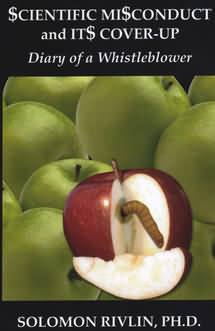
Book review: Scientific Misconduct And Its Cover-up

I found this book interesting.

Scientific Misconduct And Its Cover-up: Diary Of A Whistleblower. Rivlin, Solomon. Boca Raton: Brown Walker Press (Fl), 2004.

The linguistics of scientific integrity would merit considerable academic study. This book provides (through a single case-example) a veritable style manual for Universities and journals trying to impede attempts to hold scientists responsible for their conduct. It includes the original (anonymized) correspondence of one particular case - a treasure trove of linguistic hocus pocus and academic bullying.

The Kafakarian behavior of the involved scientific journals is only too familiar. The essence of scientific misconduct is intentional behavior that disrupts the integrity of the scientific record. Unacceptable and obfuscatory handling of allegations of misconduct would seem to constitute scientific misconduct in and of itself.

Previous book reviews on this blog:
  • Shuchman, Miriam. the Drug Trial: Review| Rating 0/10
  • Shuchman, Miriam. the Drug Trial: Review| Rating 0/10
  • Washburn, Jennifer. University, Inc.: The Corporate Corruption of American Higher Education: Review| Rating 10/10
  • Rivlin, Solomon. Scientific Misconduct And Its Cover-up: | Rating 7/10

Earlier|Later|Main Page

Sunday, July 08, 2007

More on the David Kern affair at Brown University

Dr David KernI have written previously about the depressingly familiar treatment of Professor David Kern at Brown University. The reputation of Brown was brought into disrepute through those events and through other parallel scandals such as that involving Professor Martin Keller. As Kern states "while our medical school and university administrators continue to proclaim a dedication to truth, to the search for knowledge, and to the advancement of civilization, it is all pretense as wordsmithing triumphs over truth and as knowledge is buried."

The best description of the Kern affair is hidden within the (non electronic) archives of the International Journal of Occupational and Environmental Health. It is the now the 10th anniversary of those events. Brown University have yet to make any public apology, conduct any public exploration of their actions, or explain their actions. The main point of this posting is to make available the full text of the 1998 Kern manuscript detailing those events of 1997. I do so with the kind permission of the IJOEH editors. It is mandatory reading for anyone who cares about research integrity and the functioning of universities.

The manuscript is here (IJOEH 1998, 4(1) 19-40):
Manuscript (1.1 Mb)
Appendices (0.2 Mb)

An important quote in the paper comes from The American Thoracic Society who stated:

"Barriers to the open communication of scientific information must be resisted. In particular, the threat of litigation and/or elimination of financial support to prevent the open communication of scientific information is abhorrent."

Kern emphasizes the points actually at issue: the need to protect the freedom of scientists to communicate findings important to the health of the public, and the physician's overarching professional responsibility to his or her patients.

Some extracts from the paper follow:

We are left confronting arrogance, dishonesty, and a callous disregard for the health of workers. While our medical school and university administrators continue to proclaim a dedication to truth, to the search for knowledge, and to the advancement of civilization, it is all pretense as wordsmithing triumphs over truth and as knowledge is buried. What makes such pretense infuriating goes beyond hypocrisy to the failure of these administrators to realize that people's lives hang in the balance. They either fail to appreciate or are unwilling to acknowledge that their words and actions have jeopardized the health of individual workers, have contributed to the potentially irrevocable loss of an opportunity to advance both scientific understanding and the public health, and have undermined the collective sense of trust and mission in this academic community.

At the close of the meeting, I provided the company with a draft of a scientific abstract, describing the clinical dimensions of the ILD outbreak, which I was planning to submit to the American Thoracic Society for presentation at its annual international conference in May 1997. Two days later, Mr. Fulks called to say that I could not submit the abstract and, that if I did, the company would take legal action against both the hospital and me.

THE MEDICAL SCHOOL ADMINISTRATION'S FIRST STRIKE

During the following week, I contacted the University Grants Office and was referred to Peter Shank, Associate Dean of Medicine and Biological Sciences. Dr. Shank wrote to me, stating: "I see no way in which you can publish results of your studies at the company with-out their written approval . . . you should immediately withdraw your abstract to the national meeting." He copied his letter to both Rick Dietz and H. Denman Scott, MD, Physician-in-Chief at Memorial Hospital. [Professor Shank's letter is here]

THE HOSPITAL'S SHIFTING SANDS

The following day, Dietz told me that he would arrange for me to speak with the hospital's legal counsel. He then went on to say that given the absence of any public health concern it seemed to him that I should withdraw the abstract. When I asked him why the disease outbreak did not pose a public health concern, his response was that no other company in the world makes what this company manufactures and that NIOSH personnel were already conducting an investigation at the company. I explained that this is not the only company in the world manufacturing these products, to which he replied, "Yes it is." I noted the existence of two other companies in Rhode Island, a considerable number of business competitors throughout New England, and an international trade organization having at least 50 member companies. With that, he became somewhat agitated, stating that I was going to destroy the company.

CONFLICTS OF INTEREST

Perhaps worthy of note is that Microfibres is one of eight benefactors responsible for construction of the hospital's histology laboratory. Three members of the company owner's family serve as members of the Memorial Hospital Corporation. More troubling, however, is that the company was asked to contribute to the hospital's Primary Care Center Capital Campaign at approximately the same time as Frank Dietz and Dr. Scott were attempting to allay the company owner's anger about our having submitted a scientific abstract on the disease outbreak. Moreover, the solicitation was made jointly by Rick Dietz and the Chairman of the Capital Campaign. The Chairman of the Capital Campaign also serves both as Vice Chairman of the hospital's Board of Trustees and as hospital attorney. In the latter role, he has provided guidance to Frank Dietz on how to deal with the confidentiality agreement, the submitted scientific abstract, and me.

THE MEDICAL SCHOOL ADMINISTRATION'S SECOND STRIKE

On December 20, I asked Dr. Scott for clarification of two points. When I asked what would happen if I re-fused to withdraw the abstract, I was informed that if the company sued the hospital, the hospital would in turn countersue me. When I explained that what I had really been asking was what would happen to my job, he answered that he did not know. When I asked what Frank Dietz had meant in stating that our occupational health program no longer existed, Dr. Scott answered that I could not have any contracts with industry.

THE MEDICAL SCHOOL ADMINISTRATION'S THIRD STRIKE

Over the following month, the actions and statements of both Dean Marsh and the Committee of Inquiry made it clear that a search for truth was not in progress.

A Committee of Inquiry released its report. While the committee concluded that my academic freedom had been violated, it reached this conclusion on the basis of tortured legalistic reasoning and all but ignored the truly compelling facts and issues. It is difficult to imagine how anyone can take the report seriously given such conclusions as: "The company's attempt to have the abstract withdrawn is not considered by the Committee to be an attempt to compromise the health of its employees but rather an effort to avoid bad publicity and to protect its economic position."

COMMENT

Representatives of the company, the hospital, and the university have gone to great lengths to distort the truth. Yet, even were their claims true, their points of contention are irrelevant to the critical issues in this matter. That is [not], whether ... the confidentiality agreement in question has any legal standing [but]
  • attempts to suppress the dissemination of scientific findings critically important to the public health
  • interference with my professional responsibilities to care for patients, and
  • immediate termination of our occupational health program.
Earlier|Later|Main Page

Saturday, June 09, 2007

Speaking under the influence? - a note to Nelson Watts

Nelson Watts FDAProfessor Nelson Watts chairs the FDA Endocrinologic and Metabolic Drugs Advisory Committee. Of current interest, this is the committee that recommended the 1999 approval of GSK's Avandia (rosiglitazone). He is also Professor and Director at the University of Cincinnati Osteoporosis Center, home of Procter and Gamble.

I have had reason to wonder about rosiglitazone, but also about the way in which advisory committees might approach matters of science. My concerns were stimulated by an unusual E-mail I received a few days ago from a pleasant and previously unknown (to me) lady called Barbara Quart. Quart is a leading American film critic. She has postmenopausal osteoporosis and attended a major osteoporosis congress. Roy Poses posted a few days back about an excellent newspaper article by Quart in which she discusses, with considerable insight that meeting, industry influences, and the perilous state of academia in medicine (alternative source for article).

Quart subsequently E-mailed me. She related her attempt to ask a question of Professor Watts who chaired a session she attended. She apparently felt humiliated by his response and entered into an E-mail exchange with him. I was surprised that this exchange pertained to me. With her permission I reproduce that exchange, and discuss its significance.

Quart: I enclose the letter I wrote to Watts on April 23, and then his smoothie evasive answer back the next day.

Barbara Quart to Nelson Watts 23 April 2007:

Dear Dr. Watts,

I was the person who asked the question at the evening satellite session over which you presided, about Proctor & Gamble’s apparent suppression of clinical trial research results in Sheffield England, according to a very persuasive article in an important on-line magazine called Slate.

It troubled me that you reacted a little indignantly to my written question so I have to tell you who I am. I was an academic at City University in New York for 35 years, PhD in American literature, published a book and many journal, magazine and newspaper articles. (You can “google” my name and see some of what I’ve done.) As a visiting humanities person, a bit shy, I found it hard to rise and speak in that ballroom as you challenged me to do.

I came to the Symposium to write about it for a newspaper, and to inform the community of women in my area, and I am in the process right now of writing that piece. But also I must say I was trying to understand my own diagnosis and the best way to deal with it. My doctor prescribed Actonel and I have hesitated (for a year!) to start it (because of the side effects) so I have a very personal stake in this issue. But certainly huge numbers of other women have much at stake as well. And the profession—especially a person like yourself, who is not only eminent within the profession but who consults with the FDA in overseeing this huge pharmaceutical operation among other things, would—I’d imagine—want to know why a senior lecturer and bone metabolism specialist (Dr. Aubrey Blumsohn) who was entrusted by Dr. Richard Eastell with completing the Sheffield study, would accuse the producer of one of THE major osteoporosis drugs of interfering with, and ultimately suppressing. clinical trial evidence about that drug.

And the presence of pharmaceutical money in all this is not reassuring.

I thought since one of the panel members that night had actually worked at Sheffield University, that he especially might have something solid to say about what seems to me a most serious charge, which I can find no response to on the Web. Why did he not speak?

Since the Sheffield study, according to the Slate article of December 22, 2005, was expected to “shed further light on how Actonel affects women’s bones and their susceptibility to fractures.” one has to be seriously concerned about what Proctor & Gamble found that they didn’t want the world to see.

Surely, given how many of the attending physicians have prescribed and will continue to prescribe Actonel in massive numbers--with NOF’s enthusiastic endorsement, so to speak--surely this accusation demands some attention in high places?

I will send the actual article to you in a second E mail, plus a thoughtful disturbing article that the researcher himself has put on the Web.

Hoping to hear from you, especially before I finish writing my own article,

Sincerely,
Barbara Quart


Welcome to CincinattiReply Nelson Watts to Barbara Quart - 24 April 2007:

Thank you for the explanation.

I don't know that "indignant" is the right word to describe my feelings, but your question was not directly related to the topic of the symposium and (without knowing where it came from), seemed designed to provoke controversy. Now I can understand your interest.

I know the parties involved but have no direct knowledge of the allegations. I do know that the research being questioned by Dr. Blumsohn has nothing to do with the efficacy or safety of Actonel or other osteoporosis medications.

I would be happy to talk with you by telephone or correspond by email if you have questions that I can answer. If you want more information about the Blumsohn story you should contact Procter & Gamble (Tom Millikin is the head of external relations and the right person to address all inquiries to, his phone number is 513-622-1522).

Nelson Watts


So what have we here:
In effect, Professor Watts, faced with a question about science and scientific malprocedure
1) brushed-off the questioner
2) referred her to the chief public relations officer and media contact of his commercial benefactor
3) with a reassurance that the research in question "has nothing to do with the efficacy or safety of Actonel"


Watts also seems to regard questioning in science (by a patient) as inappropriately "provoking controversy". But scientific questioning is precisely about controversy, and the honest resolution of that controversy.

To appreciate the significance of this interchange, and its relevance to other aspects of drug approval, we need to know a little more about Professor Nelson Watts.

Watts chairs the FDA Endocrinologic and Metabolic Drugs Advisory Committee. He is Professor and Director at the University of Cincinnati Osteoporosis Center, home of Procter and Gamble. Unsurprisingly he is extensively associated with Procter and Gamble, has "authored" a lot of P&G funded studies about Risedronate, some with Professor Richard Eastell (or here). He was involved with Eastell in helping P&G to produce educational material to rebut the implication from Merck's FACT trial that Alendronate may be more efficacious (using in part the very data we generated in Sheffield). He does plenty of speaking for P&G. He also gets honoraria from Aventis (who co-market risedronate), P&G, and Merck. He serves as a consultant for Aventis, Eli Lilly and Company, GlaxoSmithKline, Merck, Novartis, NPS, P&G, Roche, Servier, and Wyeth. He receives other funding through his university from Amgen, Aventis, Eli Lilly, Merck, Novartis, and P&G. Sadly Watts had to get special dispensation to be allowed to attend one FDA meeting involving a Pfizer insulin inhaler because he earned too much money each year for serving on Pfizer's speaking bureau (around $10,000).

When Watts gets a question about science and scientific mal-procedure his natural instinct as a scientist is to refer it to the public relations department of P&G.

So what of Avandia? Watts should have made some comment about the FDA's approval of Avandia by the advisory committee he now chairs. Perhaps he saw the 2000 letter from Dr. Buse about Avandia to the FDA where Buse stated that GSK employed "blatant selective manipulation of data" and had attempted to silence him. He may even have seen actual raw data from GSK instead of GSK's own interpretation of those data. He may have some thoughts about the FDA staffer who was recently abused for trying to raise the problems with Avandia. Perhaps Watts agrees with the view that those within the FDA who bully ethical FDA scientists should be fired. He might however agree with the view of FDA Commissioner Andrew von Eschenbach who feels that those within the FDA who try to discuss science should not be tolerated. Perhaps Watts has a view about the survey showing that almost one-fifth of the FDA scientists surveyed said they had been pressured to manipulate findings. Does any of this matter?

Perhaps all these things too should be referred to some Public Relations technocrat at GSK or P&G for a little smoothing-over? That seems to be the way of science. What do you think Professor Watts?

By the way Professor Watts - I note your paper
Watts et al., J. Clin. Densitometry, 7: 255-61, 2004.
May I ask who wrote it?
I know that the medical writer (ghostwriter) for that paper was Mary G Royer. I also know that the paper contained assertions and text about bone density that have striking similarity to those in the two draft papers about bone turnover (in those same studies) that P&G attempted to publish in my name.

Perhaps we need to consider the role of a scientist Professor Watts. One role of a scientist is to admit when a question is too hard to answer. Another is to respect evidence, logic and honesty, and to refer questions to someone who will supply a truthful answer. Some feel that the most important single attribute of a scientist is a curiosity intense enough to make them keep questioning their beliefs to see whether they fit with actual observations. Sending questions about science to a public relations officer does not seem to be a good approach, particularly for someone in your position. Perhaps scientists who fail to recognize that should not be sitting at the table where decisions are made that impact on public health.

I apologize if I am lacking in decorum Professor Watts. I don't care about decorum when it trumps integrity and when it involves academic bullying that damages our patients. Perhaps you will join the tiny collection of your bone colleagues who have cared enough about the integrity of our profession and our clinical speciality to have discussed the matter with me before passing callers onto the public relations arm of a commercial benefactor. That might have been a kind gesture towards a beleaguered colleague - and a colleague who was also in the right. But you wouldn't really know that, would you?

For starters you might like to read about the way in which P&G attempted to interfere with the first attempt to correct the scientific record. You might also ask why P&G persists in their refusal to allow us to make the raw data they eventually provided that formed the basis of the Eastell 2003 paper and the two further draft papers available for public scrutiny. Any views about these things and their likely intent Professor Watts? A scientists who is truly confident of the integrity of their work, should have nothing to hide.

In the words of Upton Sinclair:
"It is difficult to get a man to understand something when his salary depends upon his not understanding it."

Earlier|Later|Main Page

Wednesday, May 30, 2007

A whitewashed crow soon shows black again


A whitewashed crow soon shows black again (Chinese Proverb)

Dedicated to Tareq AlBaho and to his morally adept colleagues Hans Herrmann, Francoise Virieux and the
Nobel Prizewinner Pierre-Gilles de Gennes (who died last week on 18 May 2007).

We have a Nobel prize winner (Physics 1991) who tried and failed to conceal criminal activity by his senior staff against a junior researcher. Those individuals were later tried and convicted in 2000 and 2001. An interesting story - More to follow.

Great intellect implies neither humanity nor ethical insight.
It's all in the ventromedial prefrontal cortex several inches behind the brow.
See Wall Street Journal, 11 May 2007 Scientists Draw Link Between Morality And Brain's Wiring.

"To analyze their moral abilities, Dr. Koenigs and his colleagues used a diagnostic probe as old as Socrates -- leading questions: To save yourself and others, would you throw someone out of a lifeboat? Would you push someone off a bridge, smother a crying baby, or kill a hostage?

The effort to understand the biology of morality is far from academic, said Georgetown University law professor John Mikhail. The search for an ethical balance of harm is central to medical debates on vaccine safety, organ transplants and clinical drug trials."
Hat tip S.S for neurology.

Earlier|Later|Main Page

Tuesday, May 29, 2007

Take good care of yourself - the health hazards of truthtelling

deaths amongst concerned doctorsFeeling mistreated can hurt, especially when it comes to the heart (1).

An 11-year study of 8000 senior civil servants in London found that those who strongly agreed with the statement"I often have the feeling that I am being treated unfairly" had an increased risk of heart attack (hat tip pharmagossip ).

Out of the 567 people who agreed very strongly with this statement, 51 suffered a heart attack or severe chest pains, known as angina. By comparison, 64 out of the 966 people
who felt mild mistreatment had these heart problems. The results appear in the Journal of Epidemiology and Community Health (2,3.

There is growing evidence that despair can have all sorts of ill effects on the body (4, 5). Wrongly suspended and bullied doctors frequently suffer permanent ill health, and many have committed suicide or have experienced myocardial events (6, 7).

Doctors who have been suspended (often for whistleblowing) have a mortality rate of over 2%. This is higher than the mortality rate for open cardiac surgery and is entirely induced by employers. The mortality falls principally into two categories. (a) clinical depression ending in suicide and (b) myocardial infarction. Myocardial infarction is four times more common among suspended doctors than other doctors of the same age and sex. It has been recommended that affected individuals should take low dose asprin to reduce the risk of cardiac events (7).

This posting is dedicated to my pathology colleague, Dr Chris Chapman who died on 4/11/98 at the age of 56. Chris Chapman was a Principal Biochemist at Leeds General Infirmary working in conjunction with Leeds University, was made redundant after alleging corruption and fraud in the research being carried out. He was sacked the day before his 50th birthday to avoid paying him pension. He was re- instated following his legal victory. In a saga characterised by whitewash and obfuscation, inquiries were held to clarify the facts before a number of senior academics were given early retirement and replaced. However, this was too late for Chris.

See also
  • Jean Lennane. The canary down the mine: what whistleblowers' health tells us about their environment [Link]
  • Lennane K.J. "Whistleblowing": a health issue. British Medical Journal, 1993. 307: 667-670 [Link]
  • Yamey G. Editorial: Protecting whistleblowers. Employers should respond to the message, not shoot the messenger BMJ 2000;320:70-71 [Link]
Earlier|Later|Main Page