Thursday, February 07, 2008

Micro Statistics Tutorial 03: Asking the right question

"Cheer up! Have you no aim in life?"
She tenderly inquired.
"An aim? Well, no, I haven't, wife;
The fact is -- I have fired." (GJ)

Dave discussed the elements of good statistics in Tutorial 01:
  1. A decent, honest, well described set of data
  2. Proper definition of terms, specified in advance
  3. A clear, well framed and unambiguous question (or problem), specified in advance
  4. A plan for examining those data, specified in advance
  5. Honest intent
The wrong questions may get asked in the search for the right answers. Sometimes this is deliberate. Quotations are useful. This is a good one:
"If they can get you asking the wrong questions, they don't have to worry about the answers."
(Pynchon T, 1995 Gravity's Rainbow. ISBN 140188592)
Here are some others:
It isn't that they can't see the solution.
It is that they can't see the problem.
G.K. Chesterton
First things first, but not necessarily in that order.
Doctor Who
It is a poor scientist who refuses to explain what question they are answering.
Example: 1463 days to nothing - The MHRA and the GlaxoSmithKline Criminal Self Investigation

See here for Collated Micro-Statistics Tutorials

Earlier|Later|Main Page

Wednesday, February 06, 2008

Micro Statistics Tutorial 02: Double Blind (Trust)

Blinding in clinical trials refers to a type of study design. The graphic explains the concept. It does not refer to the hiding of science from authors of papers, "regulators", doctors, or the public.


In a blind study, the researcher or the participant or both (double blind) are blind to (unaware of) the type of treatment being administered. Double-blind trials are more likely to produce objective findings. This is because the expectations of researcher and participant cannot alter the outcome. It also makes cheating more difficult. Practitioners of "complementary" medicine such as bone throwing are not too keen on blinded trials (bone throwing is not yet available on the NHS - but watch this space).

For a good example of blinding in practice see: Vioxx and a quacking duck

A few of us have been agonizing over the potential problem of "functional unblinding" in Vytorin/Zetia trials. This is where effective unblinding happens without officially opening the book of randomization codes. There are a few possible mechanisms for this including a) inspection of treatment surrogates or confounders, b) looking at data distributions, c) inspection of treatment side effects, or d) taking a sneak peek at the codes when no-one is looking. Each of these will form the subject of a later tutorial.

See here for Collated Micro-Statistics Tutorials

Earlier|Later|Main Page

Micro Statistics Tutorial 01: Lessons from Dave, the forecasting pig

Most (not all) statistics is about prediction. Forecasting is about prediction of future events (usually, but not always, in advance of those events). For example, Carrie Smith Cox, President of Schering-Plough, dumped $28 million worth of stock before anyone knew about negative studies, altered endpoints or anything at all about the drug Vytorin (ezetimibe/simvastatin-combination). That is an example of forecasting. We might however want to predict events in one group of people, knowing what happened in another group.
Here is where we introduce Dave, the Forecasting Pig (Reuters 31 Jan 2008). Dave lives in Ohio. He opines (or oswines) on US economic status, and is a key statistical tool used by the Ohio treasurer's office. Dave decides between a trough of sugar or one of sawdust to gauge the economy's future. Sadly, better methodologies are available (ask Carrie Smith Cox).

Tutorial take home message:
The ingredients of good statistics:
  1. A decent, honest, well described set of data
  2. Proper definition of terms, specified in advance
  3. A clear, well framed and unambiguous question (or problem), specified in advance
  4. A plan for examining those data, specified in advance
  5. Honest intent
Example of a well framed unambiguous question:
Have you had the measles?
If so, how many?
(Armstrong Ward)

See here for Collated Micro-Statistics Tutorials

Earlier|Later|Main Page

Micro Statistics Tutorials: Introduction

Some say I should run a series of real-world statistics "tutorials". A bit like the good book Statistics at Square one but in juicier chunks.
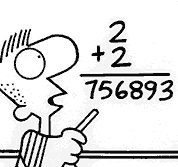
The stimulus was the wonderful letter in the BMJ (signed by around 20 statisticians) asserting that EU regulators should employ more card carrying statisticians to "explore methods and data in real depth".

The claim for God-given magical powers of statisticians would carry more credibility if any of the signatories were commentators on instances of blatant fraud in clinical trials, or on the absence of actual data to "explore".

I like statisticians but they have no such magical powers. Most statistics is (and should be) transparent and straightforward.
Some actual statisticians have screwed up, lied, colluded with fraud, colluded with ghosts, completely misunderstood the science, or agreed to the hiding-away of data. Most have stood by in silence.

Please send along any examples. Here goes - the Scientific Misconduct Blog Micro-Statistics Tutorials. Some will be serious, others couched in frippery.

The usual disclaimer: INAS (I'm Not A [proper card holding] Statistician).

See here for Collated Micro-Statistics Tutorials

Earlier|Later|Main Page

Saturday, February 02, 2008

Updated Political Map of pharmaceutical bloggers

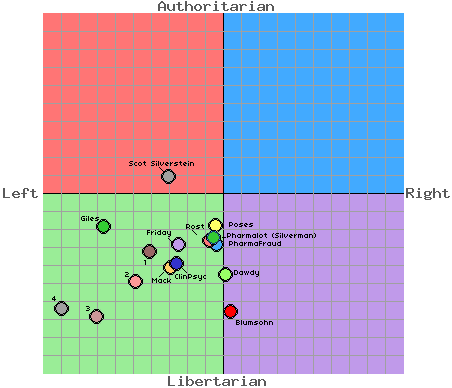
This is the updated "political chart" of pharmaceutical bloggers. For background see here. For details see here. Take the test here.

Clicking individual "dots" should open the respective blogs in a new window. For comparison with historical political figures and UK political parties according to the authors of the test see here.


Blogs so far are
Healthcare Renewal (Roy Poses and others) - the serious master of them all
Pharmagossip (Jack Friday) - the less serious master of them all
Pharmalot - and the man behind it - Ed Silverman of The Star-Ledger of New Jersey. Superlative journalism and a key source.
Brandweek NRX and Dr Peter Rost, previous Vice President of Pfizer
Pharma Giles - Good Fun
Pharma Fraud - Doesn't Like J&J particularly
Furious Seasons - Excellent look at seriously bad science in psychiatry
Scientific Misconduct Blog - This blog
Clinical Psychology and Psychiatry: A great blog discussing the malfunction of medical science with an emphasis on psychiatry
Pharma BlogoSphere and much more from John Mack (Editor & Publisher of Pharma Marketing News/Pharma Marketing Blog)
Dr Scot Silverstein, an author at Healthcare Renewal

1, 2 and 3 are three excellent and hard hitting (and deeply depressing) UK-based patient blogs devoted specifically to exposing misconduct and misrepresentation in clinical trials of Seroxat (Paxil) and various aspects of the integrity of GlaxoSmithKline.

1 = Bob Fiddaman Blog
2 = Seroxat Secrets
3 = It's quite an experience: Matt Holford (a compliance lawyer)

4 is Honest Medicine. Julia Schopick created Honest Medicine in honor of her late husband, Tim Fisher, as a way to "work with others to make significant changes to the way people think about, and interact with, our flawed medical system."

This test is significantly flawed, but we'll leave that for another day.

Earlier|Later|Main Page

BMJ Advertising Watch : 02 February 2008

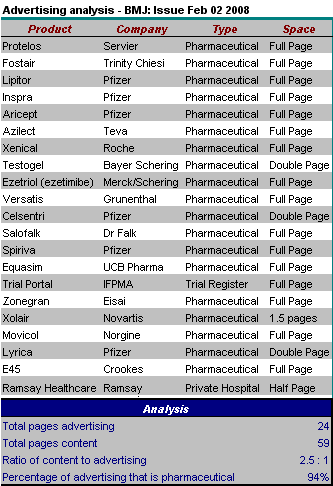
This is the British Medical Journal Advertising analysis for this week.

Rules: As usual this is for the UK version of the BMJ. The classified advertisement section is excluded, as are pages advertising the BMA or products of the BMJ/BMA/BNF.

Comment: There were 24.5 pages of advertising (1 page of advertising for each 2.5 pages of content). The proportion of advertising devoted to pharmaceuticals fell to an all time low of 94%. The other 4% was:
  • a half page advertisement for Ramsay Healthcare (for more about Ramsay and their cozy links with the Labour Government see here)
  • a one page advertisement for a register of clinical trials.
Discussion about the Ezetimibe scandal: Following the terse news snippet last week about the shonky research underlying the approval of Ezetimibe (Ezetriol, Vytorin, Zetia) there remains no entry in the BMJ about the precise way in which the scientific community were deceived, the delayed reporting, the attempts to circumvent investigators and to alter endpoints, the interesting sale of Schering shares ($25 million) by an executive, or any discussion of the principles of good science. However this issue had an advertisement for Ezetimibe ("Better Together"). The advertisement fails to mention that the only evidence available so far suggests that the drug has no clinical benefit. It also doesn't mention what happened to the data.

There were a few other notable items this issue:
  1. A letter from a reader (Jeremy Stone) complaining about discordance between a double page advertisement for testosterone supplements in the previous issue, and (on the very next page) a double blind RCT showing that testosterone supplements have no effect on functional mobility, muscle strength, cognitive function, bone mineral density or quality of life. I'll look out for proper referencing in the next appearance of this advertisement. They might even want to reference our paper showing that testosterone supplementation does nothing useful to anything (except plasma testosterone).
  2. There was a dismal letter signed by around 20 statisticians asserting that the EU regulatory agencies should employ more card carrying statisticians to "explore methods and data in real depth". The plea for employment and the special God-given powers of statisticians would carry more credibility if there were evidence that any of the signatories were regular commentators on instances of blatant fraud in clinical trials (no statistical expertise required) or on the fact that neither regulators nor scientific authors have genuine raw data to "explore" in any case. None (as far as I am aware) have commented on Ezetimibe. Statisticians would also do well to realize that only a few aspects of data integrity are within the special remit of complex statistics. All scientists require raw data.
  3. There was a detailed Obituary of Moses Judah Folkman (the "father of angiogenesis") by Jeanne Lenzer. In contrast to other Folkman obituaries it did at least mention that he had been forced to "apologise" over scientific fraud (false descriptions of methodology and falsified findings in an NEJM publication).

Click here for collated BMJ Advertising analyses.

Earlier|Later|Main Page

Friday, February 01, 2008

A few notes on the abuse of occupational health procedures

"Whom the Gods wish to destroy, they first make mad"
-Euripides

Over the past few years I have listened to many cheerless stories of individuals who have exposed unacceptable practices within universities and hospitals. The institutional response is almost formulaic.

A frequent part of the common experience is the abuse of occupational health procedures. Following an incident this week involving a colleague, I have summarised some aspects of UK occupational health law below.

Most of these individuals started with the belief that their institutions would assume responsibility for upholding their own rules of conduct. They assumed that responses would be honest, colleagues and professional bodies would behave honorably, and that someone would take responsibility for the safety of the product (whether that product is a drug, honest science, open academic discourse or care of individual patients).

In reality, most are projected into an Alice in Wonderland world of sham procedures, collusion, lies and bullying. Many become ill (see the case of Dr Z), and some die. Distress signals are used by poor managers to invent "health concerns" and to avoid rational discussion about genuine problems. That hospitals and medical schools abuse their staff through health mechanisms is indicative of deep immorality within these institutions. The process usually starts as an apparent expression of genuine concern about the health of the employee.

Sadly, psychopathic administrators and medical leaders are rarely subjected to psychiatric or medical evaluation.

Employees should almost never agree to an employer's "offer" of health evaluation under these circumstances. When such evaluation takes place, it should only be for the benefit of the employee. Any assertion by the employer that they must have any right of access to health information is illegal and constitutes serious bullying.

Aspects of the relevant law is summarised from these sources: a) Occupational Health Law, 4th Edition, Diana M Kloss ISBN 0632-064978, b) Medical Ethics Today: Its Practice and Philosophy, Veronica English, Gillian Romano-Critchley. 2002 2nd Ed. BMJ Books, ISBN 0727917447
  1. The physical occupational health (OH) records technically belong to the employer, but the employer has no right of control or access to the information therein.
  2. OH doctors should have an agreement their employer with regard to confidentiality of records. If the doctor leaves the company, records remain the property of the employer, but should be passed to a new doctor or nurse with the same obligations. If an employee moves to another employment, OH records can only be transferred to the new employer with consent.
  3. Employers cannot enforce terms in contracts of employment stating that employees must provide copies of medical records.
  4. OH doctors have a duty of confidence which is the same as that for any other doctor. For example, if an OH physician were to reveal to the human resources department (without permission) that an employee has a drink problem the doctor could be sued for damages. Secretarial staff who have access to confidential information share these obligations.
  5. According to the General Medical Council there are restricted circumstances under which information could be conveyed by a doctor:
    • The patient explicitly consents.
    • Some circumstances where the doctor shares information with other health professionals caring for that patient
    • Parliament requires disclosure (notifiable diseases, RIDDOR reporting of injuries at work, and more worryingly "terrorism legislation")
    • Disclosure may be made to a statutory regulatory body for investigation into a health professional's fitness to practice (it is worrying that the GMC would see fit to incorporate such a provision without detailed qualification)
    • Disclosure is in the public interest, e.g. to the police about a serious crime
  6. If consent is provided, it can later be withdrawn. Consent should be in writing for the protection of the doctor or nurse. Consent should clarify exactly what records may be passed over - not simply "all records". The OH doctor can refuse to accept partial consent if that would be misleading through omission. An OH doctor should not communicate with the patient's own doctor without consent.
  7. Guidance from the Nursing and Midwifery Council (2002) is more coherent with greater emphasis on the purpose for which information was supplied: "To trust another person with private and personal information about yourself is a significant matter. If a person to whom that information is given is a nurse, midwife or health visitor, the patient or client has a right to believe that this information, given in confidence, will only be used for the purposes for which it was given and will not be released to others without their permission".
  8. Mere attendance at the OH department does not imply consent.
  9. Even if an employer is facing legal action by an employee, OH records should not be disclosed to the employer without consent or a court order.
  10. An occupational health doctor may find that an individual is somehow unfit for a job or that the employee is in danger. This does not justify a breach of confidence. If the danger is to others there may be a case for breach of confidence, but even then this requires very careful deliberation.
  11. Per the Faculty of Occupational Medicine's Guidance on ethics: "Occasionally the occupational physician ....may find that an individual is unfit for a job where the safety of other workers or the public is concerned. He should then take great care to explain fully why he thinks the disclosure of unfitness is necessary.... Where this is not obtained the occupational physician is faced with an ethical dilemma..... Ultimately, the safety of other workers and the general public must prevail..."
  12. Occupational health doctors should not become involved in advising employers on the validity or otherwise of sickness absence of an employee. They can however (in consultation with the employee) advise management on potential changes required to the conditions of employment. The doctor may also advise the employer about future employability but without providing clinical details of sickness to the employer.
  13. Some occupational health records may be of direct relevance to the employer (for example where the employer has a legal requirement to monitor toxic substances). Those records should be maintained separately from other records. Conveying of such records also requires consent.

Earlier|Later|Main Page